

London-based vertical farming technology firm Vertical Future has been listed for sale on an insolvency marketplace after posting a sharp decline in revenue and widening financial losses.
The company generated just £692,000 in turnover in 2024, down from £6.7 million the previous year, according to a report by City A.M. Pre-tax losses exceeded £10 million, prompting a strategic review and sale process.
In a statement, the company said: "Vertical Future can confirm that it has engaged advisors to explore strategic options for the business, including a potential sale. Like others in the vertical farming sector, we have faced significant headwinds in a difficult capital environment. The board continues to work hard to support customers and partners while considering the best path forward. We will update stakeholders in due course." © Global Vertical Farming Show
Investor backing and business model shift
Founded in 2016, Vertical Future had raised over £37 million since its launch, including a £21 million Series A round in 2022, which valued the company at approximately £100 million. Backers included SFC Capital, Pula Investments, and more than 30 angel investors. Among them were Gregory Nasmyth, a UK environmentalist and philanthropist; Nickleby Capital, a London-based family office; and Dyfan Investment, a Luxembourg-based private investor.
Companies House filings show that in 2022 and 2023, Vertical Future issued new shares on multiple occasions, including a round in October 2023 that brought the total face value of its shares to about £265,000. Despite this, the company's attempt to raise an additional £60 million to scale production capacity and reduce unit costs was unsuccessful. Rising energy prices, high operational overhead, and weak consumer demand for premium produce all contributed to the firm's financial decline. At the time of listing, the company employed 32 staff. While no formal administration has been announced, a change of registered office and board appointment in July 2025 suggests a potential governance shift ahead of a transaction.
Prior to its financial difficulties, the company pivoted from crop production to selling automated vertical farming infrastructure and growing towers, targeting retail and pharmaceutical customers. These systems were supported by DIANA, the company's proprietary SaaS platform designed to automate and optimize crop growth through data analytics and machine learning. DIANA was positioned as a core part of Vertical Future's integrated offer to clients seeking scalable, intelligent production systems.
According to investor Nickleby Capital, this transition was intended to improve margins and scalability after the initial approach, supplying premium produce to restaurants, proved commercially limited. As noted in a September 2023 report by Sifted, the company's move toward automation and systems sales was seen as an attempt to "improve unit economics" and reduce labor dependency. © Vertical Farm Daily
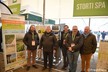
The Vertical Future team showcasing DIANA at Indoor AgTech in 2024
Public diplomacy amid private strain
Throughout 2023 and early 2024, Vertical Future maintained a high-profile international presence despite mounting financial pressure behind the scenes. In December 2023, the company was showcased at COP28 in Dubai as a strategic partner of the World Green Economy Organisation (WGEO). Positioned in the conference's exclusive Blue Zone, Vertical Future delivered keynote remarks on food security and climate-resilient agriculture to UN-accredited delegates. The partnership framed the company as a key player in the global green transition.
Just months later, in May 2024, CEO Jamie Burrows met with Iraq's Prime Minister, Mohammed Shia Al-Sudani, to discuss national-scale deployment of autonomous farming systems to address the country's worsening water and food crises. Burrows cast Vertical Future as a pragmatic alternative to what he described as "capitalist-led" vertical farming failures, claiming the company had anticipated the sector's unraveling.
These engagements were emblematic of Vertical Future's positioning as a technologically mature, globally relevant operator. But by mid-2024, the company's finances had unraveled beyond recovery. The contrast between its strategic diplomacy and its insolvency highlights just how sharply even the most ambitious CEA narratives can be severed by economic reality. © Vertical Future on LinkedIn
CEO Jamie Burrows speaking at the 2023 Global Vertical Farming Show in Dubai
Research ambitions in space and cities
Vertical Future was known for its ambitious R&D projects, particularly in space agriculture. The company received a £1.5 million UK Space Agency grant to develop autonomous farming systems for long-duration space missions, collaborating with organizations including Axiom Space, NASA, and the Australian Space Agency.
The company also ran urban farming trials with the Foundation for Future London, and formed research partnerships with institutions including NIAB, the University of Adelaide, and the CEA Alliance. Its "Crop-Science-as-a-Service" platform allowed external clients to trial crops using Vertical Future's systems, aiming to accelerate plant performance and product development. Despite its innovation credentials, the company's commercial model proved difficult to sustain under tightening capital conditions.
Sector-wide contraction continues
Vertical Future's collapse adds to a growing list of high-profile CEA startups to face insolvency in the past two years. According to the Sifted report, at least 15 vertical farming companies across Europe have entered bankruptcy, including Infarm, once the region's most heavily funded player, as well as Agricool in France and more recently, Jones Food Company in the UK.
Analysts cite high energy costs, inflationary supply chains, and premium pricing models as key challenges. Indoor vertical farms spend around 60% of their revenue on electricity, according to the European Commission, with just 27% of operations proving profitable. These margins became increasingly difficult to maintain as wholesale energy prices soared across Europe following the war in Ukraine.
As interest rates rose and investor appetite cooled, high-tech, capital-intensive operations like vertical farms struggled to maintain momentum. "Growing some greens and berries in a really expensive-to-build farm and selling them to supermarkets is a pretty bad business model," said Marco Schiavo, managing partner at Nickleby Capital, in the Sifted report.
While some investors still see long-term potential in the sector, the wave of failures has exposed deep structural challenges. For many startups, promises of sustainability and food security have collided with the harsh realities of cost, scale, and consumer economics.
For more information: 
Vertical Future
Jamie Burrows, Founder and CEO
[email protected]
www.verticalfuture.co.uk