
NASA invests in technologies that have the potential to revolutionize space exploration, including the way astronauts live in space. Through the Deep Space Food Challenge, NASA, in partnership with CSA (Canadian Space Agency), sought novel food production systems that could provide long-duration human space exploration missions with safe, nutritious, and tasty food. Three winners selected last summer are now taking their technology to new heights – figuratively and literally – through commercial partnerships.
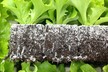
Interstellar Lab of Merritt Island, Florida, won the challenge's $750,000 grand prize for its food production system NuCLEUS (Nutritional Closed-Loop Eco-Unit System), by demonstrating an autonomous operation growing microgreens, vegetables, and mushrooms, as well as sustaining insects for use in an astronaut's diet. To address the requirements of the NASA challenge, NuCLEUS includes an irrigation system that sustains crop growth with minimal human intervention. This end-to-end system supplies fresh ingredients to support astronauts' health and happiness, with an eye toward what the future of dining on deep space missions to Mars and the Moon may look like.
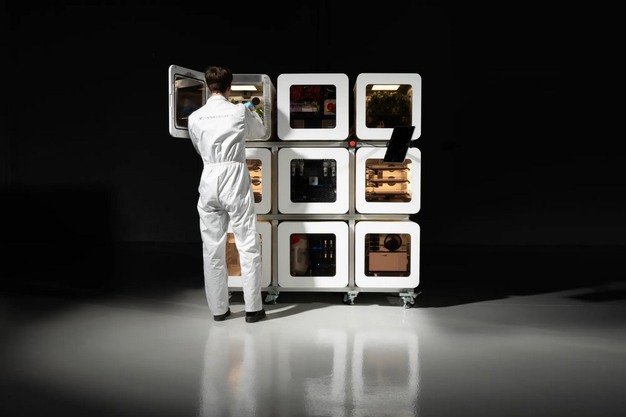 © Interstellar Lab
Since the close of the challenge, Interstellar Lab has partnered with aerospace company Vast to integrate a spinoff of NuCLEUS, called Eden 1.0, on Haven-1, a planned commercial space station. Eden 1.0 is a plant growth unit designed to conduct research on plants in a microgravity environment using functions directly stemming from NuCLEUS.
"The NASA Deep Space Food Challenge was a pivotal catalyst for Interstellar Lab, driving us to refine our NuCLEUS system and directly shaping the development of Eden 1.0, setting the stage for breakthroughs in plant growth research to sustain life both in space and on Earth," said Barbara Belvisi, founder and CEO of Interstellar Lab.
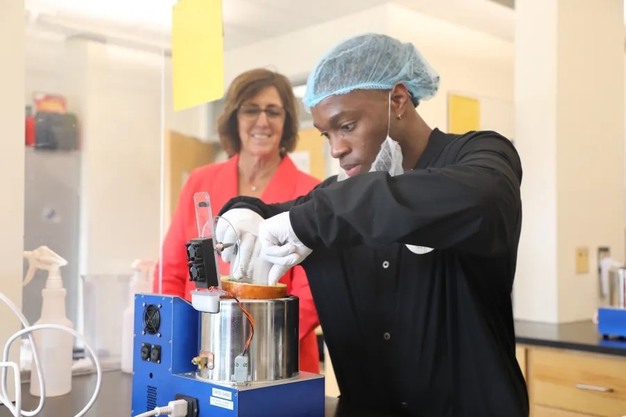 © NASA/Savannah BullardFuanyi Fobellah, one of the "Simunauts" from The Ohio State University who tested food production technologies as part of the Deep Space Food Challenge, removes a cooked omelet from the SATED appliance.
Team SATED (Safe Appliance, Tidy, Efficient & Delicious) of Boulder, Colorado, earned a $250,000 second prize for its namesake appliance, which creates an artificial gravitational force that presses food ingredients against its heated inner surface for cooking. The technology was developed by Jim Sears, who entered the contest as a one-person team and has since founded the small business SATED Space LLC.
At the challenge finale event, the technology was introduced to the team of world-renowned chef and restaurant owner, José Andrés. The SATED technology is undergoing testing with the José Andrés Group, which could add to existing space food recipes that include lemon cake, pizza, and quiche. The SATED team also is exploring partnerships to expand the list of ingredients compatible with the appliance, such as synthetic cooking oils safe for space.
Delicious food was a top priority in the Deep Space Food Challenge. Sears noted the importance of food that is more than mere sustenance. "When extremely high performance is required, and the situations are demanding, tough, and lonely, the thing that pulls it all together and makes people operate at their best is eating fresh cooked food in community."
 © OSU/CFAES/Kenneth Chamberlain
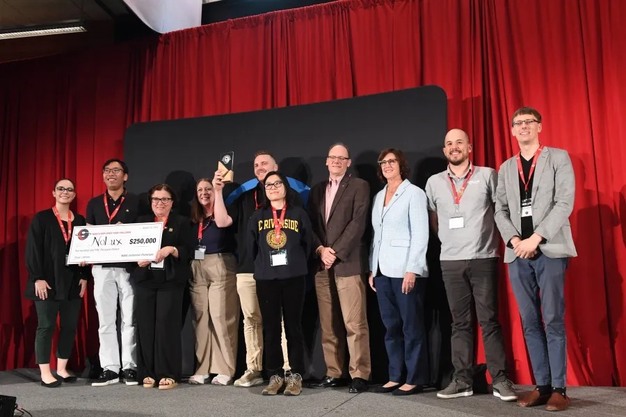
Team Nolux, formed from faculty members, graduate, and undergraduate students from the University of California, Riverside, also won a $250,000 second prize for its artificial photosynthesis system. The Nolux system – whose name means "no light" – grows plant and fungal-based foods in a dark chamber using acetate to chemically stimulate photosynthesis without light, a capability that could prove valuable in space with limited access to sunlight.
Some members of the Nolux team are now commercializing select aspects of the technology developed during the challenge. These efforts are being pursued through a newly incorporated company focused on refining the technology and exploring market applications.
Source: NASA