
"You can grow anything with vertical farms, but what and how do you grow? That is the question investors kept asking us. When we pitched our approach as a premium vertical farm that has learned from earlier failures and built something unique, they were really keen to listen," says Shun Sano, Co-Founder and COO of Cai Foods.
Since we last spoke with Cai Foods in March, the company has made steady progress toward realizing its vision for wasabi cultivation in the U.S. and beyond. Today, Cai Foods is moving away from a Proof of concept to production, expanding its facility in New Buffalo to supply over 30 restaurants with fresh rhizomes in the year ahead. 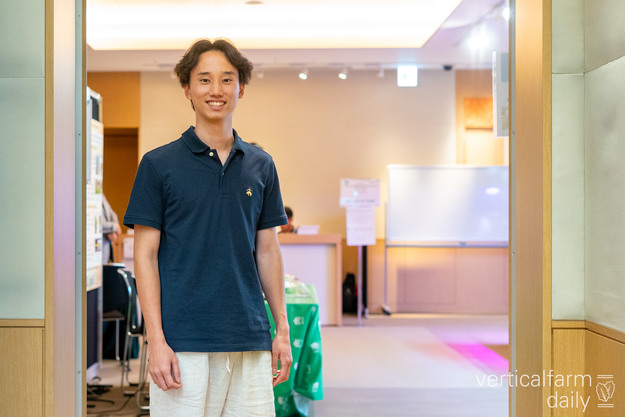 © Rebekka Boekhout | VerticalFarmDaily.com
Shun Sano at the 2025 JPFA Symposium in Chiba, Japan.
Transparency
Investor interest in indoor wasabi is growing, particularly in Japan, where the appetite for vertical farming has returned after earlier setbacks. According to Shun, Cai Foods stands out by being transparent about its financials and open about potential challenges.
"We are farmers, not a tech company. We want to take our time, prove out the technology, and they value that honesty." Each part of their current system is designed specifically for wasabi's strict needs, but it leverages existing hydroponic hardware and LEDs. Cai Foods' growing system reduces the wasabi growth cycle from 2.5 years in greenhouses to under 10 months indoors.
Shun grew up in Japan in a family with longstanding agricultural roots. Therefore, he sees this work as more than a commercial opportunity and is about preserving the cultivation of wasabi. "In this way, we can share its incredible flavor and benefits with the rest of the world," he says.
With production in Japan declining by over 70% in the last two decades, due to climate change and an aging farmer population, wasabi cultivation is becoming increasingly scarce. The company sources tissue culture materials directly from Japanese labs and Japanese farms, some of which have been cultivating wasabi for over 12 generations. Shun sees this as a key differentiator, with access now to nine cultivars. "We're the only ones some of them trust to send the tissue culture to, and it's currently being tested at our Michigan facility."
 © Cai Foods Company
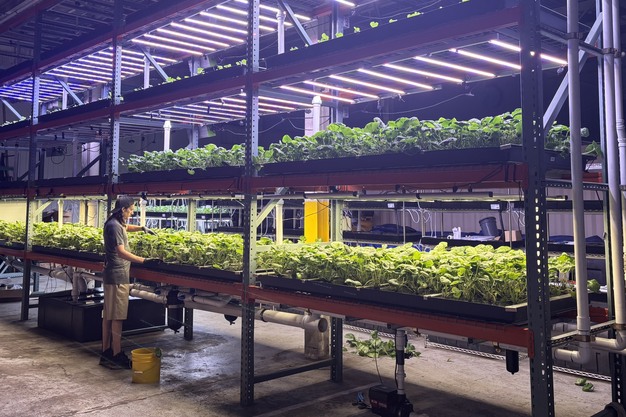
Cai Foods' current proof-of-concept farm
High sales potential
Trials begin with two weeks of propagation in acclimation chambers, followed by a six-week nursery phase, before moving into a four-tier system. Here, 2,500 plants grow under five distinct lighting setups. "Early results are promising, with cultivars producing robust, better-tasting, and higher-quality wasabi," Shun says. He notes that the system operates at roughly one-third the cost of a leafy greens farm.
"Each plant gives us about 100 grams, excluding leaves. That means we can supply 30 restaurants weekly with 10,000 plants, selling at around $35 per wasabi. If we scale this to a 50,000 square foot facility, the model shows potential to supply over 800 restaurants and generate $28 million in revenue."
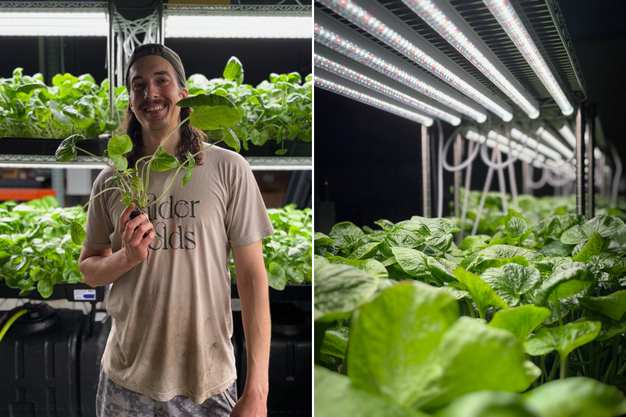
Research and development efforts are led by Daniel Kluko, Cai Foods' Chief Science Officer, who brings more than 15 years of experience in hydroponic systems. "The goal in hydroponic farming is not to overcomplicate the system and have as few potential points of failure as possible," says Kluko. While wasabi does not require complex technology, Kluko and the team are working to refine lighting strategies and system configurations needed to achieve optimal crop performance.
 © Cai Foods Company
Chief Science Officer, Daniel Kluko
Expansion into other sectors
Beyond the fine dining sector, the company also plans to collaborate with CPG brands, natural flavoring companies, and explore opportunities in nutraceuticals. Cai Foods can use the whole plant and process wasabi into pastes and powders for use by other industries. Recent studies have linked wasabi's bioactive compounds to antioxidant effects, detoxification, cognitive enhancement, anti-aging properties, and other health benefits. This aligns with the company's interest in developing health-focused products.
At the same time, demand for closed-environment wasabi cultivation is growing. As the first company in the world to test wasabi at a plant-factory scale, Cai Foods is now in talks with companies in Japan, Europe, Canada, and Singapore. Many of these markets have limited access to fresh, authentic wasabi and are exploring how the company's technology can help. © Rebekka Boekhout | VerticalFarmDaily.com
U.S. market momentum
Shun also sees strong traction in the U.S. market, particularly among high-end omakase restaurants in New York City, which will soon be part of the company's distribution network. "Chefs in NYC often rely on importers and large seafood distributors for their wasabi, but we can offer something fresher, more consistent, and premium."
Moreover, it's not just the rhizomes that are drawing interest. "We sell the stems and leaves, too, so nothing goes to waste. With food coloring bans coming into effect in 2026, people are starting to realize that 99 per cent of their wasabi is fake. Natural alternatives like ours are only going to grow in demand."
For more information:
Cai Foods Company
Shunsuke Sano, Co-Founder and COO
+1(914) 310 9812
[email protected]
www.caifoods.co