
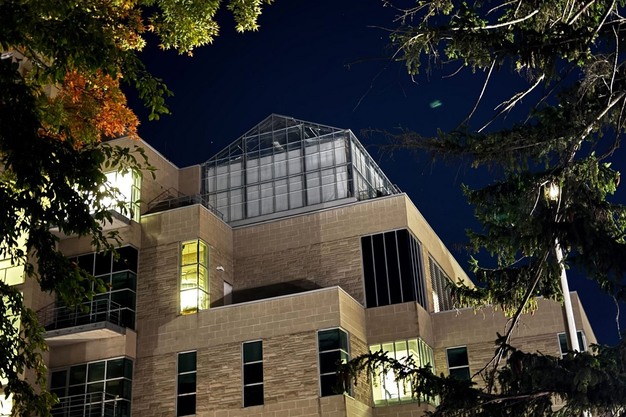
The glowing purple dome on top of the Biosciences complex is getting a new upgrade.
Located in the Bioscience complex, the Phytotron facility provides Biology projects with specialized laboratories featuring enclosed, controlled environments to test plant growth. The facility, which has been in place since 1966, is seeing new updates to its operations following a donation from Globe Florex, an India-based AgriTech company. The announcement was made in the Queen's Gazette on Aug. 5.
The facility includes six climate-controlled greenhouse zones, 30 environmental growth chambers, and a laboratory—all designed to simulate different environmental conditions such as temperature, humidity, CO2 levels, and light exposure. The facility also has a conservatory, which is home to more than 150 tropical plants.
 © Jonathan Reilly
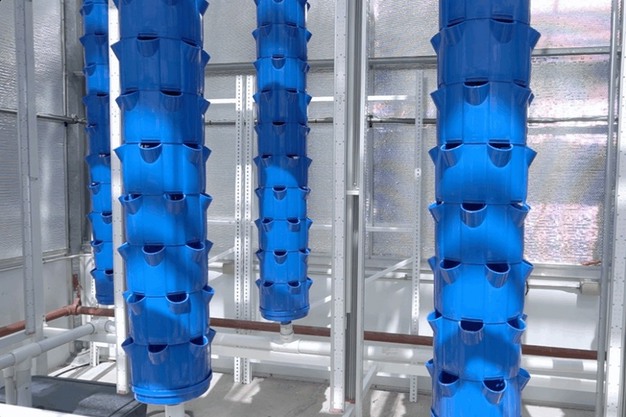
Following the donation, the University installed the Revoponics system, a rotating vertical farming technology. Phytotron Manager Saeid Mobini spoke with The Journal to discuss the new updates.
Mobini explained that Queen's will be the first institution in North America to implement Revoponics. He noted that the system is more efficient than traditional vertical farming methods. In most vertical farms, one square foot of plant canopy requires one square foot of light. In Revoponics, however, a single square foot of light can support three square feet of canopy, thanks to the rotating towers.
When asked why AgriTech donated the system, Mobini said the company recognized Canada's unique agricultural challenges—particularly a short growing season and a heavy reliance on imported produce—and saw value in supporting local research aimed at making farming more sustainable.
 © Claire Judice
According to Mobini, efficiency also extends to labour. In conventional vertical farms, companies may need hundreds of robotic arms to tend crops. However, Mobini said revoponics reduces that need, claiming that a farm that would normally require 200 robots could operate with about 55.
With the Revoponics system in place, Mobini said the next step is expanding student training and collaboration with industry. He added that many farms don't share data, as they're for-profit. However, since Queen's is a non-profit University, it can assist the industry more broadly. He added that partnerships with robotics firms in Japan and Germany, as well as remote sensing companies in Israel, are being discussed to expand their operations.
For Mobini, the importance of vertical farming goes beyond research. He pointed out that 95 per cent of Canada's fresh produce is imported, primarily from California and Mexico, often travelling thousands of kilometres before reaching grocery shelves.
"35 to 45 per cent of this fresh produce is going to waste because of the long trip […]. When [the food] arrives here, it's poor quality, nobody even likes the taste or the nutritional value," he said. "When we [at the Phytotron] plant and harvest it on the same day that they go on the shelf, it has two weeks with no symptoms of a bad shape, so they have much more nutritional value and higher taste and flavour, and of course, we are not wasting all of this energy [in transportation]."
Mobini emphasized that vertical farming also addresses long-term concerns about drought, climate unpredictability, and reliance on imports, saying Canada would only have about two weeks of fresh food supply if borders were closed.
Aside from having less of a reliance on other countries and avoiding food waste, Mobini added that the quality of food would be improved by an increase in vertical farming as well.
"Strawberries are very susceptible to pests and diseases, and the growers in California apply a chemical [pesticide] every single week. In Florida, twice a week. Making it in this completely secure and sealed environment, there's no need to apply any chemical or any pesticide. So, we are making 100 per cent super organic [food]."
The Phytotron operates on a 24/7 schedule, remaining open through weekends and holidays to support its researchers.
Source: The Queen's University Journal