
There was an upbeat tone on the show floor throughout the two days of the Global Vertical Farming Show in Dubai, but industry leaders did offer a reality check about the tough road to profitability, not only in the Gulf, but the sector as a whole. In line with global sector trends, energy remains one of the region's most significant barriers to scale, with wide variation in costs across emirates and countries, according to speakers in the Sustainable Food Systems session.
Heavy import competition from countries like Morocco, Egypt, Jordan, Iran, and the Netherlands is putting pressure on local growers to differentiate on freshness, food safety, or environmental sustainability. But the tide may be shifting: retail shelves are beginning to feature more UAE-grown leafy greens and tomatoes, and government initiatives such as the UAE Food Security Council and Saudi Agri-Food Tech are establishing frameworks that support domestic production. Several exhibitors noted that market viability depends on aligning supply with local consumption patterns.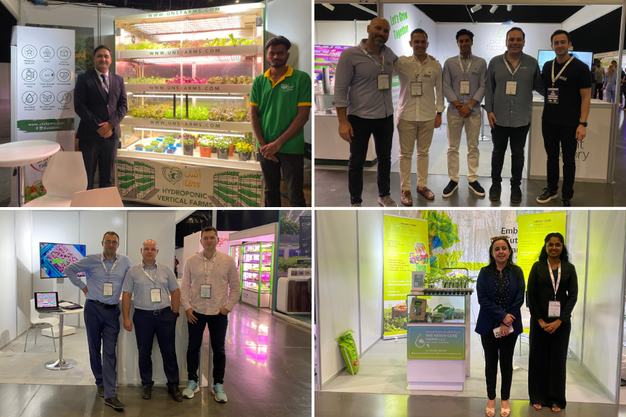 © Wesley Francis | VerticalFarmDaily.com
Reality check on the road to profitability
Panelists throughout the event urged a move beyond pilot-scale projects toward commercial infrastructure. Discussions emphasized the need for investment not just in farms, but in downstream logistics such as cold chain, packhouses, and distribution. Government-linked speakers highlighted infrastructure hubs such as the Abu Dhabi Food Hub as enablers of long-term resilience.
Several speakers drew attention to consumer dynamics in the Gulf, noting that while appetite for local produce is rising, price sensitivity and trust remain hurdles. Transparency, traceability, and branding were repeatedly cited as levers to close that gap.
AI, automation, and improved crop genetics were also positioned as future unlocks. "In two years, maximum to three years, with the inclusion of AI, the whole perspective of farming will be changed," said Mahdi Alhindawi, founder of UAE-based Enjazponic.
New entrants eye local partnerships over quick wins
Many exhibitors approached the show as a first step in navigating Gulf-specific market conditions. "This is our first year, and we just want to enter this market here in Dubai," said Ivan Morozov of Lanna Group. The company showcased closed-loop aeroponic systems with modular units as small as 9 square meters, noting that scalability, stability, and fast crop cycles are essential for UAE conditions.
Turkey's Plant Factory took a different approach, arriving not to sell equipment but to explore joint ventures. "We just came here to understand what is going on in this region and the possibility of making a factory," said CEO Halil Beskardesler.
Sharjah-based Themar Al Emarat, which produces 6 to 7 tons of mushrooms daily, said demand continues to outstrip supply even within the UAE. The company is planning to expand its number of growing rooms from 18 to 24 and is already seeing smaller startups rely on it for substrate supply and advisory support. "We continue to get many orders," grower Akhil Moharakrishnan noted. "We even support many startups."
Krishi Care Farms, a local operator based in Dubai with a mix of hydroponic, vertical, and open-field formats, observed a surge in activity over the past year. "I see a lot of new farms coming in, more with vertical structures. People are converting warehouses," said Bhawna Chopra, Founder and CEO. "The government wants to make the UAE a food-secure nation. We're planning to expand into Abu Dhabi. Right now, the farm is in Dubai, but the goal is to grow our footprint and reach more people directly."
For more information:
Global Vertical Farming Show
[email protected]
www.verticalfarmingshow.com