
Clear tills, rebranding, improving cold chain technology, and introducing robotics are just some examples of innovation in the North American mushroom industry. "This innovation can be broken down into two areas; visible innovation and invisible innovation," says Jose Cambon, CEO of Highline Mushrooms. Visible innovation is very much centered around the consumer with one of the most recent changes being the move towards clear tills. "I hope and expect this trend will continue here in North America," he said. "I'd like to think we are leading this initiative, but it has always been our goal to have the entire industry come on board." In addition, Cambon is expecting the share of top seal packaging to increase as it is being well received by retailers.
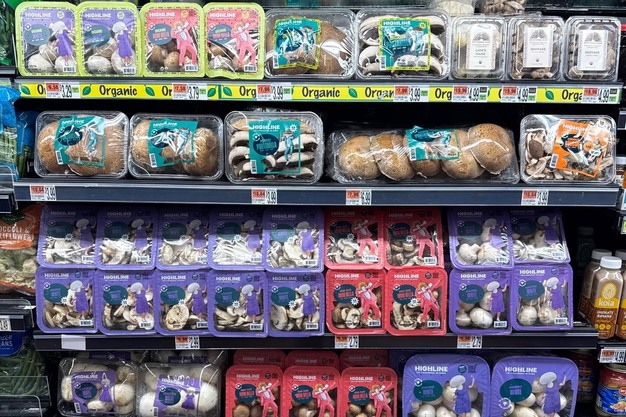
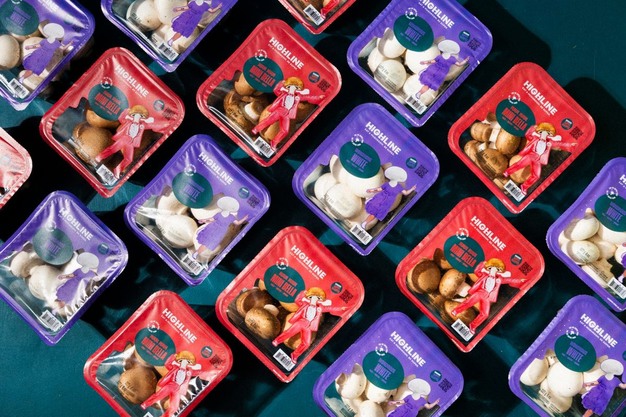
Also visible to retailers and consumers is a new brand that Highline Mushrooms officially launched a few months ago. Newly designed bold packaging intends to bring mushrooms into the spotlight. Retailers and consumers are now being introduced to the re-branded products.
 © Highline Mushrooms
Rebranded mushroom products on the shelf.
Invisible innovation
"However, at this point in time, we've been investing most in the invisible innovation around packing technology and cold chain technology," commented Cambon. In the past 24 months, the company has invested millions of dollars in that area with the next major investment being a new farm. The official groundbreaking took place the week of July 2nd and the first product from the Mushroom Farm of the Future should be available before June 2026. "We're not revolutionizing anything but basically taking the existing infrastructure from other sectors to the mushroom industry," shared Cambon.
 © Highline Mushrooms
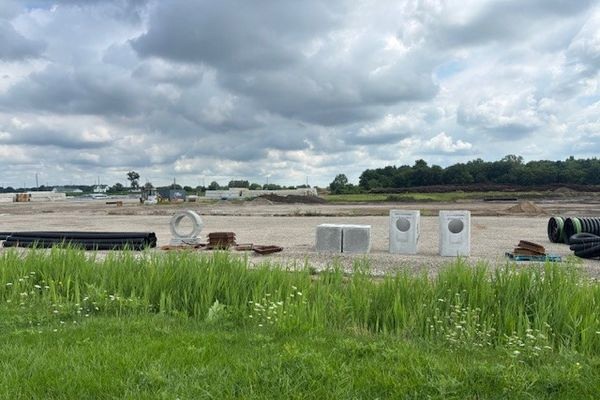
Building site Mushroom Farm of the Future.
Improved cold chain
One of the key elements of the new mushroom farm is an uninterrupted cold chain. "This is crucial because for every hour a mushroom spends outside of the cold chain, about 24 hours of shelf life are being lost. Ultimately, the goal is to maximize the quality of mushrooms on the shelf. "Many growers are focused on how their mushrooms look day one, as they leave their farm. Of course, this is important, but the challenging and crucial part is for a mushroom to look great on the shelf. Our focus is to make sure the product looks great in the store on the last day of its shelf life." One way to achieve this is by ensuring mushrooms are in the cold chain in less than an hour from being harvested. "On the new farm, our cold chain process will be even quicker."
Robotics
On the growing and harvesting side of the new farm, the expectation is for reduced reliance on humans and human decision making. "We see a future where humans and robotics are working together. However, over time, we would like to see a future where the robots will be making that decision," shared Cambon. With the help of visual technology, it should be possible to determine how fast mushrooms are growing and what the optimum harvest time is. "We continue to work with our robotics partners on solutions and substantial progress has been made in recent years."
The ultimate goal is for a data driven decision making model, with significantly reduced reliance on humans. "Compare it to the car industry in Detroit," said Cambon. At the Ford Motor Company facility, humans don't go to the car. "The car comes to them, and each person performs their tasks on the assembly line using the robotics around them. That's where I see the mushroom industry heading in the future." Being in a controlled environment, this should be easier to manage compared to an open field facility. As a result, the evolution is expected to happen fairly quickly.
Consumption remains a challenge
While innovation continues, the main challenge for the industry is to drive consumption. At a global level, it's pivotal to understand the function of mushrooms. "Why are people eating mushrooms?" A shift in temperatures is having an impact on consumption. In many parts of the world, summers are starting earlier, which is challenging for the mushroom industry. Ways need to be found to make mushrooms a key ingredient during grilling season. Right now, fall and winter are the heaviest mushroom consumption seasons and there is an opportunity to expand that window. In addition, mushrooms are favored by older demographics and that's one of the reasons Highline launched a rebrand. "Our new brand is very much focused on younger people and bringing younger demographics to the category. The entire North American market is actually working collectively to see what we can do to drive consumption."
Organic category growth
From a consumption perspective, the organic mushroom category has been outperforming the conventional segment. Organics are growing by about two percent annually while consumption of conventional mushrooms has stayed flat. Some retailers are offering organics exclusively to save on merchandising space. "Nowadays, organic mushrooms are of excellent quality whereas in the past, they weren't perceived that way. I believe this is one of the reasons the organic category is doing so well, and we are fortunate to be 100 percent organic. I believe our investment in modern farming technology allows us to grow the highest quality organic mushrooms."
 © Highline Mushrooms
 For more information:
Sabrina Pokomandy
Highline Mushrooms
Tel (+1) 519-819-7093
[email protected]
www.highlinemushrooms.com