
A recently published EPO study focuses on technologies that contribute to a sustainable food chain. Digital technologies within the agriculture and livestock sectors have seen a significant increase in patent applications since 2012, with an average annual growth rate of 9.4%. This compares to a 3.1% increase in all patent applications.
In the report, the focus is on key technologies that are driving the development of smart agriculture. Aimed at decision-makers in both the private and public sectors, it is a source of information on these technologies and the technical problems they aim to solve. The publication draws on the latest available patent data and the expertise of EPO examiners to provide a comprehensive analysis of the innovation trends driving technical progress in digital agriculture
 © Europees Octrooibureau
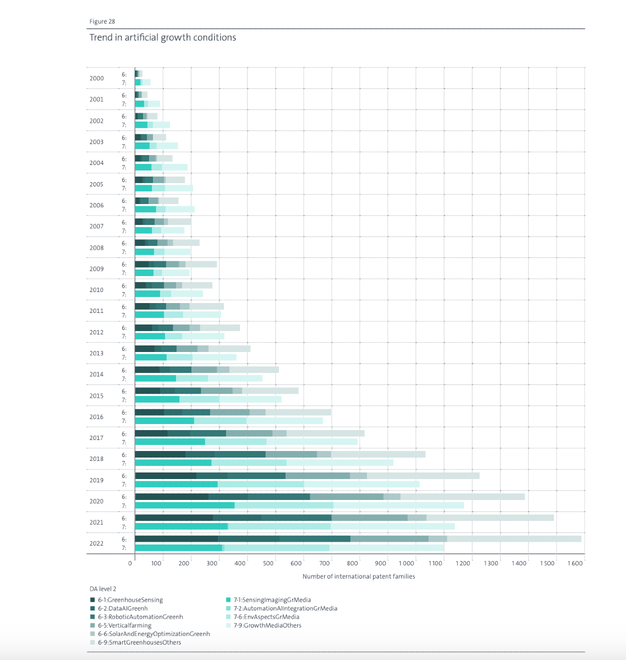
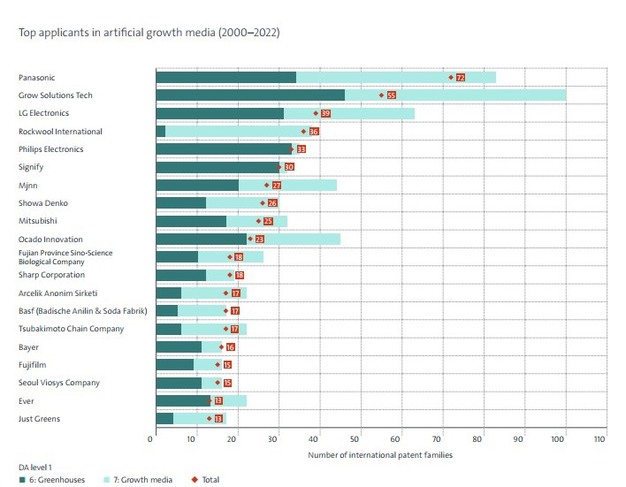
The timeline for specific innovations in greenhouses and growth media presented in Figure 28 shows a remarkable increase in digital technologies starting from a low level. The main applicant countries are the United States, Japan, China, Germany, Republic of Korea and the Netherlands. While the patents of many of the main actors relate to both greenhouses and artificial growth media, those of Philips and Signify specialise more in greenhouses
In the report, smart greenhouses are described as advanced agricultural systems that integrate technology to optimise the growing environment for plants. These greenhouses use sensors, automation and data analytics to monitor and control various environmental factors such as temperature, humidity, light and CO2 levels. By continuously collecting data, smart greenhouses can adjust these parameters in real time to create optimal conditions for plant growth. Devices or systems for heating, ventilating, regulating temperature, illuminating or watering and irrigation in greenhouses and the control of these systems allows for remote monitoring and management, enabling farmers to make informed decisions and respond quickly to any changes or issues.
US applicants file a comparatively lower number of IPFs in milking, growth media and smart greenhouses, which also have low intensity among German applicants, who focus more on open-space plant agriculture. The data for Japan reveal enhanced activity in spoil reduction and growth media, whereas the data from China show high IPF filing in harvesting, greenhouses and growth media. The Netherlands and New Zealand data indicate strong efforts in animal husbandry and milking innovation. Sweden's data are concentrated in milking and forestry.
 © Europees Octrooibureau
Source: European Patent Office