

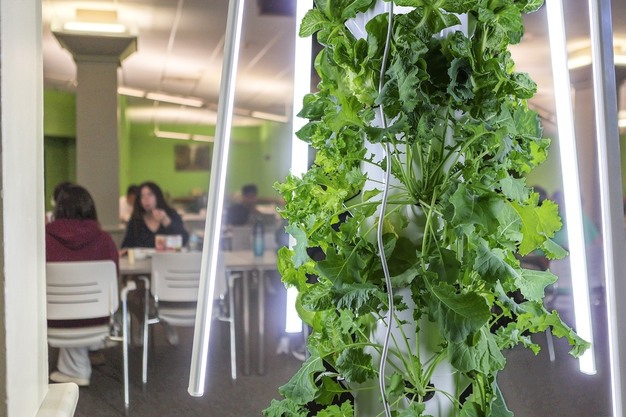
College-in-the-Woods (CIW) Dining Hall is not only surrounded by greenery on the outside, but also grows fresh leafy greens inside the building. Throughout the dining area, glowing white columns sprout herbs, lettuce and more, giving diners a first-hand look at sustainability in action at Binghamton University.
Three Tower Gardens were planted at CIW in fall 2024 after the Binghamton University Dining Services (BUDS) team learned about the hydroponic towers and collaborated with the University to bring them on-site.
 © Julianna Hall '28
With minimal attention, the towers grow produce and herbs such as kale, Swiss chard, dill and basil, with some of the seeds coming from the Binghamton University Seed Library, located in the Sustainability Hub, said BUDS Operations and Sustainability Manager Chris Harasta.
"The towers are filled with special purified water, which we add liquid nutrients to; that has to be checked and balanced a couple times per week," Harasta said. "They also have built-in grow lights, but we have those on timers so that they turn on and off automatically."
In addition to its partnership with the Sustainability Hub, the Tower Gardens initiative also partners with the Binghamton University Gardening Club, which helps maintain the towers.
Tower-grown produce is sometimes used as ingredients for dishes at CIW Dining Hall, however, much of it is donated to the Binghamton University Food Pantry, located upstairs from the dining hall. After the final harvest last spring, Harasta said they ended up with around a dozen crates of food.
"The Tower Gardens help mend that disconnect most people have with food, where they don't think about where it comes from," Harasta said. "It's important to know because food doesn't magically appear. It takes a ton of resources to make and ship. Seeing examples of how food is made adds context and value back to that food."
Source: Binghamton University