

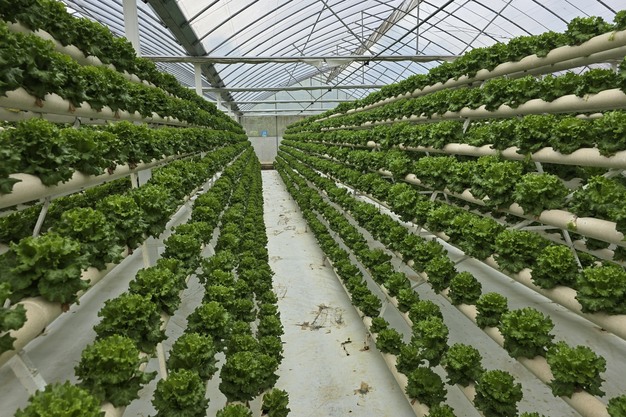
Bananas, long beans, Asian vegetables, passion fruit, a large-scale avocado project in the pipeline, and tomatoes in a demo and test greenhouse. Suriname has it all. Admittedly, commercial cultivation of fruit and vegetables is still in its infancy, but things are changing. A report of a tour that Fresh Publishers undertook through the Surinamese AGF landscape at the end of September will follow in the coming weeks. To correctly place and interpret the stories and insights, some background information cannot be omitted.
 © Pieter Boekhout | VerticalFarmDaily.com
Suriname, located just above the equator in South America, has about 635,000 inhabitants, half of whom live in the capital Paramaribo. The rest of the population lives mainly in the coastal plain, while the interior is largely covered by tropical rainforest. With an area of 163,820 km², the country is four times the size of the Netherlands. Yet it does not appear that way when you look at a traditional world map (e.g., Google Maps), where countries lose surface area proportionally the closer they are to the equator and, conversely, appear relatively larger the closer they are to the north or south pole.
Austerity measures
Suriname was a Dutch colony from 1667 to 1954, then became an autonomous country within the Kingdom of the Netherlands, gaining full independence in 1975. The official language is Dutch, but Sranantongo, a creole language, is also widely used in daily life. The economy relies mainly on agriculture and natural resources such as bauxite, oil, and gold. According to World Bank data (2024), GDP per capita is $7,430 (for comparison, $68,219 in the Netherlands), the economy is growing at 2.8%, the unemployment rate is 7.3% and inflation is 16.2%. The minimum wage in 2025 is $265.
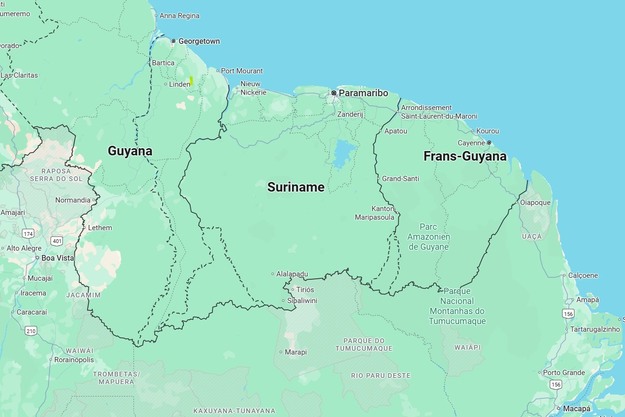 © Google MapsSuriname is four times the size of the Netherlands, and only 635,000 people live there.
After a coup in 1980, army chief Dési Bouterse took power. He stayed on until 1988 and then also led the country as democratically elected president, in two terms of office, from 2010 to 2020. In that year, Chan Santokhi won the elections, though he inherited the country with an empty exchequer. In 10 years, from 2010 to 2020, public debt had risen from 17% of GDP to 146% (figures: IMF). By 2024, the debt was reduced to 87%, although this was logically offset by austerity measures, which were not always welcomed by the population. In February 2023, Paramaribo was still plagued by riots, including protests against increases in the prices of fuel, gas cylinders, and the internet. In July this year, President Santokhi was succeeded by Jennifer Geerlings-Simons after his five-year term.
Oil extraction
On 23 September, the president said at the UN summit in New York that the world's biggest polluters must take responsibility and contribute to the preservation of the Surinamese Rainforest. "Not only with words, but also with deeds, justice and funding," she said. During her speech, she also referred to the country's future revenue, starting in 2028, from oil extraction in deep-sea areas. The money can be spent on developing sectors such as tourism, agriculture, and education.
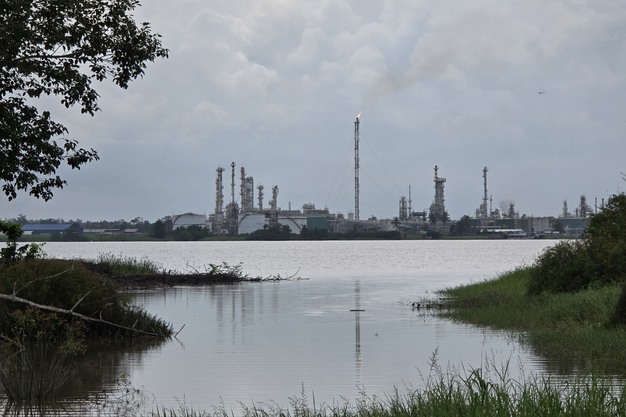 © Pieter Boekhout | VerticalFarmDaily.comWith the start of oil and gas production in 2028, Suriname can generate revenue again.
"Production starts in 2028, and we need to act now," said Anilkumar Paradath of the Chamber of Commerce and Factories (KKF) in an interview with Fresh Publishers about the oil project. "At a recent meeting, Total Energies explained their plans: 50 drilling sites, an investment of $1.5 billion, and an expected influx of 2,000 foreign experts."
Besides oil revenues, this creates opportunities for Suriname in every sector. "Building flats, delivering meals or supplying materials – everything comes into the picture," says Anil. Small and medium-sized enterprises also see prospects. Total promises to buy locally as much as possible, provided companies meet standards.
There are also opportunities in the agricultural sector, but there is a catch. "The products have to be certified," stresses Anil. "No grower can deliver just like that." Because Suriname has mostly small-scale growers – estimates indicate 6,000 to 7,000 – and certification is expensive and complicated, collective pathways are being developed. Support is expected from the Inter-American Development Bank (IDB) and the IMF.
The KKF itself will help entrepreneurs through a one-stop window, where information, registration, and guidance come together. "We are already listing available houses and catering companies," says Anil. Training courses are also being set up, for example, for divers and safety experts.
Although there is optimism in society and 2028 is already seen as an economic turning point for the country, Anil remains cautious. "We have learnt from bauxite mining. Only those who prepare well will benefit." Oil offers opportunities, certainly also for the AGF sector, but only if Suriname dares to take the step towards professionalisation.
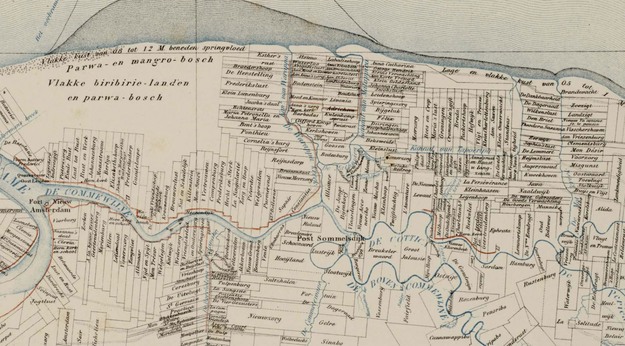 © Pieter Boekhout | VerticalFarmDaily.comOld map. All along the rivers used to be plantations. All but a few are overgrown and no longer in production. Suriname is one of the few countries in the world where water and fertile soil are not a problem.
Area and exports
Rice is by far the most widely grown crop in Suriname. The area covered 49,808 ha in 2023, according to figures from FAOstat, the statistics service of the Food and Agriculture Organisation of the United Nations. Following closely behind are the cultivation of sugarcane (2,148 ha), palm kernels (600 ha), coffee (280 ha), and cocoa (160 ha).
In 2023, fruit cultivation was dominated by citrus: 1,008 ha of oranges, 68 ha of grapefruit (233 ha in 2010, steadily declining year on year since then), and 236 ha of other citrus species. Bananas were grown on an area of 287 ha in 2023, sharply down from 2,173 ha in 2013, when banana cultivation declined year-on-year due to moko, among other factors. Further on in this special, banana cultivation and history are covered. Plantain reached a total of 227 ha in 2023 (2016: 640 ha).
Furthermore, pineapple cultivation is on the rise (224 ha in 2023 compared to 20 ha in 2010), as well as acerola (73 ha compared to 12 ha in 2010). Coconut substrate, on the other hand, has lost much ground in recent years (115 ha in 2023 compared to 1,080 ha in 2020). Mango is grown on an area of 110 ha, watermelon on 75 ha, papaya on 31 ha, and other tropical fruits on 57 ha. Of these, avocado accounted for only 7 ha in 2023, but as will be discussed further in this special, this will change within a few years – and dramatically so.
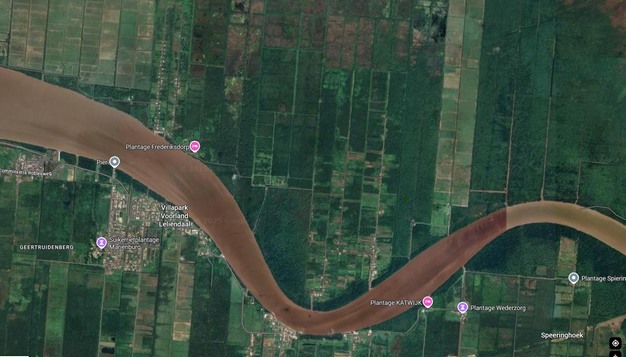 © Google MapsAlong the Commewijne River, the former structure of plantations next to the water is clearly visible.
Root, tuber, and bulb crops covered 408 ha in 2023, of which cassava accounted for 213 ha and sweet potato 44 ha. Legumes came in at 120 ha (down from 358 ha in 2017), fruiting vegetables such as tomato at 50 ha (2016: 126 ha), and cucumber at 27 ha (2016: 75 ha). White cabbage was grown on 23 ha. Other vegetable crops accounted for 452 ha, though down sharply from 1,207 ha in 2016.
Fruit and vegetable exports are very limited. According to Faostat, 2,756 tons of bananas were exported two years ago, compared to 83,260 tons in 2012, and again 40,882 tons in 2018, most of which went to the EU. Banana exports to Europe are completely stagnant today. Other fresh produce products, which are very diverse, have remained around 2,000 tons for years.
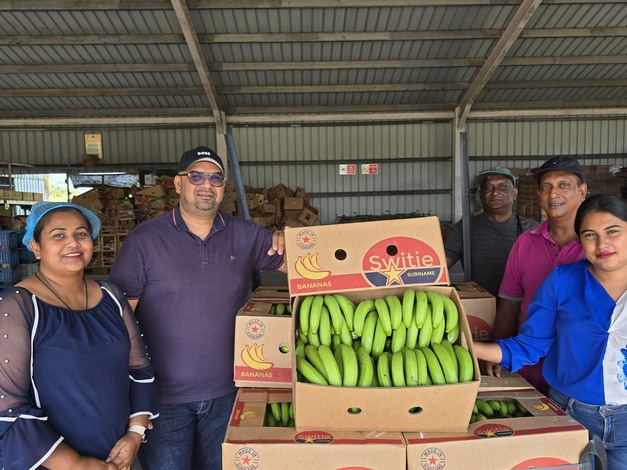 © Pieter Boekhout | VerticalFarmDaily.comAccording to Faostat, 2,756 tons of bananas were exported two years ago, compared to a whopping 83,260 tons in 2012, and again 40,882 tons in 2018, most of which were destined for the EU.
Suriname has exported to 11 Caribbean countries over the past 15 years. As a member of the Caribbean Community (Caricom), the country has free access to these markets. According to Eurostat, the EU took a total of 934 tons of vegetables and 21 tons of fruits in 2024, with the main products being beans (298 tons), aubergines (154 tons), peppers (40 tons), and mangoes (19 tons). To boost fruit and vegetable exports, there is cooperation with the Netherlands Food and Consumer Product Safety Authority (NVWA) to train Surinamese inspectors, as well as support from the IDB and FAO.