

Automation was one of the key topics during the 2025 edition of the Bus Tour, which is traditionally organized prior to the Canadian Greenhouse Conference. Growers, researchers, and suppliers boarded a bus to visit a range of facilities—each offering a different look at technology and production in the current-day industry. This year's edition took participants through Niagara's flower and vegetable sector, with research updates shared at Vineland Research and Innovation. Other stops included Meyers Farms, Freeman Herbs, Hendriks Greenhouses, United Floral Distributors, and Fenwick Berry Farms.
Click here for the photo report
From flowers to climate zones at Meyers Farms
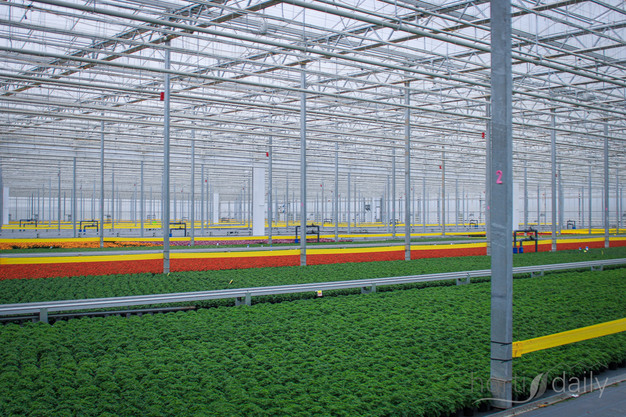
The first visit of the day brought the group to Meyers Farms, where production has shifted from vegetables to cut flowers such as peonies and hydrangeas. The farm supplies supermarkets across North America through distribution centers, shipping boxed products to regions as far as Texas and California. In spring, the company adds seasonal lines, including hanging baskets.
 © Eelkje Pulley | VerticalFarmDaily.com
Grower Aron Meyer, known for his technical management, explained how the greenhouse can operate under eight distinct climate zones but is usually kept as uniform as possible. The ebb-and-flow floor system was designed to keep the pots dry at the base, with water flowing beneath. The team has an eye for automation, but also focuses to keep things workable: spacing is standardized by the pot-placement machine, and fertilization practices remain simplified to keep operations consistent.
Research and robotics at Vineland
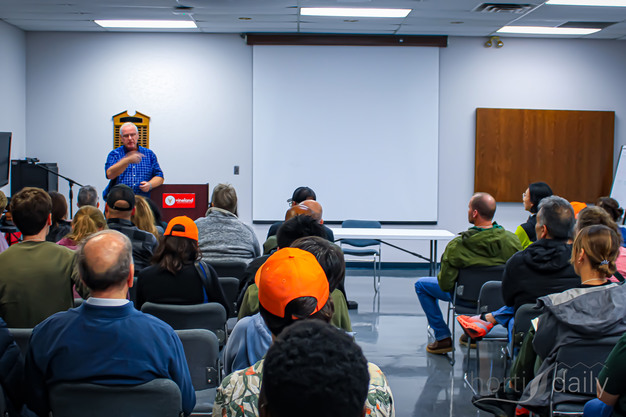
At the Vineland Research & Innovation Center, the group received several presentations on ongoing projects in lighting, crop protection, automation, and breeding. President and CEO Ian Potter introduced the center's focus on supporting the sector's long-term sustainability.
One team, led by Travis Banks and Amy Bowen, presented work on tomato breeding. Their goal: combine flavor quality, virus resistance, and yield performance. The research includes analyzing genetic pathways and flavor chemistry. New LED lighting systems were recently installed to support controlled-environment trials.
 © Eelkje Pulley | VerticalFarmDaily.com
Brian Lynch discussed the center's approach to horticultural technology. Rather than designing machinery from scratch, Vineland works with existing components to address growers' challenges. Their cucumber harvesting robot prototype was one example. The project aims to determine whether the return on investment justifies development. Other trials, such as AI-based water management for flowering plants, were found not yet commercially viable despite promising technical performance.
Herbs and LEDs at Freeman Herbs
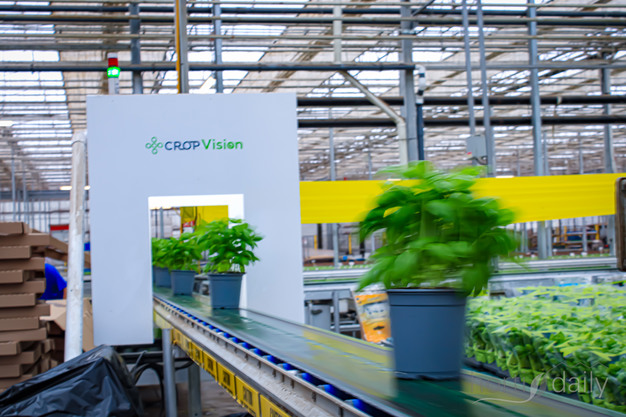
At Freeman Herbs, grower Marco Leonardis guided the group through the basil, cilantro, mint, and other herb crops. Around 65 percent of the company's products are shipped to Trader Joe's in the United States.
 © Eelkje Pulley | VerticalFarmDaily.com
A visit to Freeman Herbs always reveals something new, as testing and innovation are part of the company's DNA. Ongoing trials focus on packaging and shelf-life improvements, and a new basil variety is set to enter production next season.
The red greenhouse roof remains an impressive sight. The Luminus panels create this effect by converting sunlight to a red spectrum while generating power that is returned to the grid. In collaboration with a university partner. So far, trials have shown no measurable effect on crop growth, and benefits only energy expenses, but research continues on other crops.
The company operates two planting lines and is expanding capacity. And this expansion doesn't stop there: next year, Freeman plans to fully transition to self-moving benches and bring propagation entirely in-house.
Ornamentals and automation at Hendriks Greenhouses
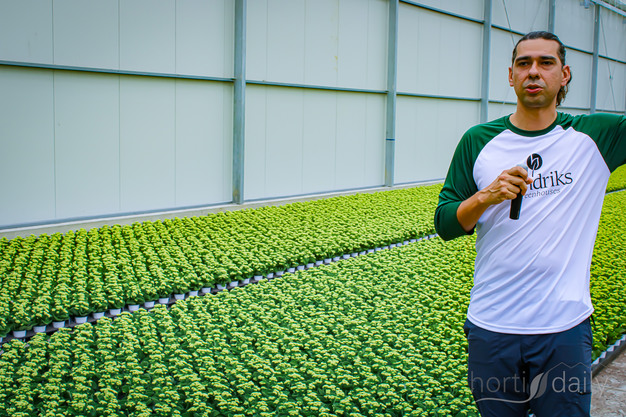
The next stop, Hendriks Greenhouses, grows tropicals, ferns, and seasonal ornamentals, operating several greenhouse and tunnel sites. Production is divided into short-day and long-day zones to handle seasonal peaks like Valentine's and Christmas crops.
 © Eelkje Pulley | VerticalFarmDaily.com
Growers Jason Lam and German Betancourt explained that two planting lines are currently in operation. Labor scheduling remains a challenge in December, when many temporary workers return home to Mexico, leaving fewer trained staff during the busy season. It is one of the reasons why automation investments are ongoing, including the addition of a tray washer and mechanized potting.
Global logistics at United Floral Distributors
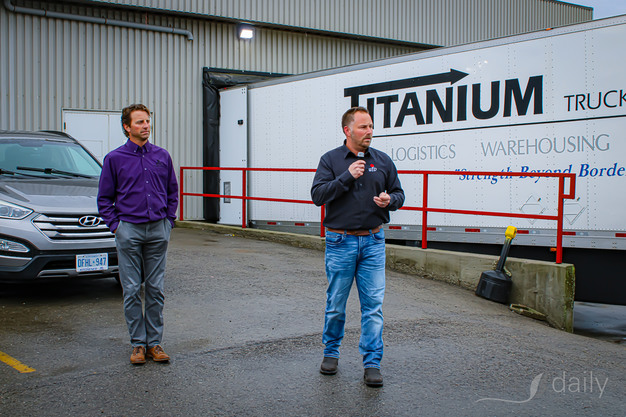
The afternoon resumed at United Floral Distributors (UFD), where participants saw how international cut flowers move through Canadian supply chains. UFD handles import, bouquet assembly, and distribution from its Ontario hub, employing about 200–250 people and operating roughly 40 trucks. The company aims to purchase as directly as possible from growers to reduce costs and maintain freshness.
 © Eelkje Pulley | VerticalFarmDaily.com
The tariffs do not make life easier for UFD: Flowers from Colombia arrive at U.S. entry points in Miami before being shipped to Canada. From Ontario, Canadian-grown flowers are exported back to the U.S., but Colombian flowers cannot be re-exported due to tariff rules.
Finishing at Fenwick Berry Farm
The day concluded at Fenwick Berry Farms, a first-generation family farm with close to 150 acres in Fenwick. Focusing on low energy cost propagation, David Klyn-Hesselink told the company is in production from the end of May into October for their strawberries, and they also grow blackberries and blueberries from mid-July to mid-September. As Vineland is partnering with Fenwick Berry Farm to explore season extension for long cane raspberries in unique substrate blends, propagation was a big topic of discussion at the company, before the group headed back to Niagara. 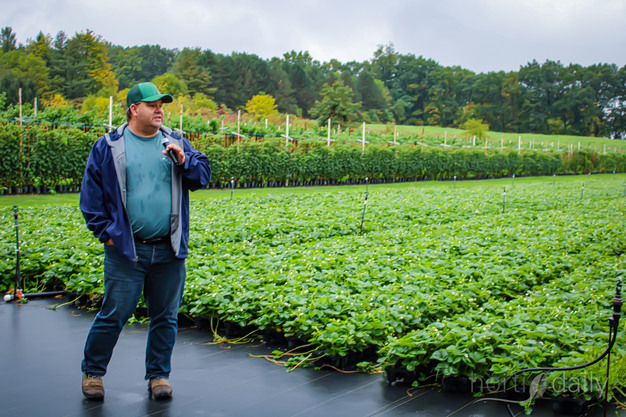 © Eelkje Pulley | VerticalFarmDaily.com