

As most attendees have returned to their homes, others were spending some more time in the Dutch capital city. The 6th Vertical Farming World Congress has come to an end. The three-day conference spanned a tour at Growy, a visit to Philips' Growwise center in Eindhoven, and concluded at the Koepelkerk in the heart of Amsterdam. A focused group of farm operators, suppliers, producers, government representatives, and academics created a family feel over the past three days.
During the conference, several key buzzwords emerged: energy, investment, transparency, profitability, and retail. Luckily, there hasn't been much focus on all the pitfalls in the industry, but rather the opposite. As a participant said at the conference, "We're a niche industry, at the start of a new beginning, through a much-needed 'shake-up'."
Click here to view the photo report.
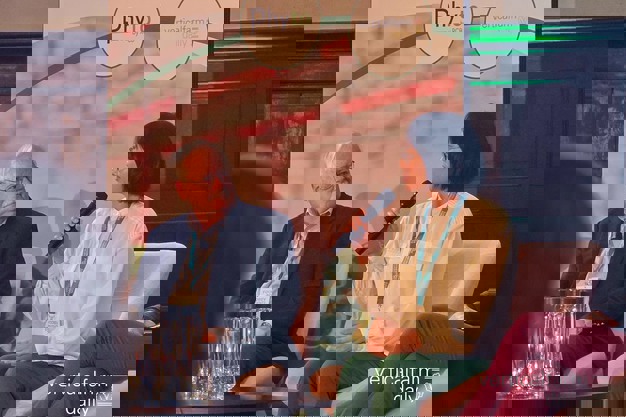 © Rebekka Boekhout | VerticalFarmDaily.comTom Stenzel of the CEA Alliance and Eri Hayashi of the Japan Plant Factory Association
Investment
More importantly, what are we now pitching investors for expansion? Based on the conversations on stage, 'a clear proof of concept, a sales footprint' is required to see new investment coming in. The 'hoping a business plan works' doesn't go well with investors anymore. Margins will remain tight; thus, inputs are most important to focus on, which in most cases are energy, labor, waste, and raw materials. Investment discussions revealed a shift away from venture capital towards debt and long-term partnerships with retailers. "It's an asset-heavy, low-margin business that needs stable offtake."
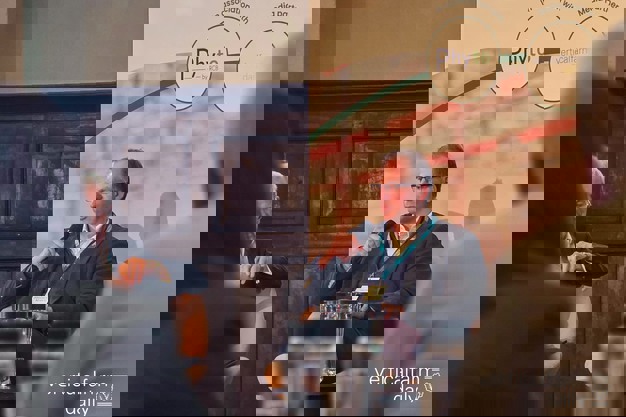 © Rebekka Boekhout | VerticalFarmDaily.comTristan Fischer of Fischer Farms revealed the company will be selling farming units globally
Co-location
Are farms supplying a product that the consumer demands, or are they hoping for offtakers. How are you approaching retail with your product and what is the value you're adding for them. Some might say, involve them in the process and build farms at distribution centers as Infarm failed at, yet, Avisomo and Coop's latest collaborative farm is set to prove otherwise. Understanding your consumer should be reflected in the product prices.
IGS, compared to previous years, focused less on highlighting the size of their GigaFarm and instead concentrated on synergies like waste streams, a point agreed upon by Philip Lee of Evolve Ag. When combining waste streams, farm inputs such as heat, nutrients, and energy can be efficiently shared and used, which drastically lowers costs.
Click here to view the photo report.
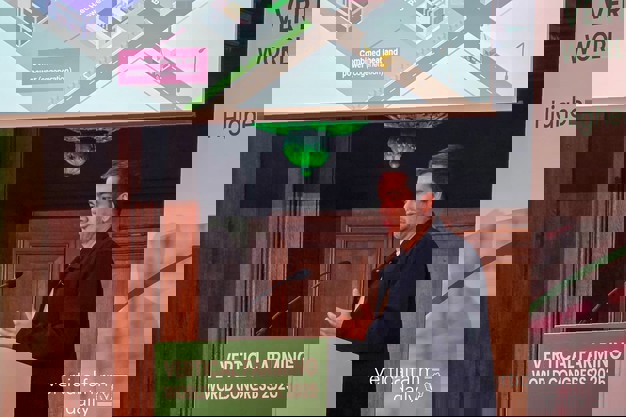 © Rebekka Boekhout | VerticalFarmDaily.com Chris Davies of Harvest London highlighting its latest Corner Corner showcase farm
A step in the right direction
Richard Hall, Owner of FoodBev Media, initiated to form a focused group of vertical farms to share growing data and create honest benchmarks for the industry. The industry needs to move away from proving vertical farming can work, but instead focus on how it can work profitably. This will be a step in the right direction of pushing for transparency and avoiding reinvention of concepts or business models that have already been proven either negative or positive.
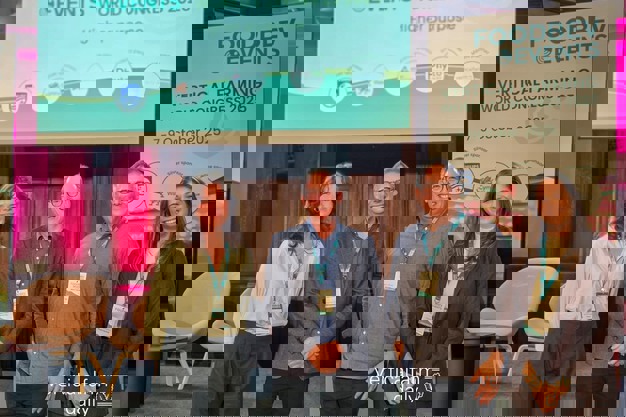 © Rebekka Boekhout | VerticalFarmDaily.com Laura van de Kreeke (Growy), Leo Marcelis (WUR), Marc Oshima (Babylon Micro-Farms), Rebekka Boekhout (Phyto by RCB)
Japanese vertical farms have been around for ages. And let's not generalize, but let's take a look at peers who can succeed. How? Their product is seen as a commodity product with unique selling points, efficient production processes, lower operating expenses through partial automation, and low capital expenditure. They meet bi-weekly to discuss their challenges and collaborate on solutions, even during production. They assist in case of a product shortage and are eager to share data to prevent any of them from failing. Because in the end, it's their, our industry.
The 2026 edition of the Vertical Farming World Congress is expected to take place in London, the UK.
Click here to view the photo report.
For more information:
Foodbev Media
[email protected]
www.foodbevevents.com