


Resource Innovation Institute has announced the release of four major industry guides developed through collaborative working groups that included industry representatives, university researchers, policymakers, and technology providers. The publications mark the completion of a federally funded, two-year project aimed at addressing key challenges facing the CEA industry across different scales and stages of development.
The new guides provide practical, evidence-based direction on topics that span emerging technologies, operational efficiency, resource-sharing models, and international knowledge transfer. Each guide was created through RII's working group model, which brings together diverse experts to translate complex technical concepts into clear and actionable guidance for the industry.
According to Rob Eddy, Horticulturist at RII and lead author of all four publications, the guides represent a major step forward for the CEA sector. He noted that the project gathered top academic and industry expertise to create resources that address real challenges for both small family growers and large commercial facilities. Eddy emphasized that the guides help operators evaluate new technologies, pursue efficiency improvements, and explore collaborative opportunities with a non-biased foundation for informed decision making.
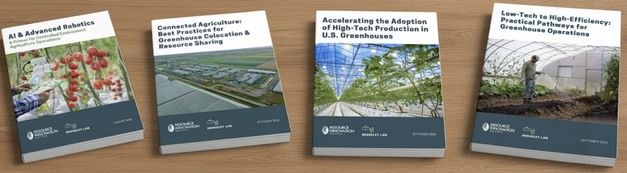
The first publication, AI and Advanced Robotics: A Primer for Controlled Environment Agriculture Operations, helps greenhouse and indoor farm operators understand and plan for the adoption of artificial intelligence and robotics. It covers current and emerging applications, workforce implications, and provides a practical view of what CEA could look like by 2035. Co-authors include robotics expert Shreyas Kousik of Georgia Institute of Technology and Bryce Carleton of RII.
The second guide, Accelerating the Adoption of High-Tech Production in U.S. Greenhouses, is co-authored by Arend-Jan Both of Rutgers University. It identifies the major barriers slowing technology adoption in U.S. greenhouses, despite the country's strong potential for high-tech development. The publication addresses regulatory inconsistencies, workforce needs, and infrastructure gaps while outlining strategies to advance adoption of technologies that are already standard in other parts of the world.
 © Research Innovation Institute
Connected Agriculture: Best Practices for Greenhouse Colocation and Resource Sharing serves as the third guide. It examines colocation models that allow greenhouse operations to share resources, infrastructure, and utilities with complementary facilities. By exploring one-to-one partnerships, district utility systems, and Farm Park-style developments, the guide presents pathways for reducing energy costs and achieving economies of scale. The authors are Carmen Azzaretti and Derek Smith of RII.
The fourth publication, Low-Tech to High-Efficiency: Practical Pathways for Greenhouse Operations, focuses on the needs of small and mid-sized greenhouse operators. It offers practical strategies for adopting technologies that build on existing knowledge and address common operational challenges. The guide highlights solutions under 2,000 dollars, equipment selection guidance, and workforce development approaches tailored to operations with limited budgets. It is co-authored by Qinglu Ying of the University of Kentucky and centers on finding technology that fits each operation's specific needs.
For more information:
Resource Innovation Institute
Derek Smith
Email: [email protected]
www.resourceinnovation.org