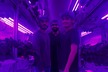

It was quite a sight this Wednesday inside the greenhouse at Tomatoworld: people wearing special headsets are "clicking" into thin air, their excitement growing by the minute. Around them, others without the headsets watch curiously as the participants gesture and move. While the headset wearers see layers of data floating around them, everyone else sees just a regular greenhouse filled with tomatoes.
This fascinating scene in Honselersdijk is part of a live demonstration showing how immersive technology can be used in horticulture. The demo was one of the highlights of Demodag NXTGEN Hightech – Data- en Infrastructuur in de Glastuinbouw (NXTGEN Hightech Demo Day – Data and Infrastructure in Horticulture).
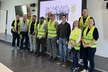
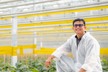
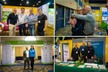
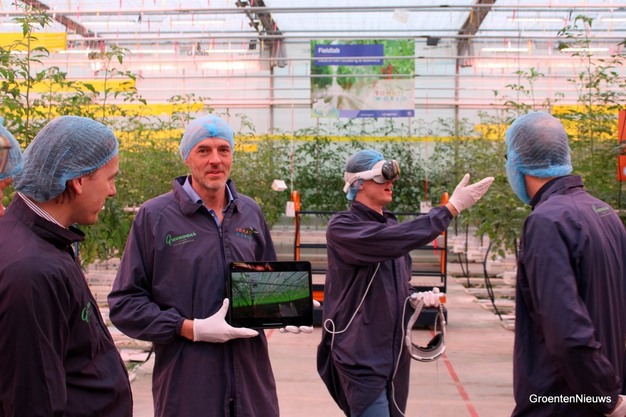 © Thijmen Tiersma | VerticalFarmDaily.comJoeri van den Hoek of Robocrops/InnovationQuarter assists Jan Verwoerd of 360Fabriek who demonstrates the operation of immersive technology. View more photos here (link in Dutch).
Prototype in action
At the heart of the demonstration is a new prototype featuring a specialized headset and accompanying software. This innovation makes it possible to visualize data not just on a traditional computer screen, but directly within the greenhouse environment—right where the action happens.
The prototype is the result of a joint project between the Erasmus Centre for Data Analytics and Robocrops. Marie Kegeleers, Immersive Tech Engineer based in Rotterdam, gave an introduction to immersive technology on Wednesday afternoon before the next group of visitors stepped into the greenhouse to experience the system for themselves.
AR used for labor challenges
According to Marie, Augmented Reality (AR) offers an entirely new way of communicating and visualizing information. The technology could help horticulture address one of its biggest challenges: labour. On one hand, the sector faces a shortage of workers, and on the other, it's losing valuable knowledge as experienced growers retire.
So far, AR has seen limited use in practical horticulture. Marie points out that a few pilot projects have been conducted by Wageningen University & Research (WUR), but spatially visualizing data—seeing real-time crop information mapped directly into the greenhouse—is still a very new concept for the sector.
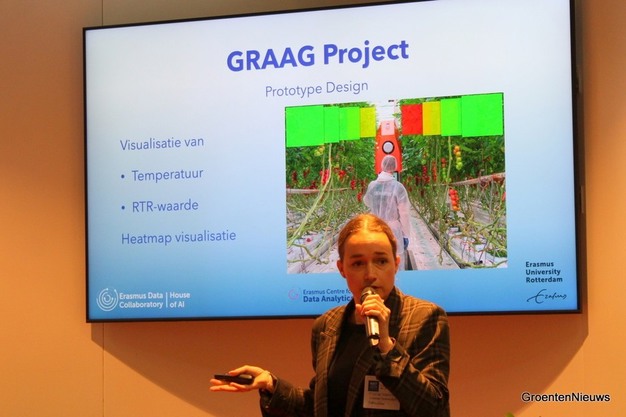 © Thijmen Tiersma | VerticalFarmDaily.comMarie Kegeleers from the Erasmus Centre for Data Analytics gives an introduction about immersive technology and discusses horticultural applications in the GRAAG project.
Data visualization in the growing area
Once inside the greenhouse, the experience quickly becomes clear to the participants. For some, it takes a moment to adjust — walking and performing tasks with the headset on isn't second nature yet. But once they get the hang of it, they can see real-time data on climate conditions and RTR (the ratio between temperature and radiation) as they move through the greenhouse, displayed right where it's relevant. With the headset on, it's also easy to spot local variations in growing conditions.
This prototype focuses on visualizing climate and RTR data and was developed as part of the GRAAG project — Green Realtime Augmented Assistant Greenhouses. Alongside the previously mentioned project partners, 360Fabriek, InnovationQuarter, and Hortivation are also involved.
Gathering feedback
According to Marie Kegeleers, what was demonstrated on Wednesday is only the beginning. There's potential to integrate much more data in the future. One of the current challenges, however, is that the ideal headset for greenhouse use doesn't yet exist. The current model is still quite large and heavy, and technically it's not an AR (Augmented Reality) headset but an MR (Mixed Reality) one, blending the real and virtual worlds.
Marie notes that several companies are already developing lighter and more practical headsets, which will open up new possibilities. In the meantime, valuable feedback can be gathered from growers testing the prototype, something that was happening throughout the demo day.
One grower commented that the current version would only partly reduce his workload. At the moment, he checks his crop data on his phone, and sometimes still relies on intuition, for instance, closing the vents when he feels a draft, even without consulting the data.
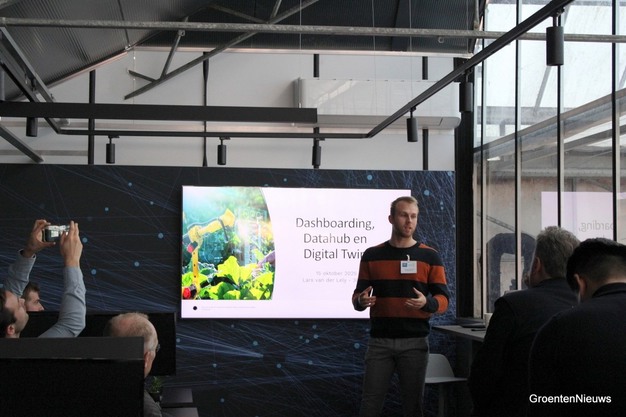 © Thijmen Tiersma | VerticalFarmDaily.comLars van der Lely of 30MHz talked about data hubs and digital twins.
Training the next generation of growers
That last remark touches on an important issue. Many of today's experienced "green-thumb" growers are nearing retirement, and their successors often lack the intuitive know-how that comes from years of hands-on experience. The immersive headset could one day play a key role in training and educating new growers, helping them bridge that gap.
Marie points out that similar technologies are already widely used in other industries. KLM, for example, trains its pilots using virtual reality, and the City of Rotterdam has built a virtual model of the city for simulation purposes. Such tools also make it possible to safely train for dangerous tasks through realistic virtual practice.
In Honselersdijk, however, the greenhouse trial went smoothly. One participant laughed with relief after taking off the headset: "I wouldn't drive a car with this just yet!" Fortunately, that's not the goal in horticulture.
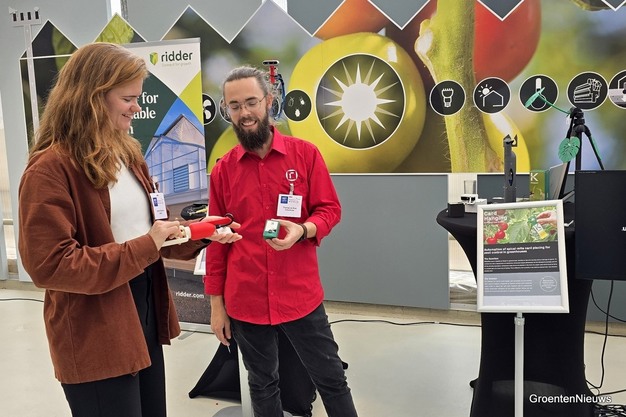 © Thijmen Tiersma | VerticalFarmDaily.comRoboHouse demonstrated a robotic application to place biology bags in the crop. The application, developed with Koppert, Octiva, and TU Delft, will still be tested in the greenhouse of Tomatoworld.
View a photo impression of the demo with immersive technology during the Demo Day NXTGEN Hightech – Data and Infrastructure in Horticulture here (link in Dutch)