


For berry growers, whether cultivating blueberries, strawberries, or raspberries, the choice of growing media can determine everything from root development to fruit size and overall yield. "While coco coir has become the global favorite for its sustainability, consistency, and scalability, one factor within coco coir often goes unnoticed but plays a massive role in crop performance: particle size", says Pounraj Kulandaivel - Director at Vaighai Agro.
He explains the structure of coco coir is defined by a mix of coco coir, short fibers, and husk chips (larger particles). "How these components are blended dramatically affects water availability, air porosity, drainage, and nutrient retention, directly influencing plant growth and crop profitability."
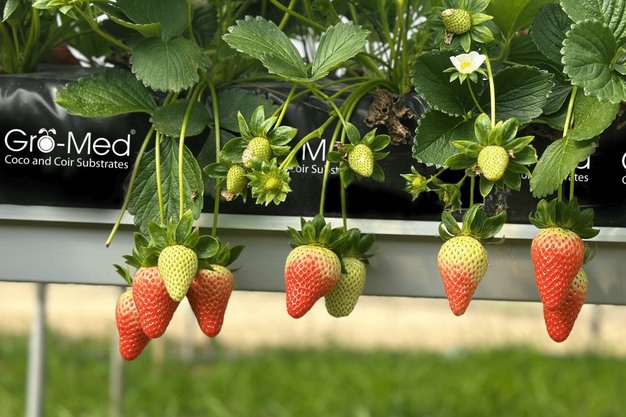 © Vaighai Worldwide
Different particles in coco coir
Coco coir is a mix of coco, chips, and fiber, each contributing distinct physical properties. "Coco particles (>1 mm) provide excellent water retention, keeping berry plants hydrated between irrigation cycles. Coarser chips and husk fractions increase pore space, improving root aeration and oxygen supply, a key factor for healthy root systems and firm fruit development. Coir fine particles or dust (<1 mm) raise the substrate's density, limit aeration, and can lead to waterlogging or root asphyxia if unmanaged", says Pounraj.
Berries such as strawberries and blueberries thrive when roots receive a steady supply of air and water. "Substrates combining varied particle sizes can be tuned to local climate or irrigation routines, ensuring roots aren't suffocated by excess moisture nor dried out between watering. Mixes with more coarse fractions require more frequent, shorter irrigation pulses, while those with finer fractions need longer pauses to allow reoxygenation in the root zone."
Pounraj explains improved root health and stable moisture deliver firmer, higher-quality fruit, while adequate oxygenation reduces risks of diseases. "Research shows that berry yields in coco coir are strongly influenced by how well the substrate balances water-holding capacity (WHC) and air-filled porosity. Higher WHC achieved through a greater proportion of coco coir particles (>1 mm) supports better fruit sizing and overall yield." Fruit quality
However, this must be paired with enough aeration from coarser particles of husk chips to prevent compaction and oversaturation. "Blueberries, in particular, benefit from coco coir blends that offer excellent drainage and naturally lower pH, allowing roots to develop more efficiently and absorb nutrients more consistently. Such blends help maintain uniform growth even in areas where native soils are not ideal for berry production. Ultimately, the success of hydroponic farming with coco coir comes down to choosing the right particle size distribution and aligning it with an appropriate irrigation strategy."
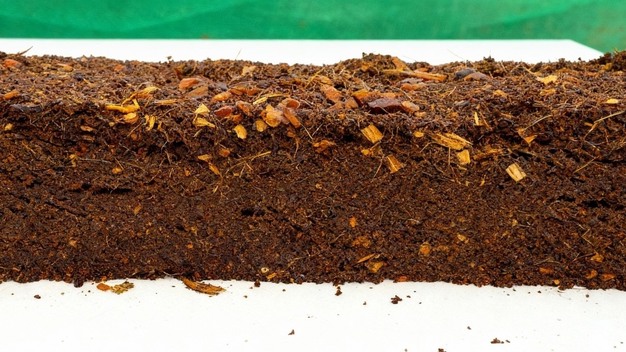 © Vaighai Worldwide
Best practices
When asked about the best practices for growers, Pounraj says to ensure your coco coir supplier provides material that is properly sieved to remove excess dust and ultra-fine particles. "Below 0.2 mm. Also, aim for a blend (often 70% coco coir, 30% husk chips) that matches your crop's root-zone needs and your irrigation schedule. Then, monitor substrate aeration, water holding, and structural stability regularly, and watch for shrinkage greater than 5%, which can affect root health and complicate daily crop management."
He advises adjusting irrigation pulses and nutrient delivery based on the substrate's water–air curves and the berry variety you're growing. "Growers who understand the relationship between particle size, substrate structure, and irrigation can dramatically improve berry performance."
Well-balanced mix
He concludes that a well-balanced coco coir blend boosts yield, improves fruit firmness and size, supports stronger, whiter roots, reduces disease risk, and ensures better moisture and nutrient efficiency. "And the quality of the coco coir you choose makes all the difference. That's why many commercial berry growers prefer Gro-Med Coco Coir Substrate—because every batch is engineered to have the right particle size distribution, stable structure, and reliable performance in your hydroponic / greenhouse farming. We're committed to helping you get the highest ROI from your hydroponic berry production."
For more information: Vaighai Agro Products Limited
Pounraj: +91 94433 12065
[email protected]
39B, Anna Nagar, Madurai - 625020, India
www.vaighai.com