

Choosing the best substrate for vertical farming sounds simple until growers try to balance water retention, root aeration, turnover speed and real-world cost. The challenge grows when supplying fresh produce to markets that expect consistency in places like the Netherlands, the USA, Canada, Mexico or Germany. Vertical farming adds its own pressure, because unlike open-field systems there is no buffer. One wrong move with substrate quality affects every tray in the stack.
Growers keep returning to coco coir mixes when they want something dependable without watching every tray. Public sources such as the Coir Wikipedia page outline the properties that make coir naturally resilient, and research groups like the Coconut Research Institute of Sri Lanka provide broader insight on coir standards. Companies such as Coco Labs have refined vertical farming blends for years, though no single brand defines the category.
Substrate matters more than technology, even though LEDs and automation usually get the spotlight. A growing medium does not get enough credit. Even the most advanced system cannot rescue roots that are gasping for air or drowning in poorly drained media. Every crop behaves differently under vertical constraints, and substrate is the one element that touches the root zone every second of the cycle. Coir-based substrates consistently rise above alternatives because they hold moisture without suffocating plants and release water gradually, which keeps seedlings steady during environmental shifts. Growers who buy substrate in bulk tend to check transparent suppliers for consistent specifications, because no one wants surprises mid-season.
The perfect substrate does not exist, but certain traits influence whether plants move smoothly through the cycle or struggle from the start. Roots need air pockets or early growth stalls, and coir naturally preserves these spaces. Vertical stacks often link irrigation schedules to sensors, so media that hold too much water can throw those sensors off. Coir blends keep the moisture curve predictable. A clean, low-EC starting point protects seedlings from stress. Sri Lankan coir is often washed and stable, which makes the transplant phase easier. Coir is also lightweight, which suits vertical racks not built for heavy substrates. Most important, coir encourages even root spread across trays, something rockwool cannot always guarantee when water distribution fluctuates. Scientific summaries from agricultural institutes help growers compare coir to other materials when choosing a supplier.
 © Coco Labs
Vertical farmers choose coir because it feels comfortable, predictable and practical. It does not compress badly over time, which keeps multi-cycle setups steady. Hydroponic and semi-hydroponic systems depend on media that support oxygen flow without trapping salts, and coir fits that need. Many growers say coir behaves like soil but without the dramatic swings between wet and dry. Leafy greens such as lettuce or kale respond well to that stability. When the substrate performs consistently, farmers can push for faster turnover without increasing their monitoring workload.
Comparisons reinforce why coir stands out. Rockwool is precise but unforgiving and dries quickly. Peat is organic but collapses over multiple cycles. Perlite and vermiculite mixes are light but hold moisture unevenly. Coco coir lands in the middle, balanced and forgiving, and works well with high-frequency irrigation. It behaves consistently across climates, which explains why growers in both the Netherlands and Mexico rely on it.
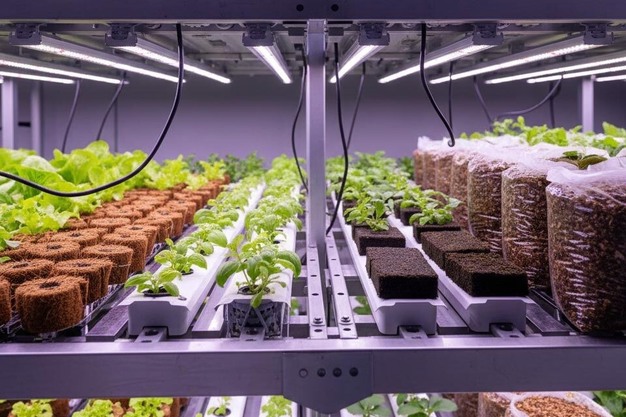
Coir shows its strength across multiple vertical farming applications. In seedling trays, coir chips help roots breathe and avoid early stress. In microgreens, uniform moisture is essential and coir delivers. In stacked hydroponic channels, coir does not crumble or clog drains. Leafy greens such as lettuce, spinach, arugula and pak choi respond well to neutral, stable coir mixes. Properly processed coir also avoids weed seeds and pathogens, reducing risks in controlled environments.
Certain substrate traits boost performance in vertical systems. Lightweight media reduce rack stress. Fast drainage prevents root suffocation. Neutral pH works well with hydroponic nutrients. Rehydration-friendly media make it easy to reset between cycles. Stable texture prevents collapse after weeks of use. A renewable source such as coconut husk fiber supports sustainability goals. Even a simple checklist built around these qualities helps growers assess suppliers.
Choosing the best substrate for vertical farming comes down to one question: does the substrate support consistent root development? No matter how advanced the system may be, plants cannot perform without stable roots. Well-processed coir from mature production regions such as Sri Lanka continues to prove itself season after season. Growers have tested many blends, but coir remains the steady middle ground, comfortable for beginners and reliable for professionals.
For more information:
Coco Labs
Email: [email protected]
https://cocolabs.lk/