

Earlier this year, Purple Farms introduced readers to fogponics, the fine mist cultivation method they believe can outperform both hydroponics and aeroponics. Now, the Ahmedabad-based company, founded by Brahmmjyot Singh Kalsi and Satya Raju, is entering a new phase. The team is moving from proving the technology to deploying commercial systems, forming partnerships, and expanding their model beyond India.
"We believe in a more collaborative effort in the fields of agriculture than a competitive one," says Kalsi. "Everybody has competed with each other so far, and it has not done any good for the industry. If you can find something that works, it will grow the sector. There will be enough market share for everybody." © Purple Farms
A partnership model built for scale
Purple Farms now integrates automation from Indian technology firm 4Climate into its systems. "We use their automation system, but the rest is our technology," Raju says. "When we open up a farm, we use their technology, so it works for us." The partnership reflects their broader approach to expanding fogponic farming through collaboration rather than competition.
Purple Farms operates a 5,000 square foot farm in Ahmedabad and has completed a 1,000 square foot installation for a client in Bangalore. Their fogponic system uses droplets of about 10 microns, which remain suspended around the roots and increase nutrient absorption. "A head of lettuce takes 35 to 40 days in the hydroponic farm," Kalsi says. "We do it in 25."
Third-party tests comparing soil-grown, hydroponic, and fogponic cherry tomatoes showed higher nutritional value and higher Brix in fogponic produce. The company is now preparing trials for strawberries, building on its work with tomatoes, chillies, and leafy greens.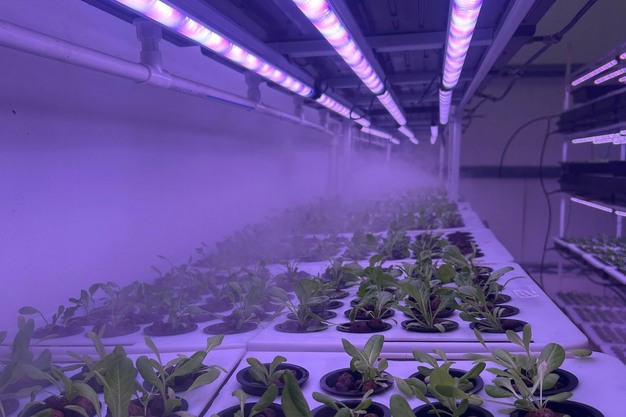
 © Purple Farms
A retrofit pathway for growers
Purple Farms has also introduced a retrofit model aimed at existing hydroponic farms. "We can come and upgrade your systems," Raju says. "You do not need to buy new systems. It is just a one-time cost. After that, you only have your cost of operation." The company sees this as a practical route for growers who want faster crop cycles without rebuilding entire facilities.
Before taking on a project, the team evaluates whether there is a viable market for the intended crop. "If a client is interested in growing a certain crop, the first thing we ask is whether they have a market to sell it," Kalsi says.
Site assessments include infrastructure, available water, and local energy economics. "Once a site is approved, Purple Farms creates a 3D model, installs the system, trains staff, and provides post-sale support. We keep an eye on them remotely." © Purple Farms
Positioning for international expansion
The company is now pursuing opportunities in the Middle East and Europe. "We are exploring these markets because our technology is more viable in these locations," Kalsi says.
"The UAE, for example, is importing its vegetables, and with subsidies, the energy cost becomes much cheaper. We can grow whatever the customer wants, as long as the economics make sense."
For more information:
Purple Farms
Brahmmjyot Singh Kalsi, CEO
Satya Raju, COO
[email protected]
gopurplefarms.com