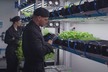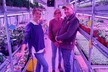

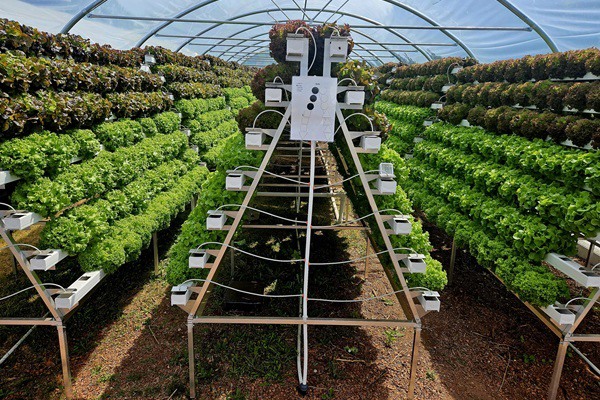
The Hessian startup Pflanzentheke has developed A-shaped plant shelves designed for users ranging from hobby gardeners to agricultural businesses. Instead of growing in soil, the plants are cultivated in nutrient-rich water, requiring very little space. The company's next step is to automate and fine-tune the cultivation process. The Deutsche Bundesstiftung Umwelt (DBU) is supporting the research with EUR 175,000.
 © Pflanzentheke GmbH
Efficient use of time, resources, and energy
Most fruit and vegetables consumed in Germany are imported. According to figures from the Federal Ministry of Food and Agriculture (BMEL), the country's self-sufficiency rate is 36 percent for vegetables and 20 percent for fruit. Large cities are especially dependent on produce delivered over long distances. DBU Secretary General Alexander Bonde says that producing food close to urban centers with high demand "saves on expensive and climate-damaging transport routes," adding that this is only possible when land is used efficiently.
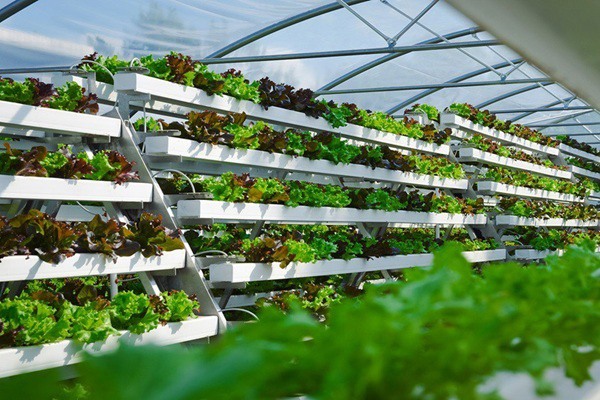
This is the aim of Pflanzentheke, based in Lorsch, which develops vertical farming systems for protected cultivation in greenhouses or polytunnels. Co-founder Leon Welker explains: "The vegetables grow on A-shaped shelves in a hydroponic system, thriving in nutrient-rich water instead of soil, across an average of seven levels per facility." With DBU funding, the company is now focusing on automating the system to improve the use of energy, labor, and resources.
Automated and data-based plant growth
Until now, young plants have been inserted manually and harvesting has also been manual. The startup is now working toward full automation with minimal energy use and low operating costs. Welker says the team is concentrating on practical steps that address the areas where small and medium-sized growers often reach their limits: harvesting, replanting, and system maintenance. The goal is to simplify daily operations with a modular system that saves water, conserves resources, and reduces labor requirements. "This makes efficient hydroponics economically accessible even for smaller businesses," he says.
To advance this, the A-shaped cultivation system is being mounted on a movable mechanism and linked to an intelligent control unit. "Sensors monitor the rows of plants and supply them with the right nutrients for each growth phase based entirely on data," Welker explains. Each row contains a crop at a different growth stage. The movable design also makes it possible to adjust sunlight exposure according to maturity. One row can be harvested and replanted while the other rows continue growing without interruption.
 © Pflanzentheke GmbH
System aims to conserve soil as well as reduce water and fertilizer consumption
Welker says the system reduces soil pressure, lowers water and fertilizer use, and maximizes food production in limited space. "The system achieves the same yield with around 90 percent less water and 85 percent less fertilizer than conventional agriculture," he notes.
The company combines the advantages of indoor vertical farming, such as high nutrient efficiency and low water use, with natural sunlight, which keeps energy requirements far lower than systems dependent on artificial lighting. Welker adds that growing crops closer to cities cuts delivery distances and can reduce reliance on energy-intensive cold chains.
For more information:
Leon Welker, Project Manager
Pflanzentheke GmbH
Tel: +49 1575 4231095
[email protected]
https://pflanzentheke.de
www.dbu.de