

Fischer Farms is known for building some of the largest vertical farms in the United Kingdom, yet founder Tristan Fischer says the company's real mission has shifted. Instead of competing with growers on premium leafy greens, the company wants to become an equipment manufacturer focused on lowering the cost of controlled-environment production worldwide.
"Our obsession is how to make the system cheaper, cheaper, cheaper," says Fischer. "If it is cheap, people can afford it. If it is too expensive, the market is restricted." What follows is a view into the firm's next phase. For Fischer, the future of vertical farming depends less on brand differentiation and more on engineering discipline, supply chain access, and the economic logic that transformed industries like solar, wind, batteries and automotive manufacturing during the last century.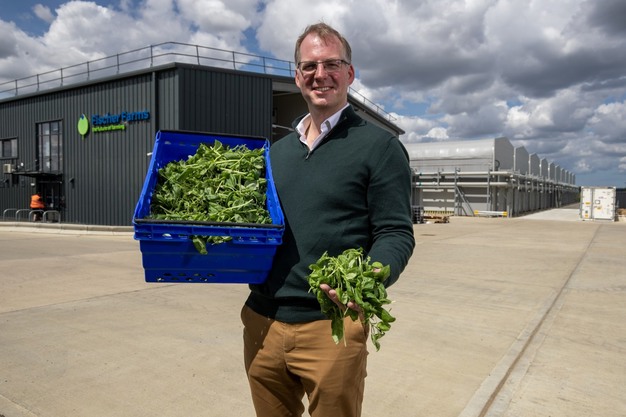 © Fischer Farms
A philosophy shaped by cost curves
Fischer draws a direct line from his previous work in renewable energy to what he believes vertical farming must become. "In wind and solar, I saw a crazy price drop over 20 to 25 years, one step at a time," he says. "I asked what they did that allowed costs to fall that fast, and how we could copy those attributes."
He rejects the idea that high prices are inherent to controlled-environment production. Instead, he argues the industry is still in its early, experimental phase, comparable to the 1890s automobile companies. "You had battery cars, coal-powered cars and liquid-fuel cars. You even had cars where the driver sat in the very front," says Fischer. "Then Henry Ford comes along and says he wants to make a car that his employees can buy. That is the Model T."
For Fischer Farms, the equivalent transformation centres on stripping out components, not refining them. In his view, improving a part by 20 percent is marginal; eliminating the part entirely is revolutionary. That principle guides both hardware design and procurement.
Radical cost reduction in lighting
Lighting is the clearest example. Fischer says their newest lighting system uses about 60 percent less electricity than their first-generation fixtures and costs roughly 10 percent of the original price.
"We went into the supply chain and said we wanted a board with specific characteristics. We were not buying an LED light, we were specifying what we needed," he says. Early Fischer Farms lights used heavy aluminium extrusions and higher-cost diodes. Today's fixtures use a simplified plastic exterior, fewer materials, and a diode configuration that reduces heat and energy load. Removing aluminium alone cut a significant share of capital cost. "At some point, you ask why you even need the tubing. Maybe you can get away with just the diode. That is the mindset."
This reduction was not optional. Electricity at the company's second UK farm is more than double the cost assumed during early modelling, moving from around 10 pence per kilowatt hour to roughly 22 pence. That shift forced a full redesign. "Our system was designed to grow rocket, and it made perfect sense at 10 pence. At 22 pence, we cannot make money on rocket," he says. "We had to adjust the product stack and improve efficiency."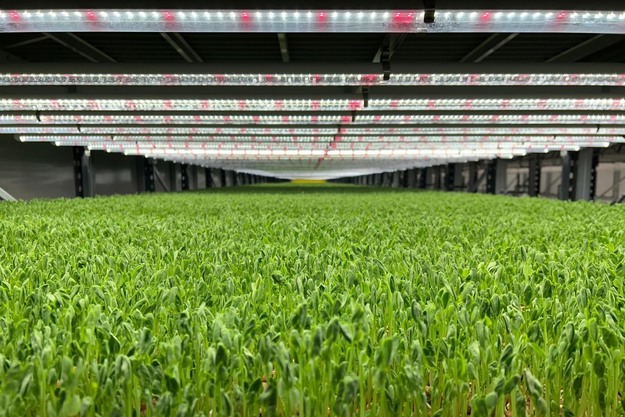 © Fischer Farms
The shift from grower to manufacturer
The company's new strategy moves away from competing with other vertical farms for supermarket accounts. Instead, Fischer Farms wants to supply modular, shippable production units to farmers, propagators and existing controlled-environment growers. "We are not trying to be a vertical farm competing with another vertical farm," Fischer says. "We want to be an equipment manufacturer for people who are farmers."
He points to opportunities in propagation for tomatoes, cucumbers and other crops where externally sourced seedlings can create timing mismatches. When plants arrive either too early or too late for available glasshouse space, transplants can become oversized or underdeveloped, leading to lost yield or, in some cases, a missed season. "We can eliminate that mismatch," he explains. "A vertical farm next to the facility gives growers control over early-stage growth and reduces disease risk." Tree propagation has also become an unexpected area of demand, with interest from both the UAE and the UK.
A modular system designed for fast deployment
Rather than building one large facility that takes years to complete and fill, Fischer Farms has developed a modular architecture based on multiples of shipping-container scale. "You can plug it in, start functioning and generate revenue. You avoid the construction project that takes months or years." The company also offers rental and lease models to remove upfront capital barriers. "You do not need to build a big system and pay the capital. Every month you pay a rental fee, and your revenue and your costs move in sync. It is a nice business model for normal farmers."
A major problem in fixed vertical farms is that upgrades require disruption. Fischer Farms designs for the opposite. "Our trolleys are the core growing module. Everything is on the trolley. You slide out the old lights and slide in the new ones. You take out a humidity sensor and put in a hyperspectral camera. It is all reachable at human height." Growers can rotate modules in and out during harvest cycles, allowing continuous improvement without tearing down the farm.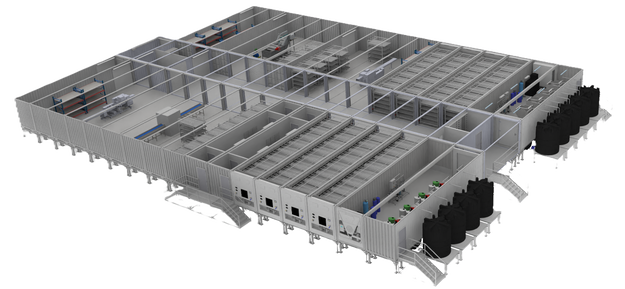 © Fischer Farms
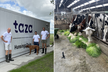
The Fischer Farms Technology Plant Factory, which enables modular vertical farming to scale through integrated, containerised growing systems.
A call for collaboration and benchmarking
Fischer advocates for more cooperation across the sector, citing the post-Freight Farms disruption as an example of why proprietary ecosystems are risky. He points to the North Sea oil and gas industry as inspiration. "All the companies put their data into an anonymised system and receive daily reports comparing their wells," he says. "You cannot see who is who, but you can see that someone else is achieving better performance. That forces improvement."
He believes vertical farming needs similar benchmarking in areas like grams per square meter per day, electrical consumption, water use and waste. "It would make things more realistic for everybody. There are questions about data protection, but those questions have been solved in other industries."
Changing the course of competitiveness
For Fischer, competitiveness will eventually hinge on who can make production affordable rather than who can craft a premium brand. "Vertical farming is a better product than field-grown. It tastes better, and it is better for the environment," he says. "But if it stays a luxury item, the market will always be small."
He envisions a sector where equipment costs fall through repetition, scale and engineering discipline. "The more we do, the more economies of scale we have. Costs fall, new markets open, and costs fall again. That is the journey."
For more information:
Fischer Farms
Tristan Fischer, Founder and Group CEO 
[email protected]
www.fischerfarms.co.uk