
When Verte Tower entered the UNICEF StartUp Lab, the Ghana-based agritech company already had a working solution but needed clarity on the way forward. Six months later, the team says the accelerator helped them refine how their solar-powered vertical growing systems fit into real food systems, and where their technology creates the most value.
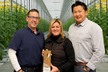
Their selection into the Lab came at a pivotal moment. "We had a working solution but needed stronger market validation, clearer impact metrics, and a more scalable business model. The Lab provided an opportunity to rigorously test our assumptions while aligning our work with broader development and sustainability goals." © Verte Tower
Georgina Boamah, Co-Founder and CEO
From local realities to outcome-driven design
"We design for real conditions, not controlled environments," the team says. "High temperatures, inconsistent power supply, and limited access to specialised inputs have heavily influenced our thinking." As a result, systems prioritise heat tolerance, energy independence, durability, and ease of maintenance using locally available materials.
"With IoT, we can assess the interactions between environmental conditions, tower responses, and crop responses, which inform the setup of all subsequent towers. This data-backed local grounding is one of Verte Tower's strongest differentiators."
Before the accelerator, Verte Tower described itself primarily through its technology. That changed during the program. "After the Lab, our narrative shifted to outcomes and use cases," the team says. "We now lead with the problems we solve, such as reliable access to fresh vegetables, reduced dependency on long supply chains, and practical climate resilience for institutions and communities."
"We are clearer about who our systems are for, what success looks like for each customer segment, and how Verte Tower fits into existing food systems rather than replacing them."
Validating users and refining assumptions
One of the most consequential insights from the StartUp Lab was about adoption. While household interest exists, the company learned that institutions are currently the strongest entry point. "The Lab confirmed strong demand from schools, training centres, and community organisations that want educational, productive food-growing systems that are visible." Solar power, they add, "is a practical necessity in areas with unreliable grid power."
At the same time, some early assumptions were adjusted. "Upfront cost, maintenance confidence, and space constraints make institutions and organised groups more viable early adopters than single households." This insight led to changes in both product design and go-to-market strategy.
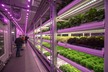
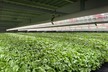
In practical terms, a typical installation consists of compact, modular systems. "Each tower can grow up to 30 plants and occupies a footprint of around one square metre," the team says. "Some systems are configured to be both solar-powered and grid-compatible depending on user needs." 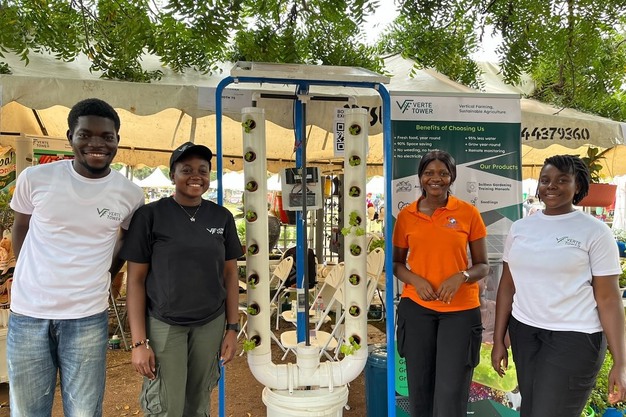 © Verte Tower
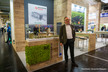
The team at the 2025 Ghana Garden and Flower Show
From selling towers to enabling growers
The accelerator also prompted a rethink of Verte Tower's business model. "It helped us move from a single-product mindset to a portfolio approach," the team says. "While selling towers remains part of the model, it is no longer the only focus. We now equally prioritise partnerships, pilot installations, training programs, and demonstration sites."
Rather than positioning itself as a food producer, the company sees its role as an enabler instead. "We focus on equipping institutions and organised groups with the tools and knowledge to grow food themselves," they say, "but we continue to explore structured collaborations with smallholder growers and aggregators."
Defining impact in measurable terms
Food security and community impact remain central to Verte Tower's mission, but the way they define impact has become more concrete. "Impact is no longer an abstract concept for us. We now measure it through metrics such as the quantity of vegetables produced per installation, reduction in food procurement costs for institutions, number of people trained, and the reliability of year-round production."
They also track secondary indicators, including improved nutrition access, educational value for students, and reduced dependence on long-distance food transport. "These indicators allow us to demonstrate tangible benefits rather than broad claims." © Verte Tower
A pragmatic approach to technology
"Our technology focus is on efficient system design, solar integration, and base-level automation," they say. "We have already integrated IoT for remote monitoring and control, providing real-time data to optimise grow protocols and improve tower design," the team says.
"We are now combining this monitoring with AI-driven recommendations, which we plan to deploy more widely as adoption grows," they add. "Technology should support farmers and institutions, not create barriers to adoption."
Scaling through partnerships, not volume alone
"Over the next 12 months, scaling impact means increasing the number of functional installations, particularly in urban communities and in schools," they say, alongside standardising system design and training materials.
"We are actively pursuing collaborations with educational institutions, government agencies, NGOs, and private-sector partners such as UNICEF and the Fisheries Commission," the team says. "We are also open to strategic manufacturing, distribution, and financing partnerships that can help reduce costs and accelerate deployment at scale."
For more information:
Verte Tower 
Rafia Kanyity Imoro-Kipo, Marketing
+233 245 992 385
[email protected]
www.vertetower.com