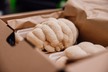


A mushroom long prized in Southwest China, but feared for its potential toxicity, is being grown safely and at scale, marking a breakthrough for both food safety and rural incomes. The lurid bolete, known locally in Yunnan as jianshouqing, is a boletus mushroom that is famous for turning blue when bruised and oxidized. While some varieties are edible, others are toxic, making accidental poisoning a recurring concern during wild mushroom season.
Researchers at the Kunming Edible Fungi Research Institute have successfully cultivated a non-toxic variety, offering consumers a safer alternative to foraged mushrooms. The edible strain, Buchwaldoboletus xylophilus, has been verified as nontoxic by Ningbo Customs, an independent testing authority in this field, according to Zhang Junbo, an associate research fellow at the institute, which is part of All China Federation of Supply and Marketing Cooperatives.
"Jianshouqing is a general term for several boletus mushrooms in Yunnan," Zhang said. "Some are edible, some conditionally edible, and some poisonous. The variety we have selected and cultivated is confirmed to be safe."
Beyond safety, Zhang said the cultivated mushroom closely matches its wild counterpart in nutritional value, taste and aroma, a key factor in winning over consumers accustomed to the wild variety.
Read more at InKunming