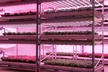


The AVF Asia Forum will take place from March 9-11, 2026, at Christ University in Bangalore, India, bringing together stakeholders across controlled environment agriculture, medicinal plant science, and regulated supply chains. Organised by the Association for Vertical Farming in collaboration with Christ University and regional partners, the conference is centred on "Elevating the Value of Medicinal & Herbal Plants through Controlled Environment Agriculture."
Dharmendra Rai, Country Director of AVF India, says the event is designed to examine how CEA systems can support the domestic and global markets for medicinal and aromatic plants. "This conference will be done in a proper, systematic manner," Rai says. "When we bring international scientists, industry, and policymakers together, it is important that everything is aligned correctly so the outcomes are meaningful."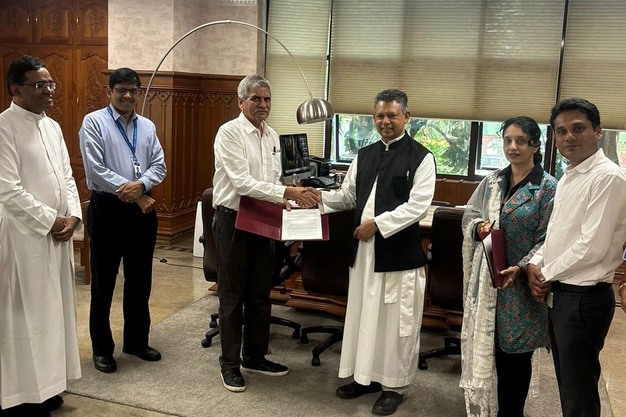 © Christine Zimmermann-Loessl on LinkedIn
Dharmendra Rai (centre left) shaking hands with Rev. Dr. Fr. Joseph C. C. (centre right), the Vice Chancellor of Christ University, after signing the MoU last year to advance vertical farming education in India
From cultivation to compliance
A central focus of the forum is aligning medicinal plant cultivation with internationally recognised frameworks, including Good Agricultural and Collection Practices, Good Manufacturing Practices, EU Pharmacopoeia standards, and World Health Organization guidelines.
"Medicinal plants are not just crops," Rai says. "They are part of regulated value chains. Quality, consistency, traceability, and compliance are essential if these plants are going into pharmaceuticals, nutraceuticals, or export markets." Rather than emphasising yield alone, the forum positions controlled environment agriculture as infrastructure for precision-driven, food-safe, and compliance-ready production.
Medicinal plants as a CEA use case
India's role as host reflects its position as one of the world's richest reservoirs of medicinal plant biodiversity. According to Rai, India has approximately 7,960 medicinal plant species, yet formal research and development has been conducted on fewer than 700 of them. "There is enormous untapped potential," he says. "This conference is only the beginning. Our longer-term vision is to establish a full research and development centre at Christ University focused on medicinal plants under controlled environments."
In this context, CEA is presented as a complementary production pathway for crops destined for domestic and international markets, particularly where climate variability, contamination risk, and inconsistent biochemical expression pose challenges in open-field systems. © Association for Vertical Farming (AVF)
A research-focused forum
The forum is structured around a formal research and knowledge-exchange framework, including paper submissions, defined thematic tracks, and an applied R&D orientation. Topics span plant physiology and phytochemical optimisation under controlled conditions, the use of sensors, AI, and photonics in medicinal crop production, and quality assurance and certification systems designed to support traceable, export-ready supply chains.
Alongside research presentations, the programme emphasizes translating findings into practice, linking cultivation systems with pharmaceutical and herbal supply chains, and exploring investment and scaling pathways for medicinal plant production under controlled environments.
Programme overview
The three-day programme is designed to move from foundation to application. The opening day focuses on integrating traditional medicinal knowledge with modern cultivation systems, combining keynote perspectives with technical sessions and hands-on design workshops. The second day shifts toward technology, certification, and markets, addressing monitoring tools, compliance requirements, and the commercial pathways needed to scale medicinal plant production sustainably.
The final day is dedicated to synthesis and application, with plenary discussions on next steps followed by a field visit to a local facility focused on medicinal and aromatic plants, linking research discussions with operational environments.
Building a recurring regional platform
The AVF Asia Forum is intended to become an annual platform, with future editions expanding research collaboration and industry participation across Asia and Europe.
Rai says that they are actively seeking strategic global partners. "This is a platform where collaboration between science, industry, and policy really matters."
For more information:
AVF Asia Forum 2026 
Dharmendra Rai, Country Director
[email protected]
www.avf-asiaforum.org