


In Barangay Abut, San Fernando City, farming has always meant soil, sunlight, and properly timing the seasons.
Today, inside a modest greenhouse, crops grow differently. Their roots do not dig into the earth. Instead, they hang in nutrient solutions sustained by routine.
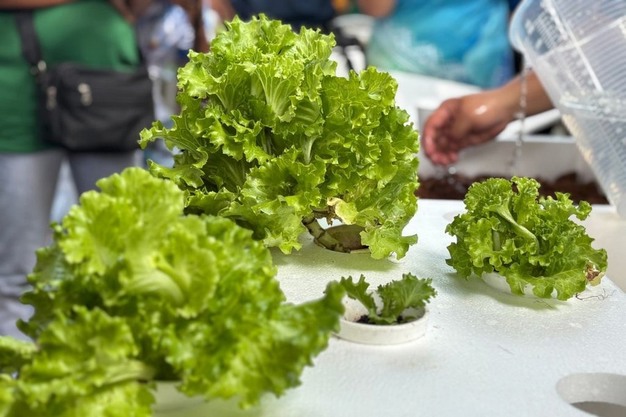
Rows of lettuce now grow without mud or plowing. Precision replaces traditional methods. Water levels must be exact, nutrients must be balanced, and monitoring must be constant. It looks simple, but it demands discipline.
On Feb. 18, 2026, residents gathered for a seminar organized by the Rotary District 3790, in partnership with the Department of Agriculture (DA).
The goal was to present hydroponics as a workable livelihood option grounded in practical application.
When farming becomes a formula
Hydroponics replaces soil with controlled inputs. Plants rely entirely on dissolved minerals. Too much nutrient solution can damage roots, while too little can slow growth. Because light and temperature still determine productivity, water levels must be checked consistently.
Participants were introduced to the Kratky method, a passive system not requiring continuous electricity.
For a community conscious of expenses, this approach makes hydroponics more accessible. Lettuce was selected as the primary crop due to its short growth cycle and steady market demand.
Testing before expansion
Barangay Abut did not begin with construction. According to Lauro Laudencia, president of the Rotary Community Corps, residents first conducted small-scale trials.
"Now that they have fully introduced hydroponics here, there is already a 100 percent acceptability," Laudencia said.
Danilo Philip Torres, district governor of Rotary District 3790, explained that hydroponics is part of the district's efforts to introduce alternative livelihood models.
Barangay Abut was selected due to its active volunteers capable of sustaining the project.
"This hydroponics is one of the special projects of the Rotary District 3790. This was intended to help the community and teach them a new way of livelihood," he said.
 © Philippine Information Agency
Infrastructure and responsibility
Following the seminar, Kratky kits were distributed to begin small-scale production.
The Rotary Club of San Fernando La Union Inc. constructed a 30-by-40-foot greenhouse dedicated to lettuce production, with around 30 members participating.
Water drums were provided for storage, while the DA committed to technical support.
While the physical structure now stands, success depends on daily management. A lapse in checking water levels can affect an entire batch.
A gradual shift
The hydroponics initiative in Barangay Abut remains in its early stages. Members are adjusting to a method where consistency matters more than enthusiasm.
The project does not replace traditional farming but rather adds another approach to food production where land and climate are uncertain.
For Barangay Abut, farming has not left the ground entirely. It has simply found another way to rise.
Source: Philippine Information Agency