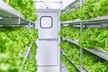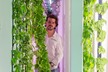


Fischer Farms' modular growing system is now operational in Abu Dhabi, marking the company's first active deployment outside the United Kingdom. The unit is producing short-cycle leafy greens and herbs while serving as a working reference site for growers, partners and prospective customers visiting from across the region.
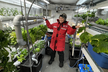
Founder Tristan Fischer says the Abu Dhabi deployment reflects a practical phase in the company's evolution, moving from design and iteration into real-world operation under different climatic, energy and market conditions. "This is not a pilot that sits idle," Fischer says. "We are growing, and we are doing it using the same equipment our customers would use."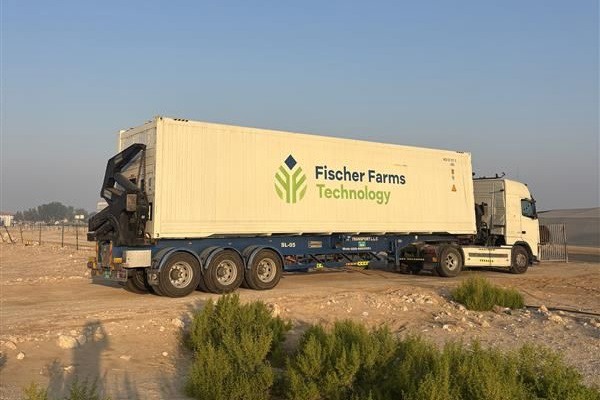 © Fischer Farms
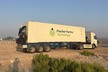
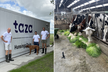
The pilot farm arrives in Abu Dhabi after being shipped from the UK
Integration with established greenhouse controls
One of the defining features of the pilot farm is its integration into existing greenhouse control ecosystems. Fischer Farms' system is compatible with mainstream climate-controlled operating and farm management systems, allowing growers to view vertical modules alongside traditional glasshouse bays within the same control interface.
"If you are already running an established greenhouse control platform, our module appears as just another bay," Fischer says. "You can see temperature, irrigation and nutrient control in one place." The platform also allows the integration of third-party monitoring equipment, including additional environmental sensors and crop-monitoring tools, depending on grower requirements. This approach reflects Fischer Farms' intention to operate as part of existing agricultural infrastructure rather than as a standalone or closed system.
Operating under Gulf climate conditions
Deploying in the UAE has placed new emphasis on thermal management. While the first unit is housed within an existing structure, Fischer says the system has been designed with outdoor operation in mind, including extreme summer temperatures. "The challenge is not just cooling, but reducing heat load before it enters the system."
Several strategies are under evaluation, including shading through elevated solar panels, net-house structures that can reduce ambient temperatures by approximately ten degrees Celsius, and additional insulation layers applied to the container exterior.
In parallel, Fischer Farms is also working on projects that deploy its internal growing modules inside existing cooled buildings, without containers, to simplify installation and reduce thermal stress in certain environments.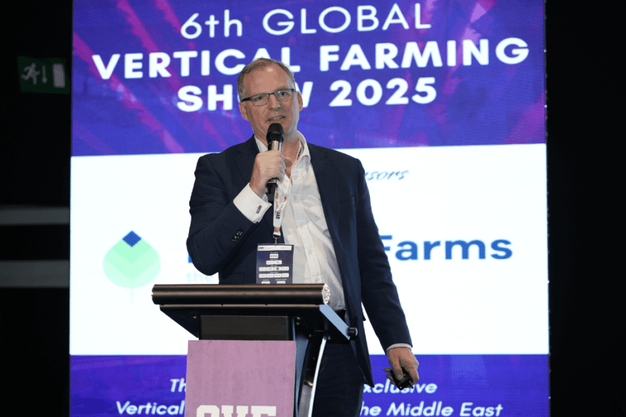 © Fischer Farms
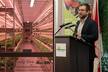
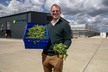
Tristan Fischer speaking at the Global Vertical Farming Show 2025 in Dubai
Substrate performance and supply-chain resilience
Substrate selection remains crop-specific. The company has trialled a range of growing media, including perlite, rockwool, polyurethane matrices, gels and substrate-free approaches for crops such as pea shoots. "One substrate does not work for everything," Fischer says. "The same seed in the same environment can behave very differently depending on the medium."
The company intentionally avoided coco coir from the outset due to concerns around long-term supply security. "If your entire system depends on something you know will become constrained, you are building a future problem into your operation," Fischer says. This approach has allowed Fischer Farms to maintain flexibility as global substrate markets fluctuate.
Working within an existing agricultural operation
The Abu Dhabi system operates on land managed by Alfafa, a long-established agricultural producer growing crops ranging from eggplant and okra to sesame. "They wanted to see it growing and see it working," Fischer says. "That was the starting point."
Operating within an established farm environment has allowed Fischer Farms to integrate into existing logistics, distribution and market channels, rather than operating as an isolated facility. "The important thing now is that people can see it running," Fischer says. "That changes the conversation."
Why the UAE matters
Electricity pricing is one factor behind the UAE deployment, but Fischer emphasises that accessibility and visibility are equally important. "People fly into Abu Dhabi and Dubai from all over the world," he says. "They can visit the site, see how it performs, and understand what it actually does in practice."
The location allows Fischer Farms to demonstrate operational performance under commercial conditions, rather than relying on specifications or simulations. Over time, Fischer expects equipment manufacturing to become increasingly regionalised, with production located closer to end markets. "Equipment should ultimately be built where it is used."
For more information:
Fischer Farms
Tristan Fischer, Founder and Group CEO
[email protected]
www.fischerfarms.co.uk