

In the Netherlands, inorganic substrate has long been the standard in greenhouse vegetable production. That is changing. An estimated half of the country's pepper acreage is now grown on organic substrate, according to Jacco Hoogendoorn, business developer at Legro and Botanicoir. With the introduction of Botanicoir's coco substrates to the Dutch market, the company is responding to a shift that has been visible internationally for some time.
 © Legro
Shift to organic substrate
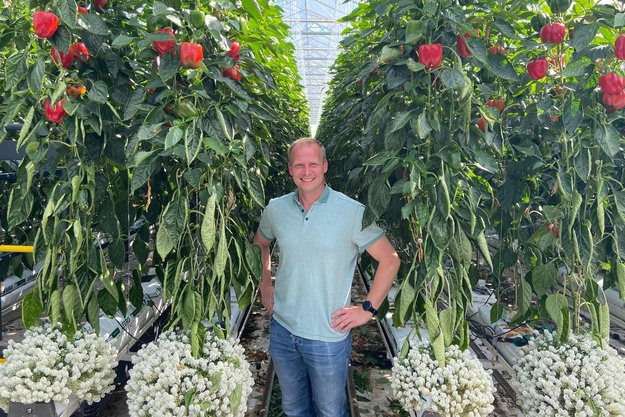
The move to organic substrates has become a widely discussed topic in the sector. Over the past two to three years, a wilt disease emerged in pepper cultivation in the Netherlands. "You would see greenhouses that looked perfectly healthy, and within two weeks plants were dying," says Jacco. "In practice, those problems occurred less frequently on organic substrates. That got growers thinking."
He is careful not to point to a single cause. "It's not just down to the traditional substrate standard. It's a combination of factors. But the result is that growers have started looking more broadly at their substrate strategy."
That reassessment has set the market in motion. "The Netherlands has been doing things the same way for fifty years," says Jacco. "That is now changing. Of the approximately 1,660 hectares of pepper cultivation in the Netherlands, roughly half is now on organic substrate. That has happened very quickly, within two years." The trend has also been visible internationally.
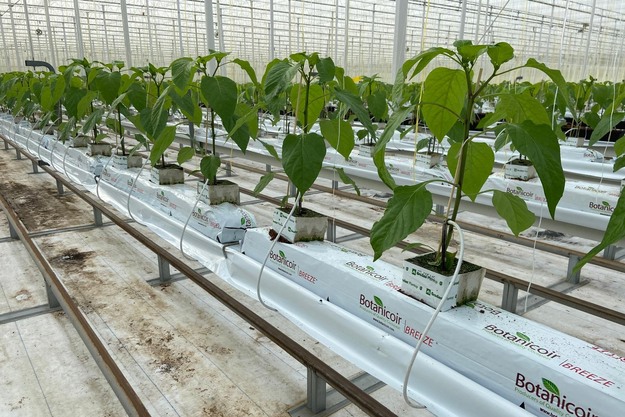
Botanicoir, a British-Sri Lankan supplier headquartered in London and 50% owned by Dutch company Legro since 2020, has begun supplying its coco substrates to the Dutch market. "Our coco substrates have been widely used internationally. Now the opportunity has also arisen in the Netherlands to position Botanicoir more strongly in vegetable growing."
 © Legro
Different water strategy, same fertilization
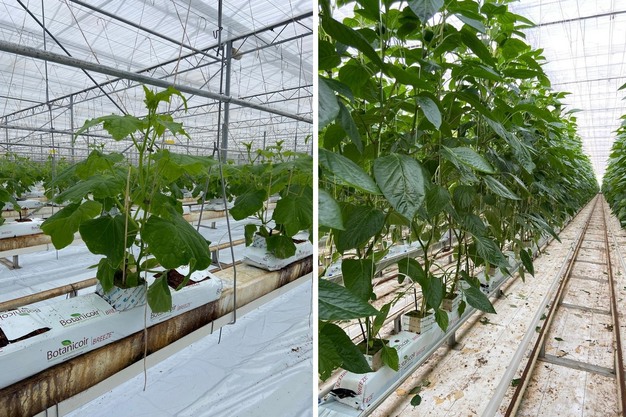
According to Jacco, growers do not need to sacrifice yield when switching to coco. "Crop output is not lower compared to inorganic substrate," he says. "What changes is mainly the way you irrigate." Coco substrate with coco chips is naturally airy. Moisture levels drop relatively quickly, but the substrate can be re-saturated easily. In practice, this translates to shorter, more frequent irrigation cycles. "Growers need to manage water somewhat differently. The total water volume can remain the same, but in practice you tend to add an extra irrigation run more frequently on coco. As a result, fertilisation ratios stay intact."
More possibilities with soil life
One of the key advantages of organic substrates lies in the possibilities for beneficial soil biology. "On coco, you can do much more with biostimulants and beneficial micro-organisms," says Jacco. "Think of mycorrhizal fungi, Trichoderma species, or beneficial bacteria. These attach more effectively to organic material."
In inorganic substrates, such biology can be introduced, but only later in the growing cycle. "It is only once root residues have built up in the slab that some attachment occurs. But if you want to actively build a population, organic substrate simply gives you a better starting position."
This aligns with the broader move toward more resilient growing. "As chemical crop protection products are phased out, growers need alternative strategies to keep their crops healthy. It helps if your substrate supports that approach."
The trend is not limited to peppers. "In tomatoes you see it too, particularly among growers targeting flavour and premium market segments. They indicate that organic substrate enables them to grow a more distinctive product. In mainstream production the need is less immediate, because current growing methods still offer good control options. But interest is growing."
 © Legro
Recycling and reuse
Alongside crop production, circularity is playing an increasingly prominent role. "Together with RHP and chain partners, we are looking at recycling and upcycling spent coco substrates," says Jacco. "Think of reuse as a raw material for retail products or as a component in professional growing mixes over the longer term." Interest from the supply chain in upgrading these residual streams is growing. "That offers perspective: the residual material retains value."
Responding to future raw material demand
Botanicoir has been active in coco for the greenhouse sector for over twenty years and continues to expand capacity. Production capacity has been increased, and two new production sites in India have been opened alongside additional drying capacity.
Jacco sees this as part of a broader market development. "In the coming decades, we will need all available and sustainable raw materials. We see the shift to coco in peppers, but there are other movements as well." He points to peat-free growing as one example. "That started in the United Kingdom, but we are hearing it more and more from Germany now. In the Netherlands it is less prominent, but we want to respond to that with Legro's product lines such as Greenline and Futuro, both in horticulture and, for example, in tree nurseries."
The shift toward organic substrates is not a short-term trend, but part of a broader development in the sector. As Jacco puts it: "Growers are looking for ways to make their cultivation more resilient, more sustainable, and more future-proof. For many businesses, coco is a logical step in that direction."
For more information:
Jacco Hoogendoorn
Legro Group
[email protected]
www.legrogroup.com