

Rooted Robotics attended Indoor AgCon in February 2026 with updated versions of its three core machines and a newly developed NFT channel cleaner, now in use with an early customer. The Boulder, Colorado-based company makes automation equipment for microgreens and controlled environment agriculture operations, developing machines accessible to small and medium-sized farms while also building more robust systems designed for large-scale throughput.
Eric Roth, Co-Founder and COO, says the updates were shaped by feedback from the company's early customers. "They help us identify the early failure points in the machine," Roth says. "Now they're built much more durably and will have a longer life before needing service."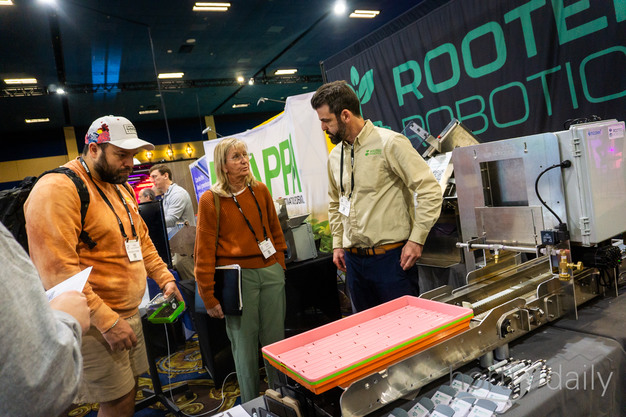 © Arlette Sijmonsma | VerticalFarmDaily.com
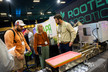
Eric Roth at Indoor Ag-Con 2026
Three machines updated
The tray washer now includes an air knife on both the top and bottom of the exit to remove water and sanitizer applied on both sides, and two spinning pressure-washer bars in place of the previous static configuration.
The harvester has gained automatic blade height adjustment with saved settings and air-assisted product removal from the separator plate into the harvesting bin. The seeder has been redesigned with an open-end conveyor so trays can be unloaded from the end, removing the motor housing that previously occupied that position.
Both the seeder and harvester now support configuration through a web app, offering a more intuitive interface for adjusting machine settings, including the ability to save and recall presets. Operators can still use the onboard HMI, but the web app provides a simpler experience for day-to-day setup. The web app will ship standard with all future machines.
"We also updated all the drive systems," Roth says. "Our biggest customer is doing 40,000 trays per week, which is a huge number, probably the largest farm of its kind. They help us identify where things fail first." A harvester that supports wider trays was due to ship to a farm in Dubai shortly after the show. Roth also confirmed that a grower he met on the final day of Indoor AgCon, who is opening a farm in Canada, intends to purchase all three machines.
NFT channel cleaner enters field testing
Beyond the core product line, Rooted Robotics has completed its first NFT channel-cleaning machine, now in use by a customer in Canada. The unit moves channels through mechanical brushing, recirculating high-flow rinse water, soap application, high-pressure rinse, an air knife, and sanitizer misting. It was built around a format specific to that customer's channels, which included protruding hooks that added engineering complexity. Future versions will not have that constraint.
Roth says the greenhouse NFT market is a larger opportunity than microgreens tray washing. "A lot of these systems use heat, a lot of them use chemical injection," he says. "There needs to be a more accessible option. Maybe just pressure washing out the gunk and sanitizing it. Food safety requirements vary widely across operations, with greenhouse growers often having different standards than indoor microgreens farms. As long as you're removing the spent media and hitting it with sanitizer, a lot of growers are ready to move on to the next cycle."
Production planning software in beta
Roth also walked through a farm production planning application, which has already generated significant interest from growers. The tool lets operators design farm layouts, manage crop varieties and yield parameters, build SKUs, generate orders by weight or tray count, and schedule seeding days against harvest targets. A customer-facing storefront for chefs and produce managers is also in development.
"There needs to be a full ecosystem of tools to get people to work on the business and not in the business," Roth says. "They need to be selling. That's what's hard and not sexy about farming. It's sales. It's the most important part. It's the most overlooked part."
While other platforms offer similar farm management functionality, Rooted Robotics aims to differentiate by integrating the software directly with its machines. The storefront is designed around how buyers actually operate. "Chefs and produce managers are used to being on their phone or on a tablet, scrolling through and seeing what's available and hitting order. Small farms don't have the digital infrastructure to do that."
Seed distribution and labor consistency
The seeder has been on the market the longest of the three machines, and customer feedback has focused on yield improvements enabled by even seed distribution. "We have one customer posting on Instagram every couple of weeks about how even the seed distribution is and how that's having a great effect on their yield," Roth says. "That's the single most controllable factor when it comes to your final yield."
Staffing is the other dimension. "Typically, at a farm, you'll have the superstar seeder that is just so good at it, nobody can do it as well as them. Until one day they're not there, and two weeks later you have really bad yields," Roth says. "A seeding machine will be as effective with somebody operating it on their first day as on their 10,000th day."
"Labor is your biggest cost for every single farm, other than the super highly automated ones," he says. "The training process becomes a lot easier, the consistency of the farm goes up, and the yields remain as steady as possible, so you're not wasting and you're not shorting orders."
Pricing transparency and rental programs
Rooted Robotics lists machine prices on its website, a practice Roth says is uncommon among automation suppliers. "A lot of these people are seeking grants and funding, and they just want to figure out how much they need. They don't even have to talk to me in that case. Then they come to me when they say, 'Hey, I got funding, I know the cost of your machine.' It saves everybody's time."
The company is also developing a rental program aimed at smaller growers who want access to equipment without a full purchase. "We want to put our money where our mouth is when we say we support small and medium-sized growers," Roth says. "A lot of companies talk about that. They're not really doing anything about it."
Roth pointed to a recent job as an example of the company's position relative to traditional automation suppliers. A customer running a competitor's conveyor had been paying around $3,000 per cutting head for replacements. Rooted Robotics replaced the full harvesting unit for a very competitive cost, with blade replacements now priced at $100. "There are some of the biggest vertical farming companies in the US that are tired of working with the dominant players," Roth says. "They're tired of very expensive, overly complicated systems with proprietary replacement parts. Being sucked into an ecosystem and trapped within it."
Industry standardization
Roth says tray size standardization comes up repeatedly in sales conversations. Growers who build farms around non-standard tray formats often face higher costs and fewer automation options when they try to scale. "I'd rather just convince you to go with an industry standard that thousands of farms use," he says. "So as new automation comes about, you can integrate it into your system. Often it's too late. You make these infrastructural decisions about your farm and your tray size, and now if you change it, you have a big gap in your flood tray, that kind of thing."
Roth has been in the industry since 2011, when he started his first farm. He says grounding new entrants in operational reality is a significant part of his sales process. "Every day more people come in, every day there's a new local news segment, pink lights in the distance," he says. "And they're working with the same information people heard in 2009. There's no clear answer for why this isn't working, or what they should be thinking about on day one."
"Growing is easy," Roth says. "It's the easiest part of running a farm. Managing people, selling product, food safety, keeping the place running, keeping your inventory where it needs to be: that's the hard part. The plants do what you expect them to do if you have the environment where it needs to be. Once you dial it in, it's clockwork."
For more information: 
Rooted Robotics
Eric Roth, Co-Founder and COO
[email protected]
www.rootedrobotics.com