

Founded in 2020 by chemist Aidan Brierley and electronic engineer Greg Short, Newcastle-based Fyto began by growing herbs and vegetables at Hoults Yard in Byker, supplying local restaurants and building modular growing systems for others to use.
That chapter has since closed. After shutting down the grow room, Fyto pivoted entirely toward research and development, repositioning as a technical engineering partner for organisations working at the intersection of agriculture, biotechnology, and sustainability.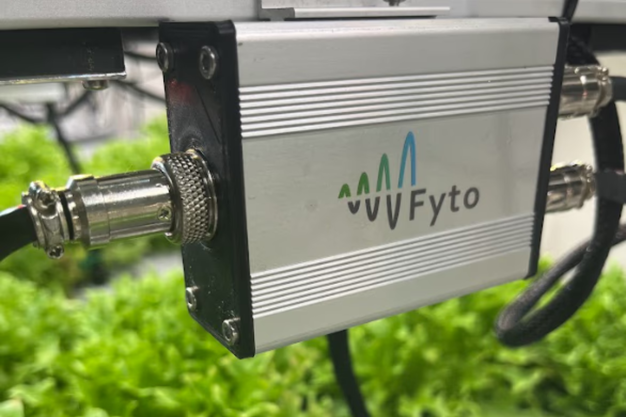 © Fyto
Reading the market
As the vertical farming sector ran into structural difficulties globally, Fyto was paying close attention. Across the UK and internationally, a succession of high-profile operators entered administration, filed for bankruptcy, or dramatically scaled back. "Just a few years ago, hydroponic vertical farming was heralded as the future of food," the company said. "Billions poured in. Headlines promised that stacked lettuce and herbs under LEDs would feed the world. Yet the market reality hasn't matched the hype."
For Fyto, the reckoning was also personal. "At Fyto, we've been close observers of this shift. In fact, it has paralleled our own journey, moving away from pure CEA and into broader nature-tech R&D support."
A new direction
Marking its fifth anniversary last year, Fyto described the evolution plainly: "What started as a controlled growing business has evolved and pivoted into a mission-driven company dedicated to enabling and supporting those who are pushing the boundaries of sustainable R&D."
Today, the company describes its mission as accelerating sustainable R&D, helping researchers, startups, and innovation teams solve complex technical problems. It specialises in hardware challenges, including sensor integration, custom imaging setups for AI training, and first-run prototypes of IoT devices. In-house capabilities span the full development lifecycle, from 3D printing and PCB design through to assembly, testing, and performance evaluation.
Critically, Fyto does not hold intellectual property. Its model is built around enabling the work of others in both commercial and academic settings. The company has positioned itself as a specialist delivery partner for grant-funded R&D, reporting a 62% Innovate UK win rate across its bids to date.
How they work
All engagements begin with four hours of free scoping work, which may include assessing existing hardware, selecting sensors, or mapping out a Technology Readiness Level assessment. From there, Fyto applies a "test early, test often" philosophy, validating the most critical system elements using low-cost components or rough prototypes before scaling up complexity or cost. "This inverted testing funnel gives our clients flexibility to pivot or refine the direction well into the process, without risking budget or timelines."
On sensor work specifically, the company is open about the rigour applied before deployment. "When it comes to environmental sensing, trust in your data is everything. Every reliable insight starts with reliable hardware, understood and calibrated."
Projects in the field
Fyto's project portfolio spans aquaculture, vertical farming, viticulture, and crop science. An Innovate UK-funded biofortification project with Newcastle University, conducted at the North East Advanced Grow Hub, deployed modular hydroponic systems, sensor-integrated lighting arrays, and custom nutrient control protocols across more than 40 trials. Results included doubling zinc and increasing magnesium content in leafy greens, alongside potassium-reduction protocols in kale and chard relevant to renal health diets. The project was recognised with a runner-up prize at the Great Yorkshire Show's GYS Innovation Award.
For a vertical farming client, Fyto delivered a low-cost, high-density sensor network enabling 80 simultaneous crop experiments, work that contributed to an independent tomato trial in which one microbial treatment boosted yield by 15.2%.
The company's ambitions extend beyond the UK. Brierley represented Fyto as part of the UK trade delegation to GreenTech 2025 in Amsterdam, describing the appearance as reflective of the success Fyto has had in the last two years, both technically and commercially.
For more information:
Fyto 
Aidan Brierley, Co-Founder
[email protected]
www.fyto.co.uk