

As biochar draws growing attention from controlled environment growers seeking alternatives to peat and stone wool, the American Biochar Institute (ABI) is positioning itself as the standards and guidance body that commercial operators will need to navigate sourcing decisions. The organization, which rebranded from the U.S. Biochar Initiative earlier this month, says its primary value for vertical farm and greenhouse operators is not in the supply chain itself, but in reducing the uncertainty that has slowed adoption.
"By positioning as an institution, we emphasize our function as a trusted, independent source of science-based information, technical guidance, and standards," said Myles Gray, Executive Director of ABI. "Our role is to reduce uncertainty in the market, helping operators make more informed sourcing decisions rather than altering how biochar is produced or distributed." © American Biochar Institute
Myles Gray, Executive Director, and Tera Lewandowski, Director of Agricultural Markets, say standards and product classification tools can help growers evaluate biochar more consistently
What the S668 standard means for sourcing
For growers evaluating biochar as a substrate component, the ANSI/ASABE/USBI S668 standard is the practical starting point. The standard does not define what constitutes good or bad biochar, but it does require that key properties, including pH, ash content, porosity, and contaminant levels, are measured using consistent, repeatable methods across different suppliers and laboratories.
Gray said that the standard gives operators a basis for comparison. "It allows growers to develop their own specifications for substrate performance and confidently compare products from different producers, even if they were tested at different laboratories. It reduces guesswork and makes sourcing decisions more data-driven."
Biochar that has not been tested under S668 is not automatically of poor quality, but it creates a different challenge. "Non-compliant biochar looks like incomplete, inconsistent, or non-comparable data," Gray said. "It may also signal variability in production or a lack of transparency, which increases risk for operators relying on consistent substrate performance."
Matching biochar to the substrate it replaces
On particle size, ABI does not prescribe a single specification for CEA use. Instead, Gray's guidance is to treat biochar as a functional substitute for an existing aggregate in the mix and match the particle size distribution to the material it is replacing, whether that is perlite, bark, or pumice.
"The goal is to maintain or improve key physical properties such as porosity, air-filled space, and water-holding capacity," Gray said. "Commercial suppliers are increasingly able to produce biochar in targeted size ranges, including screened and graded products suitable for horticultural use. However, consistency can vary, so growers need to request particle size data and, where possible, trial materials before committing."
Tera Lewandowski, Director of Agricultural Markets at ABI, added that biochar offers specific physical advantages in vertical farm systems. "Biochar can be a great fit for vertical farming because it is a lightweight substrate, ideal for racks that are not designed to hold heavier materials. It also has a high water-holding capacity and, when formulated with the right particle size, can provide plenty of airspace for healthy root growth." She described its compatibility with fertigation systems as a practical cost consideration: reduced nutrient runoff and improved nutrient use efficiency that could lower input costs over time.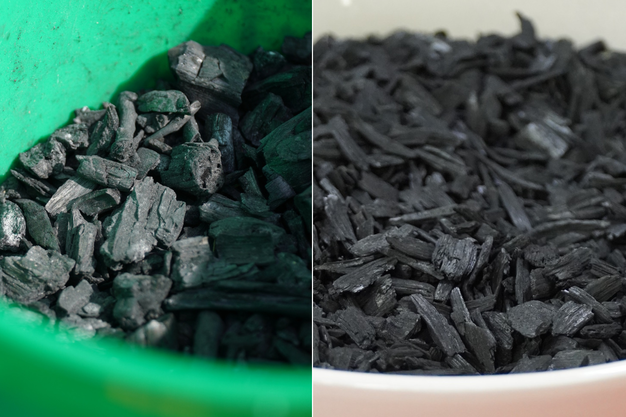 © American Biochar Institute
ABI says particle size should be matched to the substrate component biochar is replacing, with growers advised to request size data and trial materials before committing
Biochar Atlas to support product selection
ABI is also developing the Biochar Atlas, an online classification tool expected to launch later in 2026. The tool will allow users to input a biochar's physical and chemical properties and classify it across categories, including carbon storage potential, fertilizer value, liming capacity, and particle size. While the Atlas is oriented toward field agriculture, Lewandowski said CEA operators can use it to support sourcing decisions.
"By starting with a clear understanding of the intended function, such as improving structure, influencing pH, or contributing nutrients, users can identify biochars that align with those goals," Lewandowski said, "even if the guidance is not explicitly tailored to CEA systems."
CDR demand is building, not constricting, the supply chain
Some agricultural users have questioned whether large carbon dioxide removal agreements, such as Google's 200,000-ton biochar CDR purchase, or new production funding such as the EPA's nearly $15 million grant to the Tule River Tribe for a biochar plant in California's Central Valley, could divert supply away from horticultural markets. Gray rejected that view.
"Increased demand from carbon markets can actually improve availability for agricultural use," he said. "Greater production volumes, improved processing infrastructure, and more standardized products can all contribute to a more mature and competitive market, potentially putting downward pressure on prices over time."
Gray acknowledged that biochars optimized for carbon credit generation are not always the same as those developed for horticultural use, but said the broader effect of CDR-driven investment is likely to be a stronger supply chain with better availability and, in some cases, lower costs for growers. © American Biochar Institute
For more information:
American Biochar Institute 
Elza Vucane, Communications Support
[email protected]
www.biochar.org