

Jacob Pinkston's business, Pinky's Micros, started on a single shelf in an apartment kitchen. During the supply-chain chaos of 2021 he began growing microgreens for his family, noticed a gap in Nashville's restaurant scene, and decided to turn a hobby into a company.
The nickname "Pinky" dates to middle school; the "micros" arrived when chefs began asking for a reliable local source for microgreens after the pandemic disrupted national distributors. Now, Jacob and his team serve the greater Nashville area's bustling restaurant scene with high-quality greens and edible flowers.
So, how did he go from the kitchen shelf to a scalable enterprise?
The answer lies, in part, in dehumidification.
Jacob's first expansion was a 500-sq.-ft. garage. The room leaked summer air through every crack, and two bargain dehumidifiers ran nonstop without keeping up.
"When it was humid, it would be really humid inside because the dehumidifiers that we had at that time weren't really working well," he recalls. Trays damped off, LEDs dripped, and energy bills climbed while harvest weight fell.
 © Quest Climate
It was a start, but it was not an efficient business just yet.
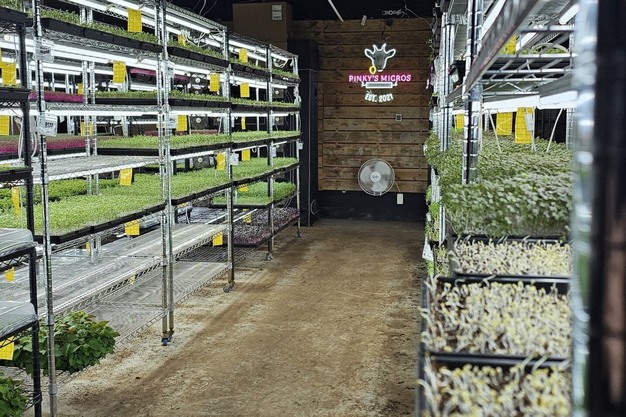
In 2023, Jacob found a vacant 3,000-sq.-ft. loft above retail shops just outside Nashville. Before a single tray moved in, he caulked block-wall gaps, insulated perimeter walls, and sealed a stairwell door. Then he installed three Quest dehumidifiers, each able to remove roughly eight to ten pints per hour at 75°F and 55% RH while running on standard 115-V circuits.
"The Quest ones were easy, plug and play," he says. After the switch, "it feels like you can breathe in here."
Today the loft holds thirty racks—about 400 to 500 soil trays of radish, pea, sunflower, and edible-flower starts under full-spectrum LEDs. Even with constant transpiration, RH floats between 55 and 60%.
The learning curve, Jacob says, was straightforward but non-negotiable: "One Quest wasn't enough. Then we needed two, and then we needed three." The trio now runs 24 hours a day within the manufacturer's recommended envelope; a thunderstorm-induced door opening only nudges RH a couple of points before the system recovers.
Low-grain-refrigerant coils allow each Quest unit to deliver more than six pints of water per kilowatt-hour—about 40% less energy than comparable models and vastly more efficient than the online imports Jacob retired.
 © Quest Climate
The coil-temperature stability also lets production run year-round.
"We control with our HVAC plus the dehumidifiers 365 days a year," he says. Crop losses tied to damp-off have disappeared, and edible flowers such as violas and dianthus, once plagued by lingering moisture, now bloom without mildew.
For more information:
Quest
www.questclimate.com