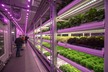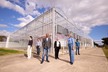

Take Root Bio Technologies (TRBT) is applying principles from space biosphere design to vertical farming, with a focus on modular systems that integrate community, resource efficiency, and land reuse. "We don't just build farms, we engineer modular biospheres," says Kirk Siderman-Wolter, the company's Director and Co-Founder. "These systems can be deployed on a rooftop in Birmingham, a derelict warehouse in Toronto, or one day, a Martian crater."
TRBT's model evolved in response to a European Space Agency (ESA) challenge exploring how to grow food in extreme off-world environments. Since then, the company has adapted its approach to Earth-based needs, particularly those facing post-industrial cities and climate-stressed communities. © Take Root Bio Technologies
Farming as ecosystem engineering
While many vertical farms emphasize yield per square meter, TRBT starts from a broader question: How do we build human-centered ecosystems that support plant, microbial, and social life in challenging conditions?
"The answer lies in closed-loop systems, which are climate-regulated units that recycle water and nutrients, use AI to optimize growing conditions, and operate with minimal external inputs," Siderman-Wolter says. At the center of this approach are TRBT's modular "bio-containers," which draw inspiration from space biosphere models but are built for real-world urban deployment. "The real innovation isn't just in the engineering," Siderman-Wolter explains. "It's in how these biospheres interact with people, place, and purpose."
Growing crops and communities
TRBT's model goes beyond technology. Drawing lessons from Biosphere 2 and ESA simulations, the company designs for more than just food production. "These modules are designed to support more than agriculture. They cultivate confidence, strengthen community ties, and build local capacity," Siderman-Wolter says.
In urban regeneration zones, the farms double as community assets: reconnecting people with nature, providing training in digital agriculture, and offering shared ownership models. Localized production helps to address food insecurity while simultaneously building green jobs in areas hit hardest by industrial decline. © Take Root Bio Technologies
From land reuse to local resilience
Unlike most vertical farms that occupy new warehouses, TRBT specializes in adaptive reuse, converting brownfield sites, disused rooftops, and abandoned industrial buildings into productive biosphere hubs. "Every underutilized space is a potential ecosystem," says Siderman-Wolter.
This approach supports the 15-minute city model and dramatically reduces food miles. According to Siderman-Wolter, each TRBT module can replace up to 20 times its footprint in conventional farmland, while also avoiding the embodied energy costs of new construction.
Education, AI, and future food stewards
TRBT's AI-driven training platform teaches operators how to monitor crops, troubleshoot issues, and simulate planting cycles using a digital twin. The tool is designed to adapt to local languages, climates, and cultural needs. "Just as space crews train to run biospheres, communities here should be empowered to manage their own food systems."
The company also supports school partnerships and apprenticeship programs to cultivate future farmers, educators, and technologists. In Siderman-Wolter's words, vertical farming isn't just infrastructure but rather, "a skill set for the future."
Local food security in a globalized world
Referencing a 2022 Nature Food study, Siderman-Wolter notes that Guyana is the only country in the world that currently produces enough of the right types of food to meet its own dietary guidance. "As climate pressures mount and imports grow less reliable, food security is becoming increasingly urgent across the UK and Europe," he says. "And that's where distributed, efficient, modular food systems come in."
TRBT's work with the UK Space Agency, ESA, and Canadian innovation partners highlights the crossover potential of these systems, designed for planetary exploration, but immediately relevant to Earth. "From Martian simulation labs to repurposed industrial sites in the UK, the core design requirements remain the same: to grow food efficiently, recycle resources, and foster human resilience."
For more information:
Take Root Bio Technologies
Kirk Siderman-Wolter, Co-Founder and Director
[email protected]
www.takeroot.bio