
Asmat Ullah Khan shared that he was incredibly inspired after his visit to The Institute of Urban Agriculture at the Chinese Academy of Agricultural Sciences in Chengdu, China.
He described the experience as profoundly educational, providing deep insights into the future of food production through vertical farming and hydroponics. Observing these technologies in practice gave him a strong and practical understanding of both their operations and their potential.
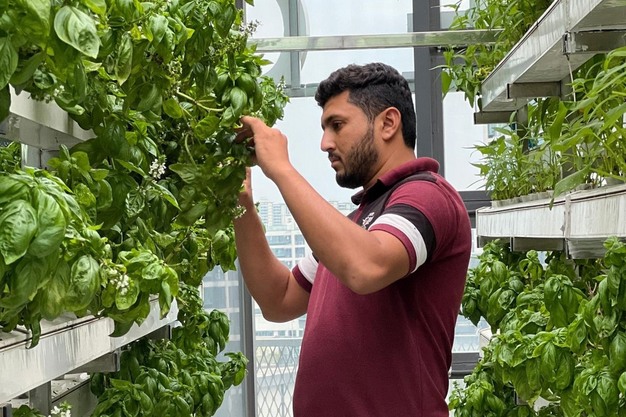 © Asmat Ullah Khan
During the visit, he noted how a variety of crops, from tomatoes and chilies to mushrooms and cabbages, were being cultivated efficiently in controlled, soil-free environments. For him, it was a powerful demonstration of how nutritious food can be produced anywhere, at any time.
Asmat emphasized several advantages that reinforce his view of this approach as the future of agriculture. Vertical farming maximizes space and reduces reliance on traditional farmland while also shortening the distance between farm and table. Hydroponic systems achieve remarkable water efficiency, using up to 90 percent less than conventional farming by recirculating nutrient-rich water directly to the roots. Controlled environments make it possible to produce reliable harvests year-round, independent of seasons and weather. In addition, the absence of soil virtually eliminates the need for herbicides, minimizes pesticide use, and leads to cleaner produce alongside healthier ecosystems.
The visit, he concluded, reinforced his belief that innovation in agri-tech is vital to building sustainable and resilient food systems for the world's rapidly growing urban populations.