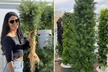


Lithuanian agtech company, Freya Cultivation Systems, has officially partnered with the German Aerospace Center (DLR) to co-develop advanced food production systems for use in space. The collaboration focuses on orbital and lunar missions aiming to overcome key limitations in earlier NASA-era aeroponics by applying Freya's proprietary ultrasonic irrigation technology.
"While NASA's early aeroponics work in the 1990s laid the foundation, the mechanical infrastructure, like pumps, filters, and nozzle clogging, remained a critical challenge," says Lukas Bartusevicius, CEO of Freya. "Together with DLR, we are now addressing these limitations using software-driven ultrasonic e-nozzles that produce mist without pressure, in any orientation."
Jess Bunchek, astrobotanist and PhD candidate at the DLR Institute of Space Systems, adds, "Resources are highly limited in space, so we're looking for innovative precision-irrigation methods to produce high-quality food with less water and power. DLR's partnership with Freya is working towards this goal, with the hope that our research outcomes will also improve how food is grown here on Earth." © Freya Cultivation Systems
Lukas Bartusevicius (left) and Jess Bunchek (right)
Engineered reliability, from greenhouses to orbit
While the collaboration opens a new frontier in off-planet agriculture, Freya's core technology is already in commercial use through its Aeroframe platform, which is designed to double cultivation area per square meter and reduce production costs by up to 60 percent.
At the core of the Aeroframe system is a clog-free ultrasonic irrigation platform powered by titanium e-nozzles. These nozzles use vibration, not pressure, to atomize nutrient solution into a finely tuned droplet size between 30 and 70 micrometers. That droplet range has been validated by Freya's team to encourage fine root hair development and maximize nutrient and oxygen uptake. Because the system has no tiny internal orifices and does not require filters or pumps, it eliminates the clogging risks that have historically plagued commercial aeroponics.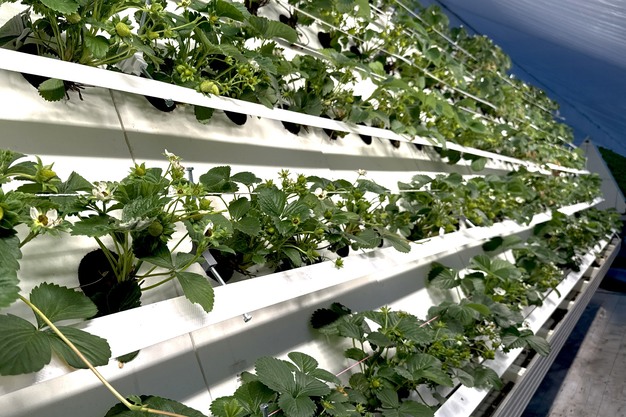 © Freya Cultivation Systems
  © Freya Cultivation Systems
Each irrigation unit carries 15 to 20 of these nozzles, all digitally monitored and connected. If one nozzle underperforms, the others are able to compensate in real time while the system notifies the operator. This level of redundancy and adaptability is critical in both orbital and terrestrial environments. "Each nozzle is a digital device, and the entire system is software-adaptive," explains Bartusevicius. "This is aerospace-level reliability applied to commercial growing."
The physical layout of the Aeroframe is a triangular A-frame structure that creates two square meters of canopy for every one square meter of greenhouse footprint. It is both modular and mobile, allowing growers to retrofit existing infrastructure or design new layouts with high space efficiency. The system is optimized for compact, high-value crops, including strawberries, leafy greens, and herbs, and eliminates the need for any single-use substrate such as peat, coco coir, or rockwool. © Freya Cultivation Systems
Measurable gains across crops
Freya's internal trials have shown quality gains across multiple crops. In strawberries, the system consistently reaches 12 BRIX, compared to the 8.1 value listed in the breeder datasheet for the Sonsation variety. Vitamin C concentration is measured at 74 milligrams per 100 grams, dry matter reaches 13.6 percent, and shelf life extends to between seven and eleven days. Annual yields are recorded between 20 and 28 kilograms per square meter in a low-tech greenhouse across different strawberry varieties.
Leafy greens grown in the system exhibit elevated polyphenol content, richer aroma, and better taste. Freya reports that production cost per kilogram of leafy greens can be reduced by up to 60 percent due to the elimination of substrate and doubled yield against fixed climate costs.
With U.S.-based trials, the system has also proven adaptable to cannabis, where U.S. growers report improved terpene expression and greater consistency across harvests, and to root crops including potatoes, onions, and saffron through a variant called Aerotable. This alternate structure accommodates crops with larger growth habits while maintaining the same uncloggable aeroponic logic.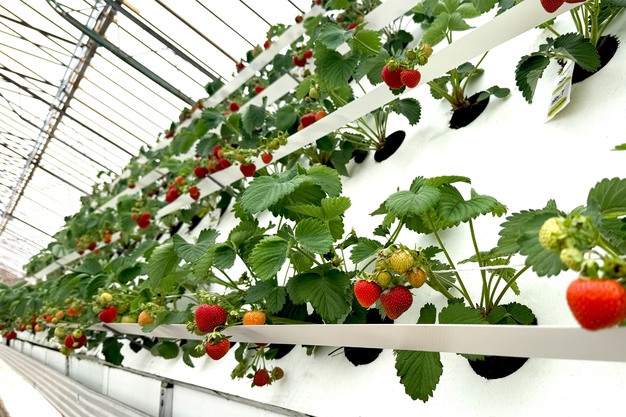 © Freya Cultivation Systems
East African pilots prove resilience under pressure
Freya's first major international deployment is currently underway in East Africa. In partnership with Canadian firm Boundless Haven Solutions (BHS), the company is installing systems in Nairobi, Kenya, and Djibouti. The collaboration builds on over two years of technical trials, including work on a World Bank-backed project focused on sustainable agriculture in resource-constrained environments. "These regions are ideally suited for high-efficiency growing systems," says Bartusevicius. "They deal with limited water, high energy costs, and very little arable land. Traditional aeroponic systems would struggle to perform there, but we built ours to be fail-safe."
Freya's irrigation controls are programmed with built-in redundancy protocols and low-power contingency settings. When power outages occur, the system automatically adjusts irrigation frequency to conserve resources until grid conditions stabilize. No filter changes are required, and maintenance downtime is virtually eliminated. According to BHS, early results in cherry tomato production demonstrate significant energy savings, faster crop cycles, and improved produce quality.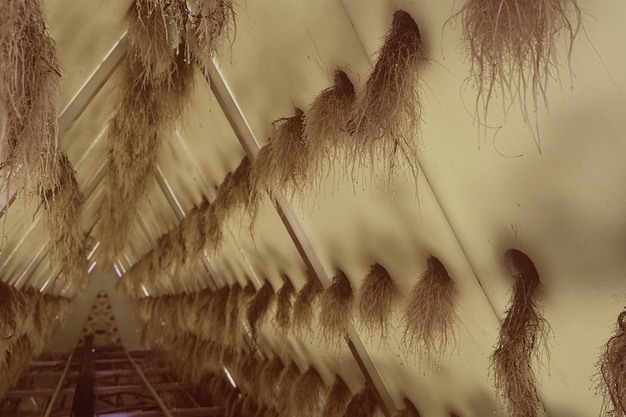 © Freya Cultivation Systems
Scalable, software-driven, and now space-driven
While the Aeroframe platform is designed for immediate commercial value, the lessons learned through Freya's collaboration with DLR are directly shaping the next generation of controlled environment agriculture. Space-grade engineering translates into real-world durability, software control, and multi-crop flexibility.
Freya is actively expanding its pilot network across Europe, Africa, and North America. The company will soon introduce an automated lettuce cultivation system that aims to deliver a 50 percent reduction in production cost per kilogram, alongside a dedicated U.S.-focused cannabis platform focused on batch-to-batch reproducibility. All of these systems are informed by the same design philosophy being tested in space: high precision, low failure tolerance, and minimal input waste.
"Space forces us to design with discipline," says Bartusevicius. "We want growers to benefit from that same mindset here on Earth. If it is reliable enough for orbit, it is built to last in any greenhouse."
For more information:
Freya Cultivation Systems 
Lukas Bartusevicius, CEO
[email protected]
www.freyacultivation.com