

Whether it's an aphid or a biological control insect, consumers find any kind of "bug" in their lettuce unappealing. Yet it now seems that consumers may need to get used to the idea, because the lettuce sector is struggling to keep aphids out of heads of lettuce. This urgent issue was the focus of a recent industry meeting, where growers, researchers, and retailers discussed how severe the problem has become. The topic has even made national headlines, following an earlier petition (link in Dutch) from the sector calling for action. So far, however, no clear solution has been found.
In an article in AD (link in Dutch), growers and researchers warn about an aphid plague in lettuce, one that consumers will soon notice as well. "It's a seriously underestimated problem," said grower Niels Zuurbier. And the issue extends far beyond the Netherlands. Lettuce is simply the first crop where the situation has become critical. Experts predict that Brussels sprouts, cauliflower, and broccoli will soon face similar pest pressures, making crop protection increasingly difficult.
Johan Kos, project leader at Vertify, criticized the current policy in his interview with the newspaper. "Ten years ago, aphids were barely an issue. Up until just over five years ago, we could still coat seeds with insecticide, which protected the plants for their entire life cycle," he explained. "Back then, we used the equivalent of just 50 grams of insecticide per hectare of vegetables."
That changed when neonicotinoids were banned in 2018 due to their risks for bees. "Since then, the amount of plant protection products used in vegetable production has gone up again to several kilos per hectare, to keep lettuce clean," Kos added. Ironically, this shift has had a negative environmental impact. And now, EU policymakers in Brussels are moving to ban even more crop protection products, further tightening the options available to growers.
Educating the consumer
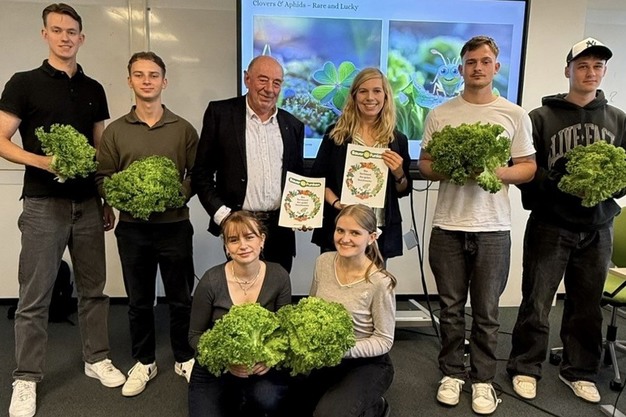
A group of students from Fontys University in Venlo is working with the German company Bauer Franken to address the consumer perception that aphids are disgusting.
"Growers want to produce organically," explained lecturer and researcher Henk van der Meulen, "but consumers still expect a perfectly clean head of lettuce, free of any insects or natural imperfections. Those expectations completely clash with each other."
Even lettuce treated with approved crop protection products is now affected by aphids, which makes the students' project particularly relevant.
The students point out that aphids have been part of lettuce crops for centuries. "We don't see it as a big deal—after all, you can simply wash your lettuce," they said. "Our goal is to make Bauer Franken's customers aware of this reality. We want to remove the sense of disgust people feel when they spot an aphid, while also helping growers promote their natural, chemical-free produce. Especially now that interest in natural foods is growing."
 © Fontys
Still, it remains to be seen whether consumers can truly be "re-educated." At the recent supply chain meeting in Zwaagdijk, supermarket representatives expressed little confidence. They regularly receive consumer complaints when aphids are found in packaged lettuce or even claims that, because of the insects, the product can no longer be called "vegan," as printed on the label.
For that reason, the sector continues to uphold a zero-tolerance policy on aphids in lettuce. On the one hand, because consumers, many of whom are well aware of the problem, still refuse to accept insects in their salad bags. On the other hand, regulations simply don't allow lettuce containing aphids to be sold in stores.
The regional newspaper De Gelderlander, part of the AD media group, weighed in on the debate with a public poll: "Better a louse than poison in my lettuce?" Readers can cast their vote on the paper's website, a telling sign of how divided opinions are, even when it comes to something as everyday as a head of lettuce.
Source: Fontys / AD (€) / De Gelderlander