

The NMU Food Pantry is on track to record its highest usage ever, topping the 2,000+ visits last year. Thanks to a collaboration with the controlled environment agriculture (CEA) program, there are now greens and herbs to expand the pantry's offerings in Gries Hall and at its satellite location in the Jacobetti Complex. Two CEA students are engaged in a service-learning initiative to grow the fresh, nutritious produce for their peers in hydroponic units funded through part of a $125,000 Swipe Out Hunger grant.
"When we were one of four colleges in Michigan to receive the competitive grant, there was a big focus on sustainability," said NMU Food Pantry Coordinator Michelle Jacob. "Shelf-stable goods came regularly from Feeding America shipments and local donors, but fresh produce was the missing piece. I approached Kari [Farkas-Lasich] from the CEA program about a collaboration. She was excited about the service learning potential and we made it happen. Food doesn't get more fresh than growing it on campus and transporting it a very short distance."
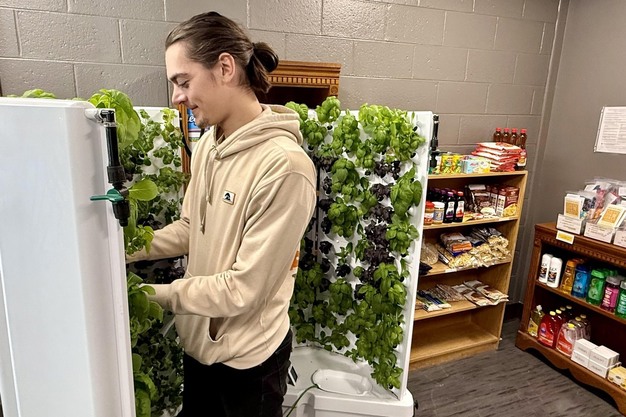 © Northern Michigan UniversityStudent Raymond Greimel attends to the greens growing in a hydroponic unit in the NMU Food Pantry satellite location in the Jacobetti Complex
Lehren Olk-Szost, an assistant professor in the CEA program, said this semester's project is staffed by students completing a directed study. It also serves as a pilot for a future service-learning course that might include partnerships with local farms using greenhouse and CEA techniques.
"The students are going from the learning unit, where they have a little more time to develop the skills for growing in these systems, to this type of full-scale work designed to grow as much food as they can in as little time as possible," Olk-Szost explained. "It really accelerates things and applies their skills in plant science and production into meaningful, real-world community service. Both students are excited to gain experience that will enhance their resumes and be helpful when they get onto a farm where that scenario is mirrored."
"It's really awesome to know that we're doing a positive thing by providing fresh and healthy options for those facing food insecurity," said student Raymond Greimel of Petoskey, who works alongside Lilly Brooks of Monroe on the directed study project. "Food pantries mainly have non-perishable items, so it's great that we're able to grow greens and herbs that are not shipped from who knows where and make them easily accessible. It's also cheaper and more sustainable to grow produce on campus."
The students are cultivating three varieties of lettuce, cilantro, basil and mint. This mix of versatile greens fit the hydroponic systems well and provide pantry visitors with immediately usable ingredients.
Fresh produce is only one of the transformations funded by the Swipe Out Hunger grant. Others include updated décor and furnishings for the NMU Food Pantry to reduce stigma and create a more welcoming environment; the satellite pantry to serve Jacobetti students who rarely get to the main campus; and a second hoop house located behind Woodland Park, doubling the growing space.
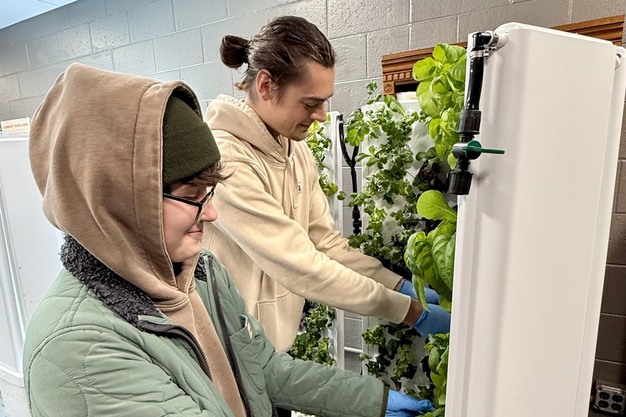 © Northern Michigan UniversityDirected study students Lilly Brooks (left) and Raymond Greimel said it is rewarding to grow healthy, fresh produce for their peers who visit NMU Food Pantry locations.
NMU construction management students have assisted the effort by building wooden produce islands to display items in the pantry, along with raised plant beds and an onsite produce washing station that captures water for reuse in hoop house irrigation.
Jacob elaborated on the value of the collaboration with CEA and its alignment with NMU's "Our Compass" strategic plan.
"I came from a very poor background, and I know what it's like to be hungry," she said. "To help make sure others aren't feeling that way means a lot because you can't be hungry and show up for class and be successful. Fresh food helps with physical and mental health. It also reinforces NMU's emphasis on sustainability because produce is grown on campus, transportation needs are eliminated and growing conditions are carefully regulated to minimize waste."
Source: Northern Michigan University