
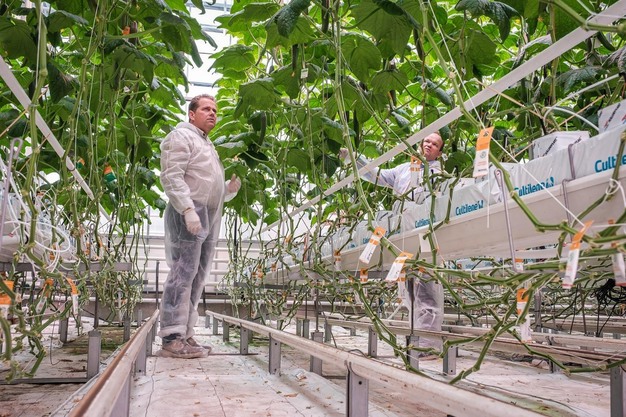
This month, Wageningen University & Research is launching a trial within the AGROS II project involving the cultivation of cucumbers, in which three greenhouse compartments will be used to experiment with different methods of autonomous cultivation. All three cucumber crops will be controlled remotely: one by a group of experienced cultivation experts, one by an AI algorithm and one by a Digital Twin. The results and lessons learned will be carefully analysed and shared with the sector in the coming months.
Support in a complex world
The greenhouse industry is facing a number of challenges. Companies are growing larger, supplier contracts get more complicated, energy prices have risen sharply and finding qualified workers is an ongoing challenge. For individual growers, it is almost impossible to oversee all these factors. Thus, there is a need for systems that can support growers in their decision making. In AGROS II, Wageningen University & Research is collaborating with the private sector to develop systems that can support growers in their operational decisions.
 © Wageningen UR
Data-driven cucumber cultivation
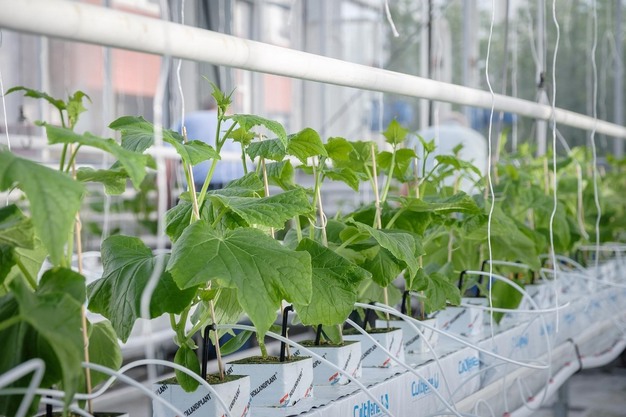
This month, cucumber cultivation will commence in three greenhouse compartments at WUR's research facility for greenhouse horticulture in Bleiswijk. Each compartment is equipped with sensors that provide real time data on the crop, substrate and climate, and will be managed by a separate method, with one being managed by a Digital Twin, based on existing crop and greenhouse climate simulation models from WUR; another by a self-learning AI algorithm; and finally cultivation controlled by experienced cultivation experts based on real-time crop, climate and substrate data provide from sensors from the greenhouse.
All compartments operate towards the same objective: maximising net profit. Net profit is determined by a balance between variable costs (electricity, natural gas, CO2) and benefits (harvested cucumbers).
 © Wageningen UR
Dashboard and digital supervision
The trial in the compartment with data-driven cultivation will be supervised by a group of growers and cultivation experts from the AGROS partners. They use both sensor-generated data from their compartment and their own visual observations. Every two weeks, they will © Wageningen UR evaluate the cultivation based on crop, climate and substrate data using a dedicated crop-management dashboard. After proposing actions based on these data, they can visit the greenhouse to verify their findings.
Project leader Anja Dieleman explains: "It will be fascinating to see whether the experts arrive at the same recommendations based on visual inspection of the crop as they do from the data. If not, they can explain which observations led them to deviate from the data-based advice, allowing us so to adjust the crop performance indicators in the crop-management dashboard."
Power of cooperation
AGROS II is a public private partnership project in which the business unit Greenhouse Horticulture of Wageningen University & Research is cooperating with Nunhems/BASF Vegetable Seeds, Cultilène, Mechatronix, Stichting KIJK, Delphy, Greenport West Holland, Gavita, Van der Hoeven Horticultural Projects, VDL ETG, Source.ag, Municipality of Lansingerland, the Hagelunie Innovation Fund and the Top Sector for Horticulture & Starting Materials. The participating companies contribute lighting systems, substrates, seeds and their valuable expert knowledge. The other partners strengthen the project through their networks of growers, companies and link to society.
For more information:
Wageningen University & Research
Email: [email protected]
www.wur.nl