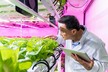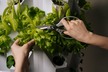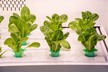


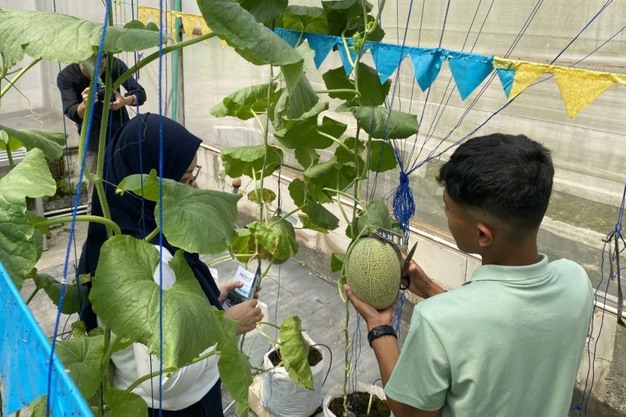
A research team from Universitas Gadjah Mada (UGM), working under the Field Research Center (FRC), is currently researching premium hydroponic melon cultivation in a greenhouse. The development of this horticultural crop is not limited to fruit production alone but also extends to the diversification of downstream products.
Melons produced through this research are processed into various products, including cold-pressed juice, confectionery products, and flour made from agricultural waste as part of efforts to strengthen food self-sufficiency and reduce Indonesia's dependence on wheat imports.
"This research at FRC UGM is not merely about cultivating melons in a greenhouse, but also about developing derivative products to increase the economic value of melons while addressing food security challenges," said Putri Rousan Nabila, Head of the Research Team, on Monday (Jan. 12).
 © Universitas Gadjah Mada
The selection of melons as a research commodity at FRC UGM was not without reason. Nabila explained that melons are fruit crops that grow very well in tropical regions with high temperatures and balanced water availability.
According to her, the combination of heat intensity and irrigation in the area can be optimally utilized when matched with the appropriate commodity. The research is being conducted in Kulon Progo Regency, Yogyakarta.
"The agroclimatic conditions in Kulon Progo, particularly in terms of light intensity and ambient temperature, are highly suitable for melon cultivation," she said.
In addition to natural factors, the choice of Kulon Progo as the research site was a strategic decision given its proximity to Yogyakarta International Airport. The location is considered to offer open-market opportunities for visitors and tourists.
The diverse market characteristics of Yogyakarta, spanning various age groups, further broaden the consumer reach of the melon research. From a distribution perspective, melons are also considered relatively safe commodities due to their fairly long shelf life.
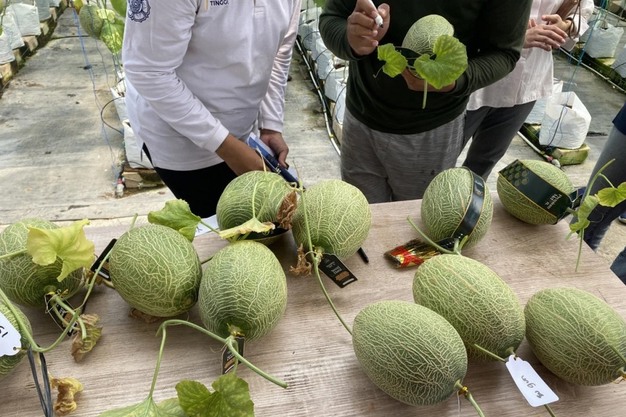
"Melons can be distributed effectively because they have a shelf life of around 15 days, which makes us optimistic about reaching markets in Yogyakarta, Sleman, and surrounding areas," she added.
 © Universitas Gadjah Mada
According to Nabila, Kulon Progo remains one of the regions in the Special Region of Yogyakarta that requires strengthening in education and knowledge. At the same time, the area has continued to develop in recent years, particularly following the airport's operation.
Therefore, increased accessibility must be balanced with community preparedness, both socially and in terms of knowledge, to adapt to change.
"With the presence of FRC in Kulon Progo, we want the benefits to be truly felt, not only in terms of facilities, but also through knowledge transfer to the community," she explained.
The impact of the melon research at FRC UGM is now being felt directly by farmers, particularly those assisted in the coastal area of Bugel.
Dr. Yosephus Ardean Kurnianto Prayitno, another member of the research team, said that the assistance provided goes beyond technological aspects to include cultivation processes.
The results of this mentoring have shown a significant increase in productivity. Through the application of standard operating procedures and developed technologies, melon crop productivity reached approximately 85 percent.
"Out of 1,000 sweet net 8 melon plants, around 850 to 900 plants were productive. About 599 kilograms of fruit entered grade A, meaning more than 50 percent of the harvest achieved grade A quality," he explained.
Dr. Prayitno noted that FRC UGM is designed as an open learning space under the concept of Jogja Open Innovation for Community Enhancement (JOICE). One form of knowledge transfer is implemented through the Open Farm concept at the FRC UGM greenhouse area.
Through this Open Farm initiative in Kulon Progo, local communities and farmers can be directly involved in learning modern agricultural practices.
Furthermore, he hopes that Open Farm activities will also serve as a research-based visit platform, similar to collaborations with partners from Japan, and as a platform for summer course programs organized by the Faculty of Agricultural Technology at UGM.
"This Open Farm is open to everyone, not only residents of Kulon Progo. Visitors can harvest melons while learning, as guides have been prepared. I hope this can become a platform for the emergence of a new generation of farmers who are familiar with smart farming through the application of technology in agriculture," he explained.
Since the establishment of FRC UGM in Kulon Progo in 2022, Dr. Prayitno described the development of this melon research as one implementation of the tridharma of higher education, particularly in applying research outcomes that can be directly utilized by the community.
It is not merely regarded as research and teaching activities, but also as tangible community service. Through the application of the tridharma in this research, FRC UGM serves as a means of identifying community and farmer group challenges that can be developed into research potential in Kulon Progo.
"With the Open Farm at FRC UGM and the research development in Kulon Progo, this is not just about land availability, but about delivering real benefits to the surrounding community," Dr. Prayitno said.
FRC UGM is one of UGM's learning centers that promotes interdisciplinary collaboration with various faculties across the university. Dr. Prayitno explained that several collaborations have been carried out with the Faculty of Agricultural Technology, the Faculty of Agriculture, and the Faculty of Biology.
At the UGM Vocational College level, research activities are also conducted across multiple study programs. He added that interdisciplinary collaborations within the Vocational College include market research, post-harvest handling, machine dosing, and agriculture-based tourism packages.
"To identify target consumers for melons or other products developed in the greenhouse, we also conduct market research in collaboration with one of the study programs at the Vocational College," he explained.
Looking ahead, Dr. Prayitno hopes that melon research at FRC UGM Kulon Progo can be directed toward strengthening a multi-helix collaboration model involving universities, government, industry, and local communities.
He noted that international collaboration had already been established in 2025 through research partnerships with Japanese institutions. By expanding this collaborative network, he hopes the research will comprehensively address shared needs.
In addition, he aims for more intensive collaboration and an increase in research projects based on real-world challenges encountered in the field and industry. This is expected to further strengthen the relevance of the research being developed.
"In the future, there will be more intensive collaboration and a greater number of studies based on real problems we face in the field and in industry," he concluded.
Source: Universitas Gadjah Mada