

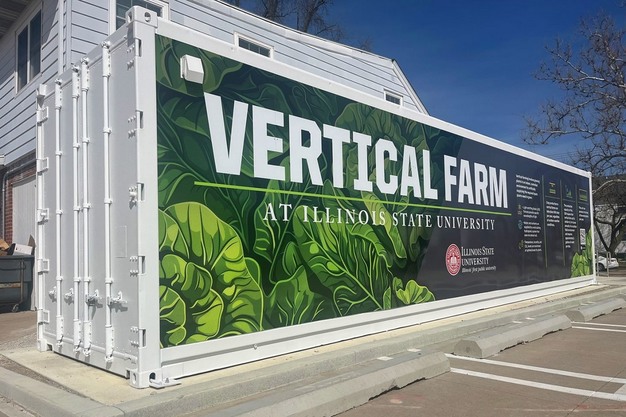
The 320-square-foot space inside a repurposed shipping container that sits in the parking lot of the Office of Sustainability is small and is a far cry from the 200-acre tree and shrub nursery in northern Illinois where Dr. Dave Kopsell, professor of horticulture in the Department of Agriculture, grew up.
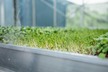
Kopsell has been interested in horticulture for as long as he can remember, and today, that interest is taking the shape of the 40-by-8-foot container that houses Illinois State University's Vertical Farm. The farm offers an enclosed, controlled environment for growing plants year-round. The farm is outfitted with a vertical hydroponic growing system with a recirculating nutrient solution and light-emitting diode (LED) lighting system.
 © Illinois State University
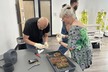
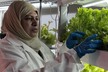
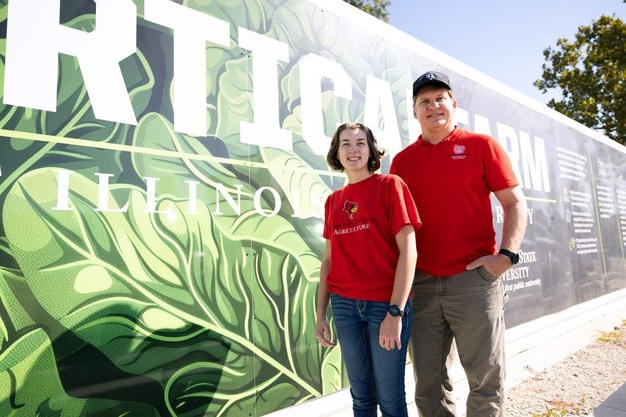
Sarah Stevans and Dr. Dave Kopsell work together planting and harvesting crops at the Vertical Farm at Illinois State University, located next to the Office of Sustainability.
The Vertical Farm project is a partnership between the College of Applied Science and Technology, the Department of Agriculture, and the Office of Sustainability. "The importance of collaborations and partnerships is really essential with a project like this," said Kopsell.
The project originally started as an idea from business students in Dr. Peter Kaufman's Innovative Consulting Community Program.
"They wanted to do some sort of garden on campus. I explained why that might be difficult and suggested that they look into the concept of a freight farm," explained Kopsell. The students researched the concept, visited a working Freight Farm unit, and worked on a feasibility study. They presented their final report in the spring of 2020. It took a full five years from their final report for the project to come to fruition," Kopsell said.
The Vertical Farm unit has the capability to grow 4,600 plants (production equivalent to 1-2 acres), using about 5 gallons of water a day (95% less water than it would take to grow the same amount of plants in a field).
 © Illinois State University
The unit will have a cyclical production sequence, so there will always be seeds being planted and plants being harvested. It takes about 35 labor hours to run the farm each week, and that responsibility falls to Kopsell, a graduate assistant, and five student employees.
Something especially unique about the Vertical Farm is that it is entirely climate-controlled regardless of the outside temperature or weather. The Vertical Farm is always 73-78 degrees.
"It's a bit of a buffer against climate change, since we are able to control all the growing conditions," Kopsell explained.
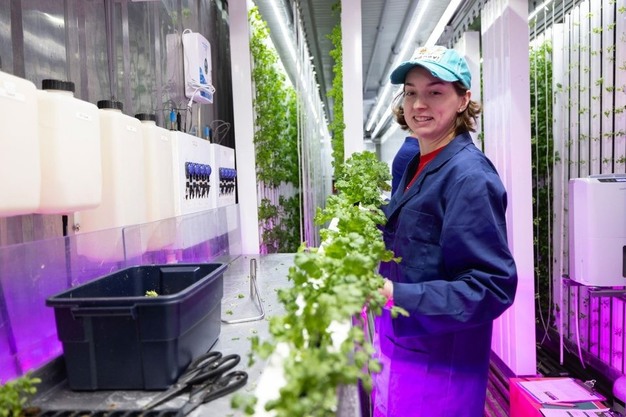
Within the shipping container, plants are seeded and grown within a few weeks to a transplant size in small, compostable root cubes. A workbench with shelves holds seedling trays that are irrigated with a hydroponic system. Water delivery and lighting are controlled with timers. Crop transplants are then grown to a harvestable size in vertical towers over the course of another three to four weeks.
The container holds 256 individual, 7-foot-long towers, which hang vertically from hooks. Inside each tower is a removable, coarse, spongy material where plant roots are suspended. When plants are mature, each vertical tower is taken off its hook and brought to the workbench for plants to be clipped at their base, weighed, and bagged for delivery. Following replacement with a new, young plant, the transplant-filled tower is placed back in its growing location, ready to be harvested again in another three to four weeks.
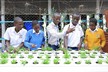
The enthusiasm about the farm has been widespread. In its opening semester, the Vertical Farm has already seen more than 150 visitors, ranging from elementary students to master gardeners.
"It was never about me asking for the farm for 40 horticulture students, or even for 400 agriculture students—it is a resource for the entire university," Kopsell said. "Once you get more people involved, there are more possibilities."
 © Illinois State University
Kopsell teaches the department's Introduction to Horticulture class online, noting that many students in the course are often majoring in something other than agriculture.
"More and more students are interested in specialty crop production," Kopsell said, citing examples that include urban agriculture, organics, and viticulture. "We're talking to more students that are interested in sustainability and interested in growing food where people are, such as urban environments. The Vertical Farm allows for that and supports their desire to learn about a new way of farming."
Moving forward, Kopsell is excited about the variety of educational opportunities that the Vertical Farm could provide.
"The farm will serve as a laboratory for the Department of Agriculture's new Sustainable Urban Agriculture class, as well as a course that focuses on fruits and vegetables," he said.
Kopsell also sees potential for students in departments such as Family and Consumer Sciences, Sociology and Anthropology, Information Technology, the College of Business, and Illinois State's new College of Engineering to learn from the farm operation.
The Vertical Farm is partnering with Event Management, Dining, and Hospitality to grow herbs, including cilantro, basil, and parsley for consumption in the dining halls on campus. Students will see videos of the crops being harvested in the farm while they fill their plates just a few blocks away.
Source: Illinois State University