
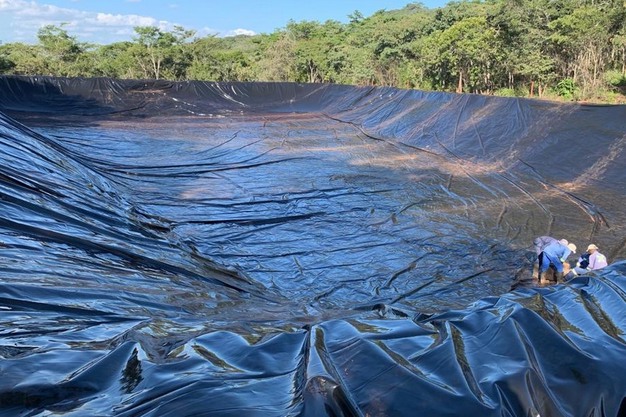
Greenhouse development across Africa is expanding as growers seek more reliable production systems suited to diverse climates, infrastructure constraints, and operational capacity. Zimbabwe-based GreenCon has been active across the continent for more than three decades since its founding in 1990. "We moved from being a steel greenhouse manufacturer to becoming agents for international greenhouse suppliers and greenhouse inputs," says Managing Director Julian Vant. "That includes greenhouse plastics, clamping profiles, trellis systems, cocoa peat, and water management products such as dam liners."
GreenCon works closely with South African company Rhino Plastics, sharing global suppliers while remaining independently owned. This collaboration provides access to materials sourced from Europe, China, Sri Lanka, and other manufacturing regions.
 © GreenCon
Geographic reach and crop focus
GreenCon has delivered projects across Southern, Central, and West Africa, covering vegetables, flowers, medicinal cannabis, and propagation. Medicinal cannabis projects have been completed in Lesotho and Zimbabwe, while vegetable and flower greenhouses have been developed in countries including South Africa, Zambia, Mozambique, Botswana, Angola, Namibia, Eswatini, the Democratic Republic of Congo, the Central African Republic, Ghana, and Côte d'Ivoire. The company has also been involved in banana propagation in Côte d'Ivoire.
Flower production remains dominant in many regions, while vegetable projects are expanding in response to food security needs and local market demand.
 © GreenCon
Turnkey delivery approach
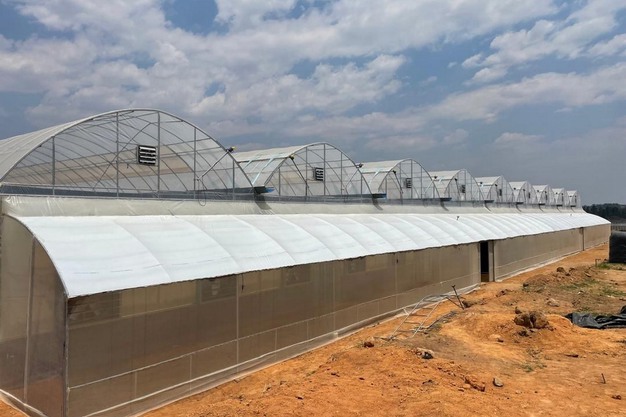
GreenCon operates primarily as a turnkey greenhouse supplier, importing structures and materials and managing on-site installation and commissioning. Irrigation is typically handled by local specialists.
"For projects outside our home market, such as Angola, they generally need to be at least a quarter of a hectare to make financial sense for the grower," Julian shares. "At that scale, we ship everything from Europe or China, install it on site, commission it, and then hand it over."
Designing for crop and climate
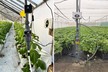
Greenhouse design is tailored to both crop requirements and environmental conditions. Structural load capacity is a critical factor for trellised vegetable crops.
"If a grower is producing vegetables, we design the structure to support 20 to 25 kilograms per square metre," he explains. "The trellis system is built into the greenhouse rather than added separately."
Climate data such as temperature and humidity ranges are used to specify ventilation and covering systems. However, simplicity and durability remain central to GreenCon's approach.
"We try to keep projects as user-friendly as possible. In many parts of Africa, growers may not have access to specialised technical support, so we avoid supplying equipment that cannot be fixed locally."
Passive ventilation solutions
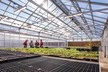
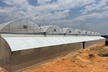
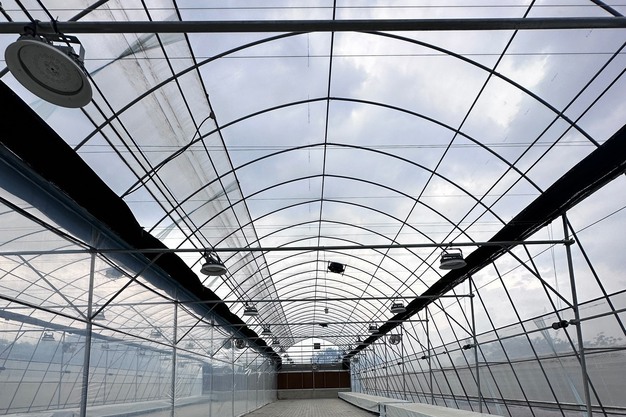
A key technology increasingly used by GreenCon is Vento, a self-ventilating greenhouse film developed by Greek manufacturer Daios. The layered roof-apex system opens automatically in response to temperature differentials, allowing hot air to escape without motors, computers, or electricity.
"It's a world-patented product that provides a basic level of environmental control without automation," Julian says. "It improves temperature control in winter and humidity control during the hottest periods in summer."
Mechanical cooling systems such as pad-and-fan units are becoming less common in many African regions due to high electricity costs and unreliable power supply. "If the power goes off, which happens frequently in Africa, generators quickly eat into profits."
 © GreenCon
Matching technology to grower capacity
GreenCon places strong emphasis on aligning greenhouse technology with grower skills and operational capacity.
"The key challenge is to keep the infrastructure appropriate to the grower's capacity. You cannot expect the same returns from a low-cost greenhouse as from a fully computerised one, but you can reduce conventional risk by using simple systems that work reliably."
Highly automated systems can increase vulnerability if technical failures occur without immediate intervention. "With naturally ventilated structures, the consequences of failure are much lower," he explains.
Production systems are also selected with risk tolerance in mind. Soil-based growing is often more forgiving than soilless substrates for smaller-scale operations. "If something goes wrong in soil, you can correct it over a few days. In cocoa peat or other substrates, a mistake left for 12 hours can kill the crop."
Current and emerging projects
Among GreenCon's upcoming developments is a 1,000 m² high-specification propagation and seed trial greenhouse in Zimbabwe. The facility will include benches, gas heating, internal screens, pad-and-fan cooling, air circulation fans, and Vento film, enabling full environmental control for vegetable and maize seed trials.
GreenCon is also involved in controlled-environment insect protein projects, including small greenhouse units designed for fly larvae production for livestock and aquaculture feed.
"We have a trial unit operating in Kariba feeding tilapia. If it proves scalable, it could become a relatively low-cost protein source."
For more information:
GreenCon
Julian Vant
[email protected]
https://greencon.co.zw