

Ukrainian vertical farms work despite war challenges, blackouts, high competition with imports, and legislative obstacles. However, this year, the "Association of City Farmers of Ukraine" was created to protect the rights of producers.
"It's like we don't exist legally," says Viktor Shuleshko, founder of the Green Future vertical farm. The city farmer supplies fresh greens to retail and HoReCa throughout Ukraine, but officially, the farms cannot obtain the status of agricultural producers. The reason is that vertical farms do not operate on agricultural land. The newly created Association currently comprises 10 members and is ready to meet this challenge, among others.
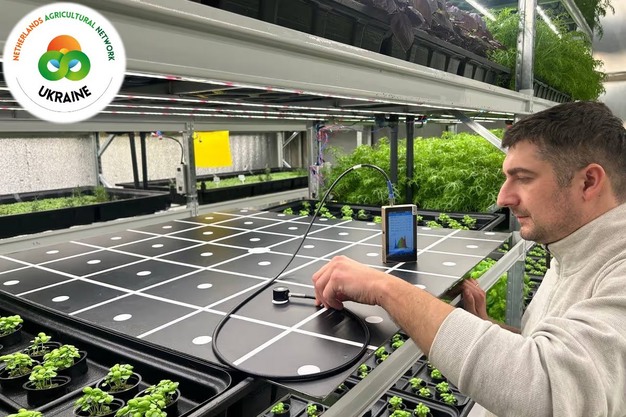 © Viktor Shuleshko
How do the vertical farms operate in Ukraine during power outages?
Vertical farms cannot work without electricity, but compared to conventional greenhouses, they have an advantage in that they do not require that much heating.
To prepare for the blackouts, all the automation on the vertical farms (pumps and other devices) was switched to backup power resources, such as batteries and inverters, and they also installed timers. For example, for a 200m2 farm, Viktor uses a 10 kW generator, which is approximately 120W per m2. The growing racks light when there is an electricity supply, and when the power goes out, the generator turns on automatically.
Although light is very important, Viktor and his colleagues' farms are unique, not only for Ukraine, but perhaps for the EU, by having the experience of working on a 12-hour lighting cycle due to the efficiency of the lamps they use. The parts of the greenhouse are illuminated in 12-hour-shifts.
During blackouts, plants on a city farm take approximately 5-7 days longer to grow. This results in higher production costs, mainly due to the rental costs of premises. However, the yield practically does not change. In the situation of a full blackout, which happened at the beginning of the full-scale war in 2022, when the farms did not have generators yet, it was clear that the quality of plants began to deteriorate rapidly after four days of power outage.
Assortment
Most city farmers start with basil as a basic crop. Now, Ukrainian retail is also interested in a wider assortment, including amaranth, pak choi, cilantro, and green onion. Production of different crops is being tested throughout Ukraine, mainly focused on import substitution in the winter months. Since the price of locally produced greens in winter is higher than imports, the main competitive advantage is freshness. The product is delivered from the farm to the retail store in two hours.
There are mainly three categories of greens in retail in Ukraine: cut, packaged mixes, and fresh greens in substrate. The latter is produced at the vertical farms. This category has the longest shelf life, and cooperation with retail goes without returns. There are trials of production of industrial hemp in city farms with the long-term goal to learn the technology for the cultivation of medical cannabis when the legislation is finally in place for export.
"This season, we failed to start the hemp trials. According to Ukrainian legislation, technical hemp (open-field crop) can only be planted until the beginning of June. The legislation does not cover the norms for indoor hemp production," says Viktor.
Association of City Farmers in Ukraine
After the creation of the association early this year, the members are building a structure and defining goals. The main goal is to integrate vertical farming into the Ukrainian agribusiness system to be able to register as an agricultural producer.
"Here is an example. I wanted to apply for a grant from FAO. I went through all the stages. But I could not complete the application, because I could not provide the certificate of lease or ownership of agricultural land," Viktor explains.
Vertical farms in Ukraine are in a state of legal confusion since production does not need agricultural land, and operations take place on premises. For this reason, vertical farm producers cannot be registered in the Ukrainian State Agrarian Register as agricultural producers, but just as producers.
"Therefore, together with other vertical farmers, we created the Association to defend the rights of city farmers, change the legislation, and ensure that vertical farms are recognized as agricultural production without registering land plots," Victor explains. Currently, there are 10 vertical farms in the association, the large producers who cover the demands of the fresh greens market throughout Ukraine. The association is open to new members.
State support of the sector
The association will focus on communication with the Ukrainian Ministry in order to introduce the specific changes to the legislation that will include vertical farms in agricultural production.
Secondly, the association will lobby for the introduction of the quality mark for the products of vertical farms, which are different from both imported and greenhouse products. The price for the imported products is growing; however, their quality due to the long logistic chain is getting worse. Therefore, the Association members believe that in 3-4 years, they will be able to compete on price with imported products.
"We also believe in cooperation with EU counterparts, like the European Association of Vertical Farming, or FAO, since there are examples that European legislation can be implemented in certain Ukrainian sectors. Therefore, we are in favor of European legislation on vertical farms operating in our country as well," Viktor concluded.
Source: Agroberichten Buitenland