

Hydroponic operations can receive organic labelling in the US. Organic labelling has the potential to increase profits in hydroponic production as organic products are sold at a premium price.
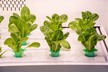
Nutrient uptake by plants follows a sigmoidal pattern, with approximately a third of the nutrients taken during the lag (slow growth) phase and the remaining two-thirds of nutrients taken by plants during the log (rapid growth) phase. Nutrient release from fertilizers should match nutrient demand from plants for optimal crop growth. There is limited information about nutrient release from organic fertilizers, their uptake by plants, and the overall effect on crop yield in hydroponic production. Eight lettuce cultivars, belonging to four morphological groups and two leaf colors, were grown in containers filled with peat-based substrate containing either customized organic or conventional fertilizer mixes with a similar quantity of different nutrient elements. Reverse osmosis water was used to sub-irrigate plants in a recycling hydroponic system. Crop yield and nutrient release differences between organic and conventional treatments were quantified in the study. Results indicated that the average fresh shoot biomass of lettuce cultivars was approximately 36% lower in the organic than in the conventional fertilizer treatment. However, plants in both treatments visibly appeared to be of similar quality. The electrical conductivity of the substrate (i.e., total soluble nutrients in the root zone) was significantly lower during the exponential (or rapid) growth stage (0.80 vs 1.23 dS.m-1), indicating lower nutrient availability for plants in organic than conventional treatment. Further, biomass reduction in organic compared to conventional treatment was larger for fast-growing varieties and green than red leaf cultivars, suggesting greater yield losses in cultivars with higher nutrient demand. Interestingly, a high dose of customized organic fertilizer (approximately twice) incorporated into the substrate resulted in a comparable yield (48.9 g·plant⁻¹) with that of the conventional fertilizer treatment (45.8 g·plant⁻¹).
However, a significant quantity of residual nutrients was found in the substrate of the customized high-dose organic fertilizer treatment. A high dose of customized organic mix plus a strategy to reuse the substrate can potentially increase yield and nutrient use in hydroponic production.
Son, S., Hoagland, L., Deering, A., Wei-Kocsis, J., & Nemali, K. (n.d.). Nutrient release and yield comparison between customized organic and conventional fertilizers in hydroponic lettuce production. *Frontiers in Plant Science, Plant Nutrition*.
Source: Frontiers In