


In Portugal, cotton is being tested in a setting normally reserved for leafy greens and young plants. Agromethod Labs, in partnership with CITEVE, the Technological Centre for the Textile and Clothing Industry of Portugal, is exploring whether the crop can be grown in controlled, soilless systems rather than open fields.
For Raquel Maria, founder of Agromethod Labs, CITEVE, and researcher Filipe Natalio (NOVA School of Science and Technology, Lisbon), the work has focused on two core questions: how cotton behaves under hydroponic conditions, and whether such a system could eventually support a viable production model at scale. "We spent two years defining the optimal growth conditions for cotton," Maria said. "Most of the available data comes from field experiments. In controlled environments, you have to define everything; nothing can be assumed."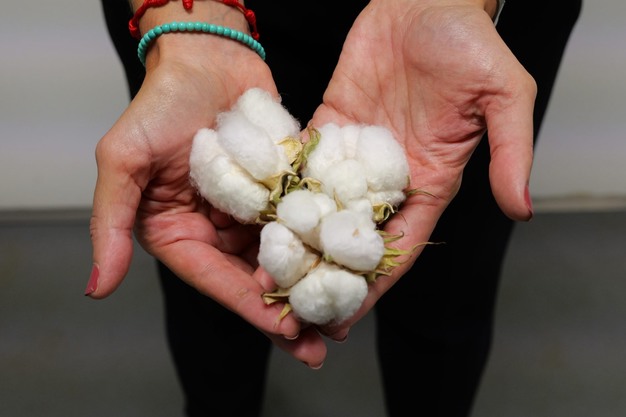 © CITEVE
Hydroponic cotton
From cancer research to cotton roots
Natalio did not start his career in plant science. His background is in chemistry and biomedical research. "I was working on targeted drug delivery for cancer," he said. "We use nanoparticles to deliver compounds to very specific locations in the body. I began asking myself: if we can target a tumor, why can we not target specific plant tissues and modify the material they produce?" That line of thinking led him toward cotton. "The first reaction I received was that cotton is not rice. It cannot be grown in water," he said. "I took that as a challenge. I decided I would prove that cotton can grow hydroponically."
Containment was a key driver. If the long-term goal is to influence fiber properties, soil presents limitations. "If you introduce specific compounds into soil, you risk environmental contamination," he said. "In hydroponics, the system is contained. You can control inputs and outputs precisely." Maria described the commercial push as the missing step. "Filipe had been working on this concept for many years," she said. "I realized that with the current global challenges we have, like climate, water, and supply chain issues, this could be the right moment to move from research into reality."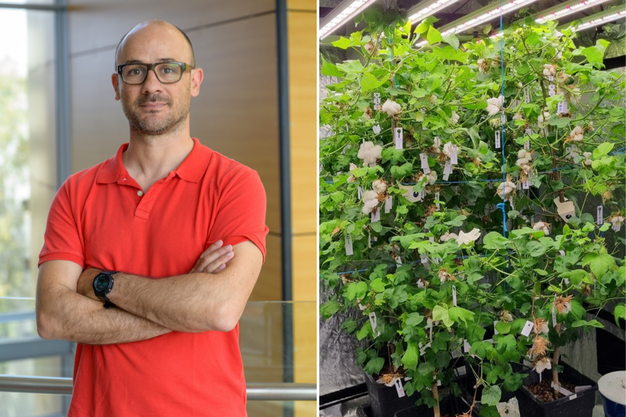 © Filipe Natalio | CITEVE
Filipe Natalio and a fully indoor, hydroponic cotton plant
From indoor trials to vertical scale
The first two and a half years were not vertical farming in the rack-based sense. They were controlled indoor trials. "We did not begin with vertical farming," Maria explained. "We began with indoor cultivation to understand the crop. Only recently did we move into a vertical configuration."
One reason was structural. Systems designed for lettuce did not translate. "Cotton develops a very large root system," she said. "Standard hydroponic systems designed for leafy greens were not suitable." The team developed proprietary setups. "Our approach minimizes the potential for cross-contamination," Maria said.
The current pilot occupies approximately 80 square meters and contains about 140 plants. "For us, moving from 20 plants to 140 plants was a major step," Maria said. "When we walk into the room now, it feels like a real production space." Engineering uniform water delivery across vertical levels was a challenge. "In vertical systems, water distribution must be extremely precise. Every plant must receive the same irrigation at the same time. That required significant technical development."
Three harvests per year  © Raquel Maria
The team reports consistent fiber performance across multiple harvest cycles. "Last year, we achieved three harvests with consistent fiber quality," Maria said. "In conventional field systems, cotton is typically harvested once per year. Indoor cultivation allows year-round production."
Maria highlighted fiber properties as one of the most important outcomes. "We are using upland cotton, which is standard commodity cotton," she said. "By adjusting environmental conditions, we achieved fiber properties comparable to higher-end varieties such as Pima." Whiteness is another reported benefit. "The fiber is naturally very white," Maria said. "If bleaching can be reduced or eliminated, that removes an entire processing step."
Right: Raquel Maria
However, the team is cautious about sustainability claims. "We are not claiming sustainability yet," Maria said. "We are currently preparing a full life cycle assessment. At the end of this year, we expect to have complete data on energy consumption, water use, and production costs." The team emphasizes biological pest management. "In our indoor systems, we use biological control agents," Maria said. "For example, ladybugs are used to manage insect populations." Controlled environments allow closer monitoring and intervention, reducing reliance on chemical inputs.
Investment gap
Despite interest from global brands over the years, commercialization has faced what Natalio describes as a funding bottleneck. "During our research, we received interest from major apparel brands," he said. "But the common response was: 'Show us the fully developed plant at scale.'"
The challenge, he explained, is that scale requires investment before proof of industrial viability. "There is a gap between academic proof and commercial production," he said. "Large companies want a ready-made solution. But developing that solution requires capital."
CITEVE plays a bridging role in Portugal's ecosystem. "We are fortunate," Maria said. "In Portugal, we have spinning, textile manufacturing, and garment production close by. We can test fiber, spin yarn, and produce fabric locally. That is a major advantage."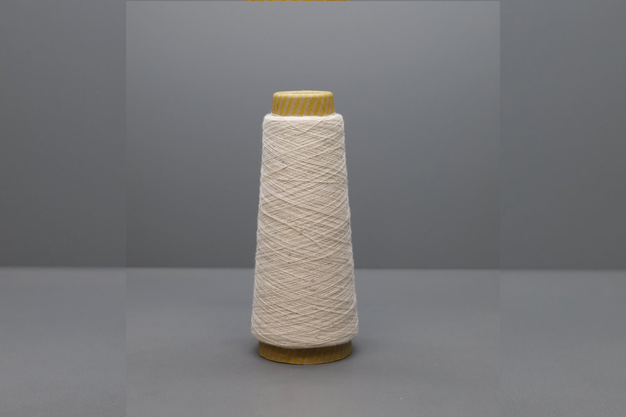 © CITEVE
Hydroponic cotton yarn
Beyond commodity cotton
The team does not see their approach as competing directly with conventional cotton on price. "We must create added value," Maria said. "This cannot be 'cotton, but indoors.' It must offer something different."
That added value may include traceability, consistent quality, engineered properties, or localized supply chains. "You know exactly where the cotton is produced," she said. "Transparency in the supply chain is increasingly important."
Maria added that education is also part of the mission. "Young people are very concerned about sustainability," she said. "If we can show that agriculture and technology can work together in new ways, that is already progress."
For more information:
Agromethod Labs
Raquel Maria, Founder
[email protected]
www.agromethodlabs.com
NOVA School of Science and Technology, Lisbon 
Filipe Natalio, Researcher
[email protected]
www.unl.pt/en/escolas/faculdade-de-ciencias-e-tecnologia
CITEVE 
(+351) 252 300 300
[email protected]
www.citeve.pt
Agromethod Labs and CITEVE test hydroponic pilot in Portugal