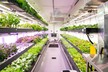


Just a few miles from the Hamilton office sits an unexpected hub of innovation: a fully operational hydroponic farm housed inside a refurbished shipping container at the Robbinsville Municipal Complex. The Spiezle sustainability committee recently visited the site to see how such a compact space produces hundreds of heads of lettuce each week while helping nourish the local community.
The committee first learned about the farm through a local call for donations of single-use plastic bottles, which are repurposed on-site. That call to action sparked interest, leading team members to collect bottles from employees and schedule a tour.
Upon arriving at the complex, the group nearly drove past the unassuming container tucked between the senior center and an old schoolhouse. A weathered mural, painted by a Girl Scout troop when the township acquired the container in 2017, marked the entrance. After checking in, the group was greeted by Recreational Sustainability Specialist Hope Neis, who guided the tour.
When the door opened, a wash of purple light spilled out, created by a combination of red and blue LED lighting designed to support plant growth. The red light supports leaf development, while the blue light strengthens stems. Ms. Neis explained that the container operates as a windowless greenhouse, equipped with regulated airflow and carefully measured carbon dioxide levels to create optimal growing conditions.
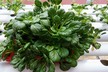
During the tour, the group learned how each head of lettuce begins its growth cycle. Seeds first germinate in plugs made from peat and coconut shells before being transferred into vertical grow towers. Each of the 256 towers holds ten plugs, allowing harvests to rotate efficiently and sustainably. As a result, the farm produces between 300 and 420 heads of lettuce each week.
The impact extends well beyond the container itself. Fresh lettuce is regularly donated to the Robbinsville Senior Center, the local food bank, Mercer County Community College, and Mercer Street Friends, a nonprofit organization focused on addressing food insecurity.
At the conclusion of the tour, each participant selected a mature head of lettuce to take home. Inside the adjacent schoolhouse, the group placed the plants into mason jars filled with clay stones and water, learning how to continue the hydroponic growing process independently. Participants also sampled freshly harvested lettuce and gained a deeper appreciation for the care and science behind each crop.
The visit demonstrated how innovation, sustainability, and community support can thrive even in a modest footprint. What appeared at first glance to be a simple shipping container proved to be a meaningful example of how local initiatives can create tangible impact. The experience served as a reminder that lasting change does not require expansive space, but rather a clear mission and the people committed to advancing it.
Source: Spiezle