

Leafy vegetables like lettuce are readily available in grocery stores and often seen as a healthy food choice. As researchers work to understand how emerging contaminants behave in plants, new research is shedding light on how lettuce responds to combined environmental stressors.
As environmental contaminants like micro- and nanoplastics become more prevalent, scientists are working to understand how they may interact with existing pollutants in agricultural systems. New research from Texas A&M University shows that lettuce plants exposed to nanoplastics and cadmium, a toxic heavy metal, absorb up to 61% more cadmium into their edible leaves than plants exposed to cadmium alone.
"We should begin reassessing 'safe' cadmium limits, and heavy metals in general, in agricultural soil and soilless media," said Dr. Xingmao "Samuel" Ma, professor in the Zachry Department of Civil and Environmental Engineering at Texas A&M.
Ma is leading research on contaminant interaction in hydroponic systems used as a controlled lab model to isolate plant responses. Performed by Ph.D. student Michael Bryant and assisted by Dr. Cory Klemashevich from the Integrated Metabolomics Analysis Core facility, the team used lab-grown lettuce as a model crop to explore how different exposures (co-exposure and single exposure) of heavy metals and nanoplastics interact with plants in a controlled environment.
For this study, researchers focused on cadmium, a naturally occurring heavy metal often found in soil. It is among the most toxic heavy metals and is harmful to both humans and animals. This contaminant can enter agricultural systems through water sources, some fertilizers, and even plumbing materials.
Nanoplastics are tiny fragments that form when larger plastics break down over time. These nanoplastics are so small that they can pass through filtration systems and even enter the water supply.
Evidence suggests the effect of cadmium uptake is likely driven by the plant's stress response.
Under normal conditions, a plant's response to cadmium is to increase its root branching in search of cleaner soil and to store the cadmium in the roots — away from the edible leaf tissues.
However, the presence of nanoplastics triggers a different stress response — oxidative stress, similar to inflammation in humans.
When oxidative stress occurs in addition to a normal stress response, it creates a competition for the plant's energy and resources. When both contaminants are present, the plant's defensive mechanisms are weakened, allowing cadmium to move more freely into the edible leaf tissue.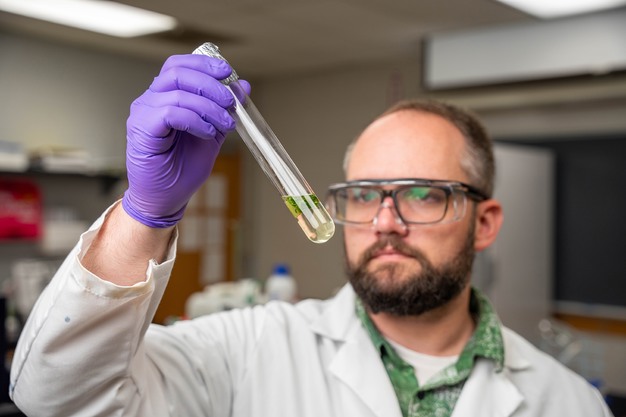 © Emily Oswald | Texas A&M Engineering Michael Bryant inspects a lettuce sample in the lab.
Ma was surprised to find that in plants exposed to cadmium and nanoplastics, nanoplastics accumulated in the edible leaf tissues at 67% higher concentration than plants exposed solely to nanoplastics.
"We theorize this outcome is due to the increased root branching caused by cadmium exposure," Ma said. "Nanoplastics do not participate in any of the active transport mechanisms performed by the plant. Rather, they are passively taken up at gaps in the root surface. These gaps are present in actively growing regions, like at the root tip, and at branch points in the roots."
Their findings suggest that when these contaminants coexist in water, their interaction makes them more harmful to plants, and potentially to animals and people who ingest them, highlighting the need to understand how micro- and nanoplastics may influence contaminant movement in plants.
"Our work does suggest that the levels of cadmium at which remediation strategies are implemented should be lowered," Ma said.
Strategies to reduce cadmium in crops have long been explored, but Ma hopes this research highlights the importance of understanding how micro- and nanoplastics interact with other contaminants in agricultural systems.
Ma plans to map contamination across U.S. regions and integrate soil survey data to begin testing whether these lab findings appear in more complex, real-world applications.
Source: Texas A&M University