

As we celebrate Women's History Month this March, we reflect on how women's roles in agriculture have changed. While once women mostly just worked hard planting seed and harvesting crops, their role has evolved to also helping shape innovation and resilience in agriculture today.
This feature spotlights just a handful of women faculty members in the College of Agriculture, Biotechnology & Natural Resources and its Experiment Station and Extension units working in plant-focused disciplines. It provides a glimpse into their leadership and expertise cultivating the future of agriculture by driving cutting-edge research, mentoring the next generation of plant scientists, and supporting agricultural communities across Nevada and beyond.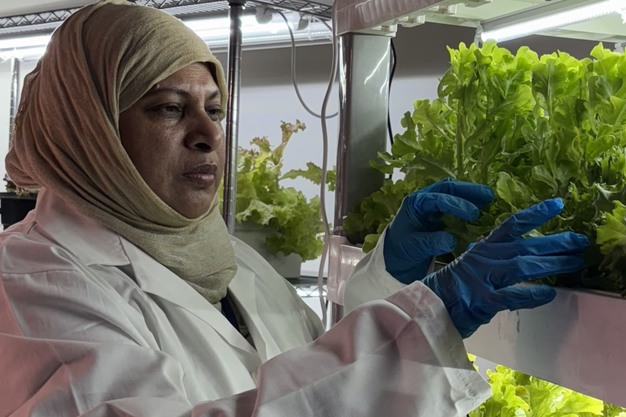 © University of Nevada, Reno | Mohammed Saifur Rahman
Most Tahera Naznin examining leafy greens in an indoor farming setup.
Most Tahera Naznin
Associate Professor, Department of Agriculture, Veterinary & Rangeland Sciences; Extension and Experiment Station
Naznin studies ways to grow food year-round using an outdoor growing system and controlled-environment systems such as greenhouses, indoor hydroponic vertical farms, shipping container farms, and high tunnels. By looking at factors such as growing conditions, irrigation, and plant nutrition, she helps farmers produce more food and strengthen local food security.
Q: Did you have a mentor or role model who influenced your path into agricultural science?
A: "Yes, I have several. First, my father was a mentor because he was a teacher. He taught me integrity, discipline, and the importance of education. My Ph.D. supervisor in Japan pushed me to think deeply and rigorously about plant science and space farming. My postdoctoral advisor, Professor Mark Lefsrud, had a strong influence on my research direction by introducing me to advanced indoor farming systems. He showed me how technological innovations can fundamentally transform modern agriculture, particularly in controlled environments and indoor vertical farming systems."
Q: What challenges did you face as a woman working in agricultural science?
A: "In Bangladesh, many people are thinking agriculture is just growing plants, nothing else. They expect if you're a smart young woman, you should go into medicine. So, choosing this path was not traditional, but allowed me to show that women can lead and how advanced technical science can help shape the future of food."
Q: What advice would you give to women considering a career in agriculture or going into the agricultural sciences, such as being a researcher?
A: "Agriculture today is not just growing plants. It is science, technology, and innovation. So, if you are curious and passionate about solving real-world problems, you belong in this field. We need more women leading the future of food and sustainability. The future of food will be smarter, more resilient, and more inclusive. And women will be the leading that transformation, it is my belief."
Read more at University of Nevada