

When Francisco Santana started his vertical farming company in 2016, no comparable infrastructure existed in Puerto Rico, or anywhere in the Caribbean. "At that time, all the information we tried to obtain did not exist," says Santana, Founder of Grupo Vesan LLC, a Puerto Rico-based indoor farming developer and producer. "We were the first to design and build a system like this in the region."
He distinguishes that early work from the wave of indoor farming activity now entering the island. "Only recently have initiatives emerged involving the 'use' of indoor farming systems, but not the construction of these systems," he says. "The comparable projects emerging today are the result of purchases from companies in other countries that install or build the systems, and in many cases purchase modules (containers) to resell locally."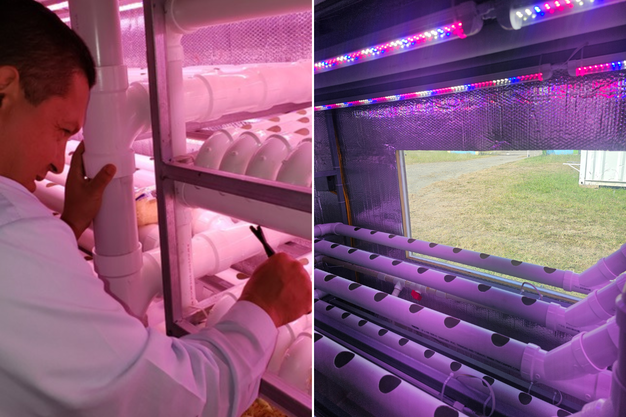 © Grupo Vesan
Cost-effectiveness as a design constraint
Grupo Vesan's system design is built around reducing the capital barrier to entry. Rather than automate every variable, the company focuses on the parameters it considers most critical for plant growth in a tropical climate: irrigation and environment.
"One of the differences we have tried to maintain in our original concept is to ensure that the system, as a whole, is as cost-effective as possible," says Santana. "We understand that one of the main limitations of indoor farming is the initial investment required."
Water and nutrient parameters are monitored continuously, with irrigation managed as a closed-loop system through flow monitoring in the pipes. Environmental data (CO2, humidity, and temperature, including historical graphs) is tracked via supplier applications. Humidity, in Santana's account, is the more demanding variable in tropical conditions.
Engineering against heat and humidity
Unlike systems designed for temperate climates that must actively generate heat, Grupo Vesan's approach centers on insulation and prevention. The modules use a double thermal insulation system to limit the effect of external temperature swings on internal growing conditions.
"In a tropical climate, you must deal with external heat and humidity, and additionally with the heat generated by LED lights," Santana says. "In mountainous areas, drastic temperature changes from day to night generate high humidity, which can impact fungal development or similar issues." The design goal is to prevent external conditions from reaching the crop rather than to counteract them once inside.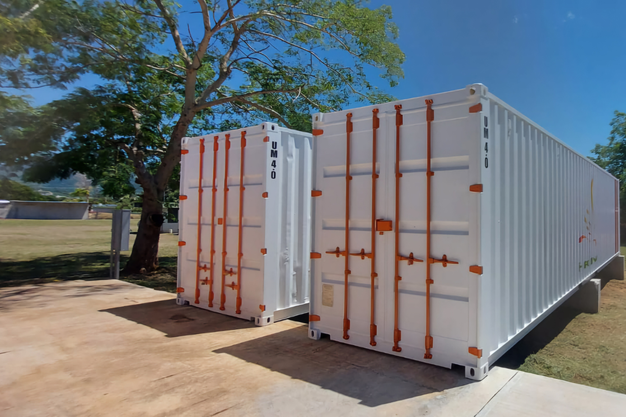 © Grupo Vesan
Crop selection shaped by energy costs
Electricity pricing in Puerto Rico directly limits which crops are viable indoors. "We take into account the duration of the planting-harvest cycle, especially due to energy costs, which are very high in Puerto Rico," says Santana. "We suggest short-cycle crops, or crops that the market can pay a good price for."
Puerto Rico's import dependency, with approximately 85 percent of food imported, creates specific substitution opportunities. Strawberries are one example he cites directly. "All strawberries sold in Puerto Rico are imported, but you cannot produce them outdoors due to the temperature," he says. "At this time, not all indoor crops are cost-effective, mainly due to the cost of electricity." Indoor production also allows operations to continue during hurricane season, which Santana describes as a critical advantage for the region.
Water savings: two sources, variable results
Grupo Vesan cites water savings of 40 to 60 percent, a range Santana attributes to two distinct mechanisms. "One is water savings from using NFT systems versus traditional outdoor agriculture, which requires much larger volumes of water," he says. "The second is that our system is designed to capture water generated by both the cooling system and the dehumidification system."
The variation within that range depends on module location. "Mountainous areas are completely different from spaces near the coast," Santana says.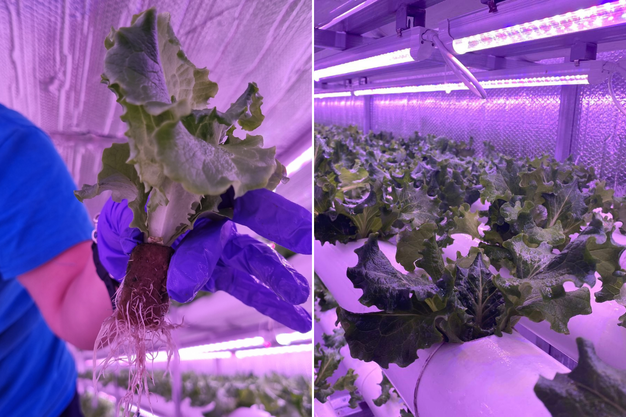 © Grupo Vesan
Labor model
Santana clarifies that the company's often-cited "four hours per day" labor estimate should be read as approximately 20 hours per week. "There are days that only require monitoring the operation and making minor adjustments," he says. "The days that require more time are harvest and packaging."
The operational model is built around weekly production cycles, with one-quarter of total installed capacity active at any given time. "One person can operate up to two units in a week on a full-time basis."
Energy cost and mitigation
Energy is the central financial pressure on the model. Santana reports average consumption is close to 700 kWh per square meter. "Our systems aim to reduce electrical consumption as much as possible by minimizing components that do not necessarily need to be automated," he says. "We are suggesting to our clients that they move indoor systems toward solar energy or similar alternatives."
He argues that premium pricing offsets the electricity burden. "The product obtained is high quality and can therefore be marketed at a much higher price than those grown outdoors, which allows balancing the cost-benefit relationship," Santana says.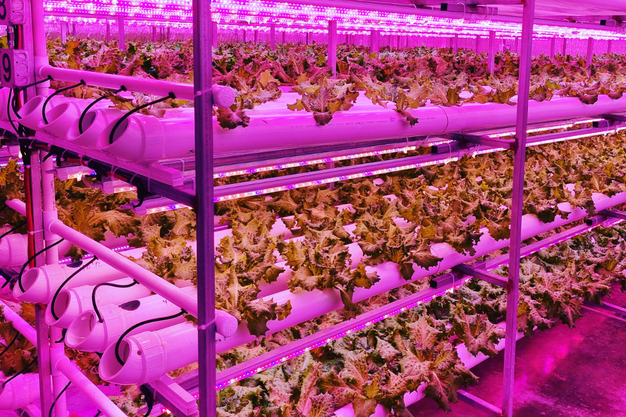 © Grupo Vesan
Hurricanes Maria and Fiona
Santana describes Hurricane Maria in 2017 as the more consequential test. The operation resumed product shipments ten days after the storm. With Hurricane Fiona in 2022, it was the following day. "After Hurricane Maria, we made changes to the structure, relocated the air conditioning systems, improved generator operability, and strengthened auxiliary support systems."
Backup power is essential to continuity, but fuel supply remains a documented vulnerability. "A critical factor that affected us during Hurricane Maria was the supply of fuel for the generator," Santana says. "Fuel in Puerto Rico is also imported."
Plans for an agrotechnological interpretation center
Grupo Vesan plans to open the first Agrotechnological Interpretation Center in Puerto Rico and the Caribbean in the middle of 2026. "We will manage it in parallel with an Indoor Farming Institute, for new generations but also for older adults," Santana says. "The concept is based on self-guided learning."
Over the next three to five years, he sees the company expanding in both module manufacturing and direct farming operations. "Our goal is to substitute imports with local production and attract new generations to agriculture."
For more information:
Grupo Vesan
Francisco Santana, Founder
[email protected]
www.verticalfarmingpr.com