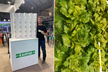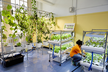


Researchers at the University of Seville have demonstrated the effectiveness of active vertical garden systems in improving indoor air quality in buildings. To do so, they worked inside a closed glass chamber installed at the Higher Technical School of Agricultural Engineering, where they found that after 24 hours, 96% to 98% of the pollutants used in the various experiments had disappeared. The work is published in the journal Atmospheric Environment.
Indoor air pollution has become a serious public health problem in many countries and has a significant impact on people's health. It causes sick building syndrome by affecting the comfort and productivity of workers and the learning of students occupying the building.
The main sources of indoor pollutants are paint solvents, perfumes and cosmetics, building materials, furniture, tobacco smoke, as well as indoor activities such as heating (fuel burning), cooking and cleaning products, while outdoor sources come from urban dust.
The team formed by Antonio J. Fernández Espinisa, Sabina Rossini Oliva, Luis Pérez Urrestarazu and Rafael Fernández-Cañero has studied the capacity of an active living wall (ALW) to remove pollutants from indoor air. They evaluated five different species (Spathiphyllum wallisii, Tradescantia zebrina, Philodendron scandens, Ficus pumila and Chlorophytum comosum) inside a closed glass chamber installed at the Higher Technical School of Agricultural Engineering.
Read more at Phys.org