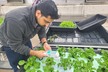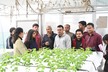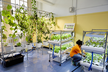


Soil salinity is a critical concern in agriculture when excessive soluble salts restrict a plant's water uptake, according to the U.S. Department of Agriculture, hindering crop growth and reducing yields on roughly 30% of U.S. irrigated land. Caused by irrigation, poor drainage or saltwater intrusion, soil salinity impacts soil structure, reduces fertility and causes economic losses. To help growers identify and mitigate salt stress, in a proof-of-concept study, a team led by Penn State researchers built a low-cost sensor system that detects signals released by plants in trouble.
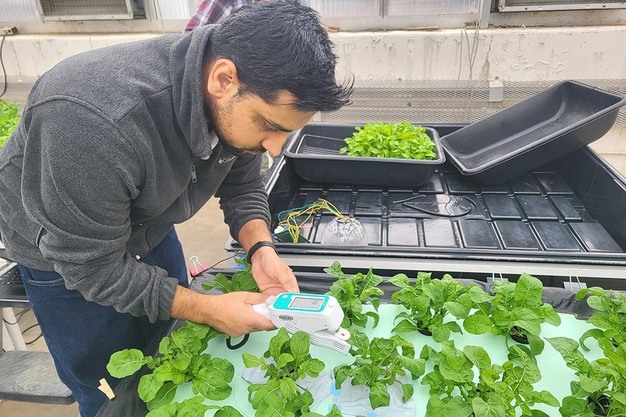 © Penn State UniversityTo confirm the sensor system's accuracy, study first author Ali Ahmad measures the plants' physical traits, such as growth, leaf condition and physiological responses. The researchers found that the sensor network achieved up to 99.15% accuracy in identifying plant stress levels
The sensor works by detecting specific gases, called volatile organic compounds, emitted by plants. The researchers reported that not only do salt-stressed plants give off different gas patterns than unstressed plants, but that their low-cost sensor system can detect the difference. They reported their findings in IEEE Sensors Journal.
"The low-cost sensor system we developed detects volatile organic compounds released by plants when stressed — think of it like an electronic nose for crops that 'smells' gases put off by plants in distress and can warn farmers of salt stress early, before visible damage occurs," said co-author Francesco Di Gioia, Penn State associate professor of vegetable crop science. "Salinity stress is a major issue in many regions and coastal areas around the world, and most vegetable crops are highly susceptible to the accumulation of salts like sodium chloride, which hinder nutrient uptake and decrease productivity."
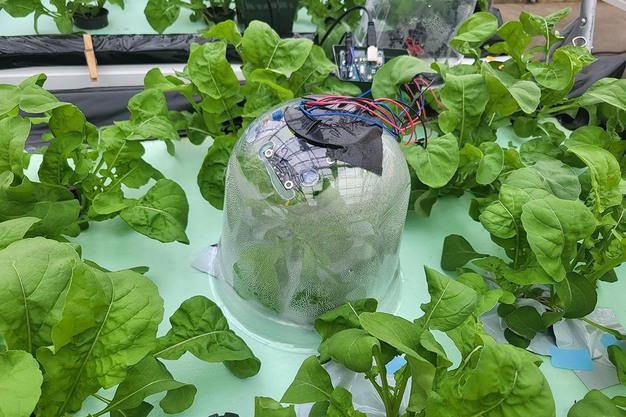 © Penn State UniversityPlants were placed under dome enclosures that captured gases they released, measured by low-cost gas sensors at the top of the domes
Study first author Ali Ahmad, a researcher and doctoral student at the Polytechnic University of Valencia in Spain, conducted this research in Di Gioia's lab in the College of Agricultural Sciences as a visiting scholar at Penn State. He selected arugula — a cruciferous leafy green commonly used raw in salads — to use in the experiment. It was grown in a hydroponic greenhouse managed by the Department of Plant Science.
"We used a hydroponic system for the experiment to be able to control the level of salinity and exclude other factors, to be sure that what we were detecting on the plants' volatile profile was determined by the difference in salinity levels," Ahmad said.
The researchers induced salt stress by adding two different amounts of sodium chloride to the nutrient solutions feeding the plants, creating a moderately stressed group and a strongly stressed group. A third set of plants — a control group — was not exposed to salt. Plants were placed under dome enclosures that captured gases they released, measured by low-cost gas sensors at the top of the domes. These sensors measured changes in air chemistry caused by volatile organic compounds released by the plants for eight days.
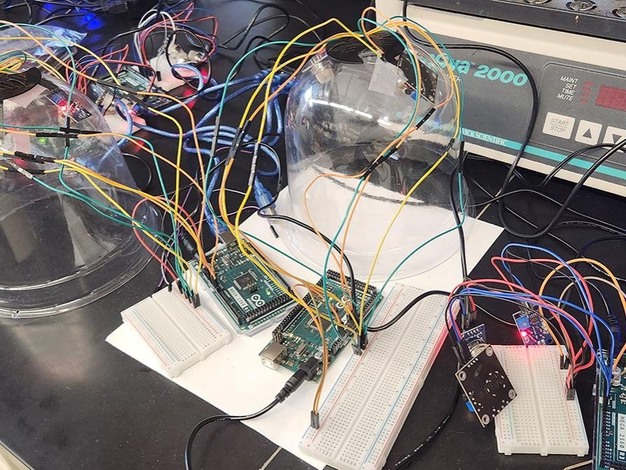 © Penn State UniversityThe researchers networked metal-oxide semiconductor sensors because they are small and easy to deploy, widely available online and very cheap. They can detect even miniscule gas changes.
"We studied metal-oxide semiconductor sensors because they are small and easy to deploy, widely available online and very cheap — some under $1," Ahmad said, explaining the sensors detect even miniscule gas changes because they initiate different electrical signals in the semiconductor layer of the sensor. "That means farmers could potentially deploy many sensors across a field. But before they could become a major tool in precision agriculture, technical improvements are needed in sensor hardware and networks."
The researchers reported that the sensors detected different gas patterns depending on salt stress level, with three distinct patterns emitted from the healthy plants, the moderately stressed plants and highly the stressed plants, respectively. The researchers then trained machine learning models — a type of artificial intelligence (AI) — to recognize the gas patterns given off by salt-stressed plants.
To confirm the sensor system's accuracy, the researchers measured the plants' physical traits, such as growth, leaf condition and physiological responses, determining that the sensor network achieved up to 99.15% accuracy in identifying plant stress levels. Salt-stressed plants, eventually, exhibited visible signs of distress.
In related work published in Advanced Sensor Research, the research team also evaluated the potential future use of low-cost metal-oxide semiconductor gas sensors for precision agriculture. In precision agriculture, which seeks to grow more crops while using fewer resources such as water, chemicals and energy, sensors could be used to detect plant problems like disease or other non-salt stress early.
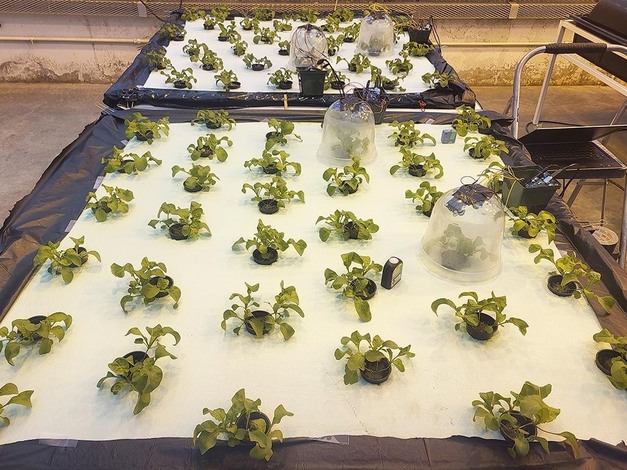 © Penn State UniversityThe researchers used a hydroponic system for the experiment to be able to control the level of salinity and exclude other factors, to be sure that what we were detecting on the plants' volatile profile was determined by the difference in salinity levels
That study by Di Gioia, Ahmad and colleagues suggests the same inexpensive gas sensors used in the more recent salt stress study could detect volatile organic compounds given off by healthy, sick and stressed plants dealing with drought, disease and pests. The ability to detect these different patterns of volatile organic compound emissions, combined with AI, could revolutionize farming — but only if current technical and practical limitations are overcome, according to Di Gioia.
"Very inexpensive gas sensors combined with artificial intelligence point to a promising future for smart farming," said Di Gioia. "But right now, the technology isn't fully reliable and there are significant challenges involved in setting up affordable networks, so more research and better data are needed. But if these problems are solved, this approach could become a major tool in precision agriculture."
Sandra Sendra and Jaime Lloret, both with Polytechnic University of Valencia, Spain, contributed to both studies. Jinhe Bai and Erin Rosskopf from the U.S. Horticultural Research Laboratory in Fort Pierce, Florida, contributed to the second study.
The research was funded by the U.S. Department of Agriculture's National Institute of Food and Agriculture and the Ministerio de Ciencia, lnnovacion y Universidades/Agencia Estatal de lnvestigacion.
Source: Penn State University