

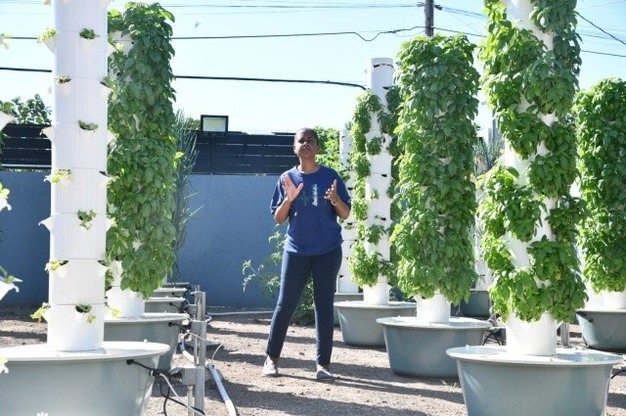
While the Corporate Area pulses with the rhythms of commerce and traffic, a quiet revolution in urban farming is unfolding in the backyard of a Havendale home. Managing Partner and Operations Director of Jamaica Tower Farms, Kerrie-Anne Gray, together with her partner, John Mark Clayton, are demonstrating through aeroponic towers that feeding a nation does not require vast rural acreage or decades of agricultural training.
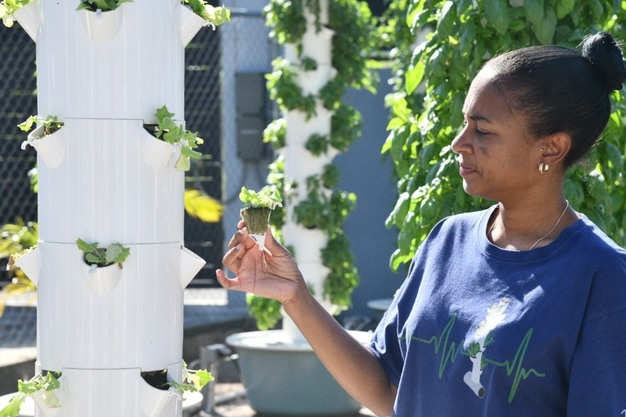
Aeroponic farming is a soilless cultivation technique that uses vertical towers, where plant roots are suspended in air and gently misted with nutrient-rich water. Drawing on their expertise in information and communications technology (ICT) and telecommunications engineering, and fuelled by their passion for farming, the duo launched Jamaica Tower Farms in June 2023.
 © Michael Sloley
Since then, they have successfully operated a commercial-scale farm in the backyard of a residential home, producing more than 4,000 plants per cycle. Ms. Gray explains that the farming venture began with Scotch bonnet peppers cultivated on 100 towers arranged on a one-eighth-acre lot.
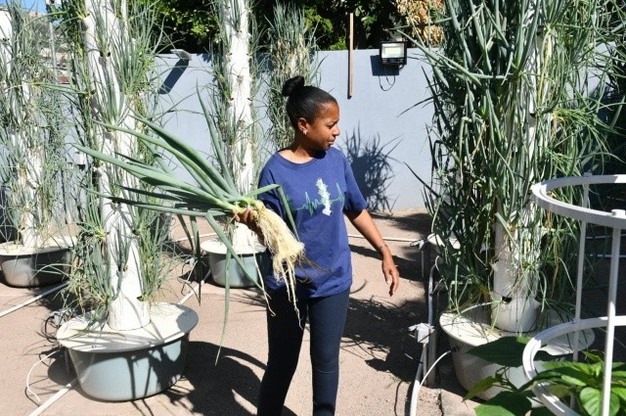
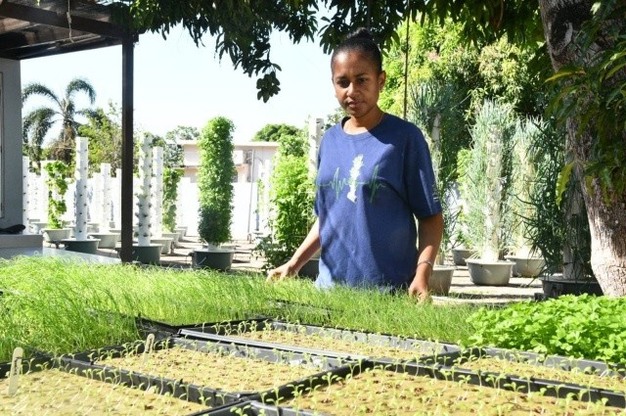
After harvesting the peppers, the team transitioned to planting leafy greens and scallions in the available spaces. She emphasises that, unlike traditional farming – where downtime is required for soil to rejuvenate between cycles – this soilless system enables continuous, back-to-back planting.
On the backyard farm, Ms. Gray notes that they cultivate a diverse range of high-quality crops, including several varieties of lettuce, cilantro, parsley, basil, scallion, tomatoes, sweet peppers, and Scotch bonnet peppers. However, crops such as carrots, potatoes, ginger, and other root vegetables cannot be cultivated using the aeroponic system.
 © Michael Sloley
As for their market, Ms. Gray shares, "We supply supermarkets, hotels, and restaurants. We also have a few private residential customers who collect their kits every week or two, depending on availability."
She notes that crops grown through aeroponic farming taste just as good, and in some cases even better than those produced by traditional soil-based methods.
For Jamaican farmers, the constant threat of natural disasters remains a challenge. However, the modular design of tower farming provides a resilience that conventional soil farming cannot match. Ms. Gray recalls the passage of Hurricane Melissa in October 2025, noting that she was able to supply her buyers with fresh produce immediately after the major storm.
"During Hurricane Melissa, we were able to take up the towers, bring them on the inside, and then right after, we brought [them] back out, and [the plants] were still growing. So, we were still able to supply supermarkets with romaine lettuce and scallion the day after Hurricane Melissa," she tells JIS News.
 © Michael Sloley
Ms. Gray emphasises that aeroponic farming is not intended to replace traditional methods; rather, it should be viewed as a complementary solution designed to withstand the extreme weather conditions brought on by climate change.
"We are in a time now where we experience climate change… so we have to prepare ourselves. Recovery is not just about after the hurricane… it's not just about trying to replant; it's also about strengthening what you have. So we're not trying to tell persons not to do traditional farming. We're actually trying to say, include smart farming into your systems, so that we're better prepared to handle any type of climate change," she adds.
Ms. Gray encourages others to invest in aeroponic farming, even at a personal level, explaining that a standalone residential unit requires only one square metre of space and can yield up to 52 plants for sale or personal use.
She adds that for individuals interested in aeroponic farming, Jamaica Tower Farms provides a full-service package, covering preparation and installation of the towers, as well as training new owners to operate the system effectively.
 © Michael Sloley
The Managing Partner also supports the Government's initiative to introduce aeroponic farming in schools, noting that it will benefit students who gain exposure to this innovative method from an early age and may build on it in the future.
"As a matter of fact, we are a part of this movement as well. This is something that will allow students from an early stage to learn self-sustainability and to be self-sufficient. It's good to start persons at that stage where they are 'sponges' and learning, because by the time they get to my age and there are improvements on the system, this will, of course, be very beneficial for Jamaica," she says.
Meanwhile, Ms. Gray shares that there are plans to expand Jamaica Tower Farms, noting that the space has the capacity to accommodate up to 300 towers. She adds that there are also plans to expand into livestock farming and orchard crops on another property, further diversifying the scope of Jamaica Tower Farms.
Source: Jamaica Information Service