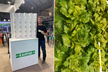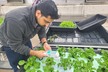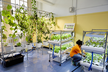


When Professor Francesco Orsini and his team at the ResCUE-AB research centre within the University of Bologna's Department of Agricultural and Food Sciences agreed to test Kaatop, a Brazilian plantable tile, against conventional hydroponic benchmarks, the results surprised even the product's inventor.
"The results confirmed our hypothesis that it is indeed possible to grow food in our tile model, with production results comparable to those obtained in traditional hydroponic systems," says Sérgio Rocha, CEO and founder of Instituto Cidade Jardim. In lettuce, that meant an average of 103g per plant, with the findings prompting a redesign of the tile's internal irrigation board. 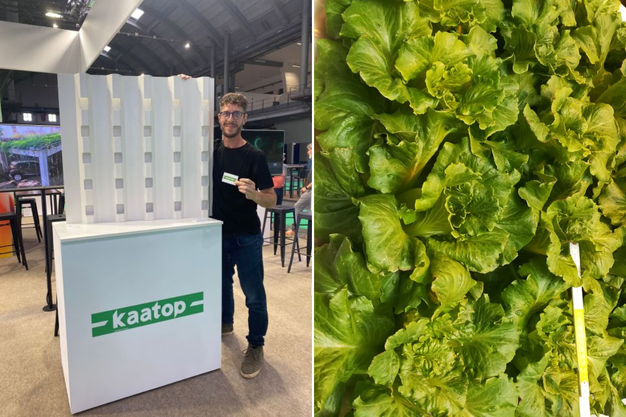 © Kaatop
What Bologna found
Rocha had always seen Kaatop as more than a sedum carrier, but finding a research partner willing to stress-test that ambition was a different matter. The collaboration with ResCUE-AB set out to answer three questions: which slope produces the best yields, which species perform best, and what realistic food production volumes are achievable on this type of roof system. "When we discovered the work of Professor Francesco Orsini and his team, we knew it was the right place to challenge our product," says Rocha. The production potential figures were striking.
"The final research report indicates that only 8m² is sufficient to supply the daily needs of fresh vegetables for one adult. This means that with Kaatop, a garage for two cars, approximately 40m², can provide all the fresh food a family of five needs to live healthier lives. Furthermore, considering the price of €1 per head of lettuce, and that a garage of this size can produce up to 800 plants, one can imagine the potential value that such a space can offer to the family economy."
The slope findings fed directly back into the product. Trials at 25% and 15% gradient produced the strongest yields; vertical installations came in 25% lower. That gap prompted an engineering response. "These results led us to redesign the internal irrigation board to improve the flow and drainage of water inside the tile," says Rocha, "arriving at the optimized design of the current commercial product."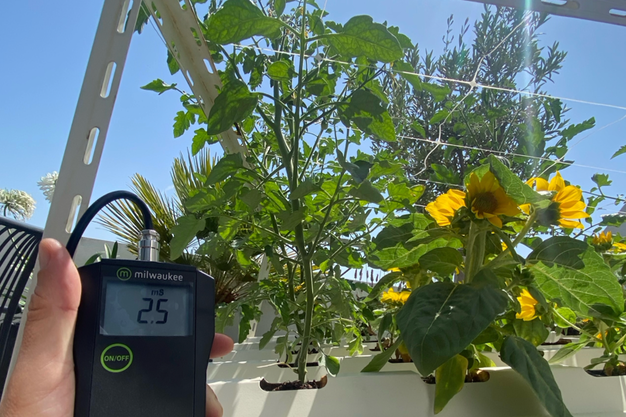 © Kaatop
How the tile works
Instituto Cidade Jardim was founded in São Paulo in 2008 by Rocha and ecologist Fabiana Scarda with a focus on green roof research and installation. Kaatop, patented in 2012, replaces the solid EPS core of a standard sandwich panel with an engineered board carrying internal irrigation channels and transverse channels for drip tubing, effectively a hydroponic system built into the roof itself. Overlapping panels handle watertightness in the same way a conventional tile would, validated by the Construction Technologies Laboratory at the Technological Research Institute of the University of São Paulo, which approved the system as a watertight element from a minimum slope of 10%.
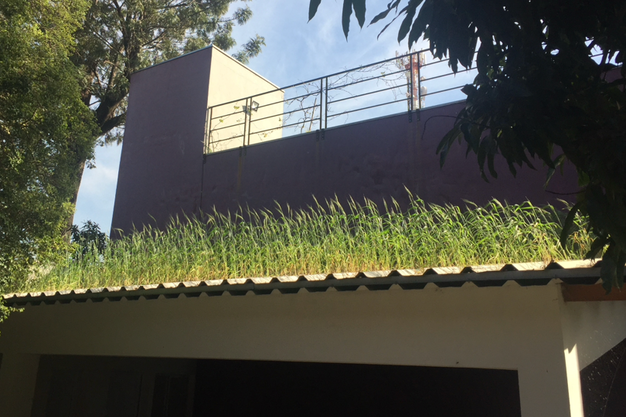
"The main engineering challenge was to make all of this as lightweight as possible, so that it would be a viable alternative for both new construction and retrofitting," says Rocha. "The board fills it in a way that weighs 35 kilogram-force per square meter max, already saturated with water and considering the biomass produced for plants around 80cm, like wheat."
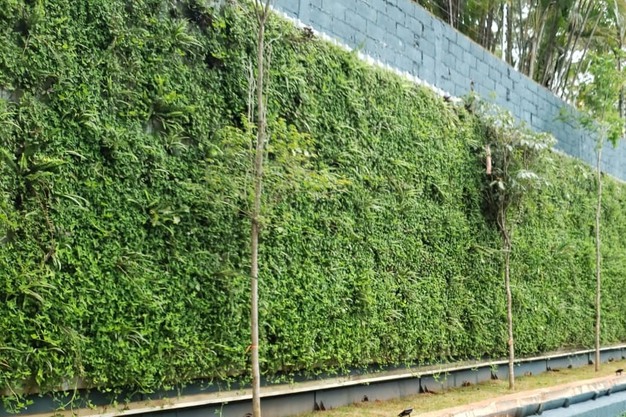
Vertical garden projects use hydroponics without exception, where aesthetic consistency drives the choice. Green roof clients trend toward conventional substrate, and some install without any irrigation at all for extensive, low-maintenance coverage. "The exception is when the green roof is used to grow food, where hydroponic cultivation stands out and allows for the best results," says Rocha.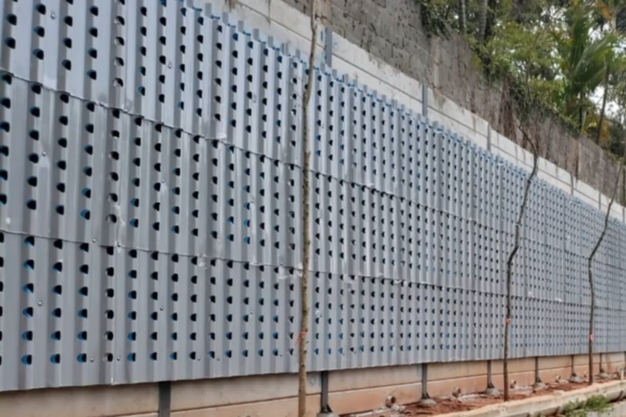 © Kaatop
 © Kaatop
Crop performance
The range of species successfully grown on Kaatop is broader than the system's building-integrated framing might suggest. Field crops, including wheat, beans, oats, and sunflowers, have been harvested alongside tomatoes, cucumbers, eggplants, lettuce, chicory, and cabbage, and herbs including basil, rosemary, and sage. Not every result was anticipated. "An interesting surprise was the planting of tulips, which developed very well, giving an interesting visual appeal to the garden planted on the roof tiles," says Rocha.
The 716m² sold in Brazil during Kaatop's first commercial year has come from a customer base that looks different from the company's established green roof clients. High-end residential projects, the core of the traditional green roof market, have not been the early adopters. "Kaatop has sparked interest among the public with more economical roof projects." Projects have ranged from 15m² to 175m², concentrated in rural sheds and NGO sites, building types that typically lack the slab or waterproofing membrane that conventional green roof systems require.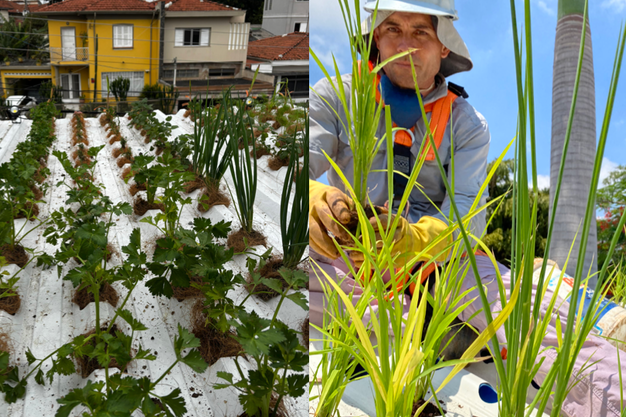 © Kaatop
 © Kaatop
Bootstrapping into Europe
The Barcelona subsidiary brings Kaatop within reach of its primary European target markets, Germany, France, and the United Kingdom, as well as the US, where the company also holds the product patent. Progress has been slower than Rocha would like, and the reason is straightforward.
"This includes everything from resources to obtain the CE marking for the product, to organising sales and technical support teams, marketing, distribution, and so on," he says. "This is a business plan that we have been building ourselves, bootstrapping it from the parent company in Brazil, which in fact makes things move more slowly than we want, and much slower than the world needs."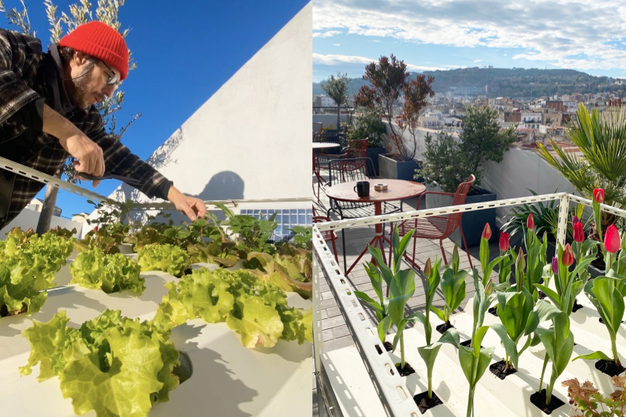 © Kaatop
The market case
Rocha puts 70% of urban surfaces under roofs, with fewer than 10% of those able to support existing green roof technology. Most are metal, ceramic, or fibre cement tiles on lightweight wood or metal structures, with no slab and no waterproofing membrane, which makes conventional green roof systems expensive and structurally complicated to retrofit onto pitched surfaces.
"Kaatop is an all-in-one product, structurally fixed to the building, in a format already known to the roofing market, which has in fact allowed its installation by construction professionals who already install conventional sandwich panels," says Rocha. Reaching that market, he argues, comes down to one thing. "The key is distribution. Kaatop needs to be offered as a building material, readily available, so people can experiment with it for their own cultivation."
For more information:
Instituto Cidade Jardim / Kaatop
Sérgio Rocha, CEO and Founder 
[email protected]
www.kaatop.com
www.institutocidadejardim.com.br