

McGill University ushered in a new era of climate-focused agricultural teaching and research today, cutting the ribbon on a teaching greenhouse and advanced plant phenotyping facilities at its Macdonald Campus in Ste-Anne-de-Bellevue.
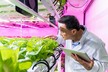
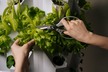
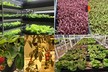
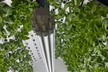
Designed for undergraduate and graduate use, the greenhouse – attached to the Raymond Building – features seven independently controlled growing bays, teaching labs, a tissue culture facility and a classroom, giving students hands-on experience with modern production systems. Built for sustainability, it uses LED lighting, energy-efficient systems and rainwater capture for irrigation.
Backed by $23 million from Quebec's Ministère de l'Enseignement supérieur and $1.4 million from McGill, the project builds on more than a century of leadership in agricultural education, research and partnerships across the province.
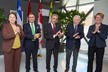
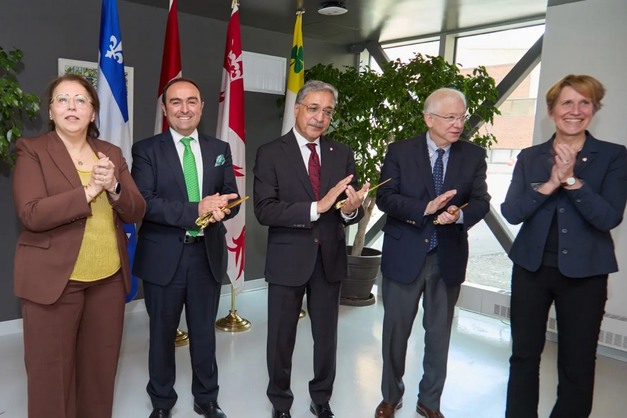 © Tom DiSandoloDignitaries at the inauguration of the new facilities included (l to r); Salwa Karboune, Dean of McGill's Faculty of Agricultural and Environmental Sciences; Mohamad Nasser-Eddine, Vice-President Programs and Planning, Canadian Foundation for Innovation; Deep Saini, President and Vice-Chancellor of McGill; Francis Scarpaleggia, Member of Parliament for Lac-Saint-Louis; and Anja Geitmann, McGill's Vice-President (Global Engagement)
The opening ceremony brought together University leaders, staff, students and faculty members, along with special guests Mohamad Nasser-Eddine, Vice-President Programs and Planning of the Canadian Foundation for Innovation (CFI) and Francis Scarpaleggia, Member of Parliament for Lac-Saint-Louis and Speaker of the House of Commons.
"Ultimately, what we are celebrating today is not only new infrastructure, but what it enables: new knowledge, new sustainable solutions and new generations of students prepared to lead in a critical field," Deep Saini, President and Vice-Chancellor of McGill, told the gathering.
"For generations, McGill has played a foundational role in Quebec's agricultural sector, through education, research and partnerships that extend across the province. The Macdonald Campus stands at the heart of that contribution, and today's inauguration signals our continued commitment to its future," said Saini, who himself is a plant scientist by training.
Expanding research capacity
Alongside the greenhouse, McGill is expanding its research capacity with the Eastern Canadian Plant Phenotyping Platform (ECP3), developed with Université de Sherbrooke. The platform will help translate plant research into practical solutions for producers while positioning Canada as a leader in climate-adapted agriculture.
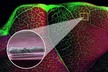
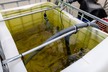
Unique in Canada, ECP3 integrates tools to identify climate-resilient plant traits and reduce environmental impacts, including a plant pest containment facility and a multi-scale imaging centre.
Anja Geitmann, Vice-President (Global Engagement) and former Dean of Agricultural and Environmental Sciences, spoke about the project's history and was profuse in her thanks for all who made it possible.
"The research we do here will help safeguard Eastern Canadian agriculture in the face of a changing climate," Geitmann said in an earlier statement. "This work will play a vital role in ensuring Canadian food security throughout the 21st century and beyond."
The $23.8-million initiative is funded by the CFI and Quebec's Ministère de l'Éducation et de l'Enseignement supérieur.
McGill's facilities complement infrastructure built at Université de Sherbrooke in 2024 through the same CFI-funded initiative. Together with Centre SÈVE, they form a shared research network across Montreal and the Eastern Townships, strengthening collaboration between universities and government.
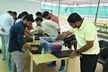
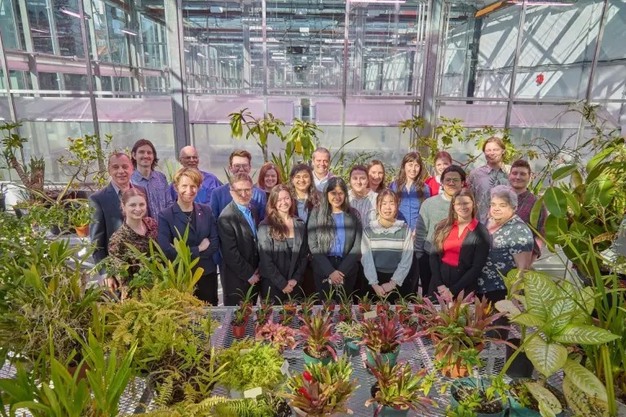 © Tom DiSandoloMembers of the Macdonald Campus community in the new teaching greenhouse
Investing in Quebec agriculture
The launch underscores McGill's commitment to the Macdonald Campus, home to the Faculty of Agricultural and Environmental Sciences and a pillar of the University's contributions to Quebec's agri-food sector for over a century.
"Today marks an important milestone for our Faculty, one that fosters both our teaching and research missions," said Salwa Karboune, Dean of the Faculty of Agricultural and Environmental Sciences.
"Agriculture and the agri-food sector are vital to both the economy of Quebec and Canada, but also to our society. There is no doubt that this sector is facing growing pressures, including climate change, environmental stress and geological instability. This is why investments, like the one we are celebrating today, matter so deeply," she told the gathering.
For students, the impact is immediate – reshaping how they learn, experiment and conduct research. In earlier interviews with the Reporter, they spoke enthusiastically about what the new facilities will mean to them.
"Access to the new teaching greenhouse gives our instructors the flexibility to design meaningful learning activities," said Marie-Anne Lauzon-Miron, an undergraduate in agri-environmental sciences specializing in plant production and agrology. "By working directly with plants and equipment, we gain practical skills that are essential for careers in agriculture."
For Lamha Kumar, a PhD student in plant science in Geitmann's lab, the new research platform will enable more sophisticated work.
"With access to both advanced imaging and phenotyping platforms, I can now directly link anatomical differences to how the plant is actually functioning," she said. "It shifts my work from describing structures to understanding what those structures actually do."
William Jordan, a first-year master's student in plant science in Martin Filion's lab, said the benefits are also practical.
"We can now more easily get ahead of the threats that climate change poses to our food supply," he said. "By creating environments that mimic future climate scenarios, we can identify vulnerabilities and propose concrete solutions."
Together, the new facilities put students and researchers – and the vital work they are doing – at the forefront of building more resilient, sustainable food systems.
Source: McGill Reporter