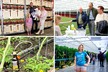


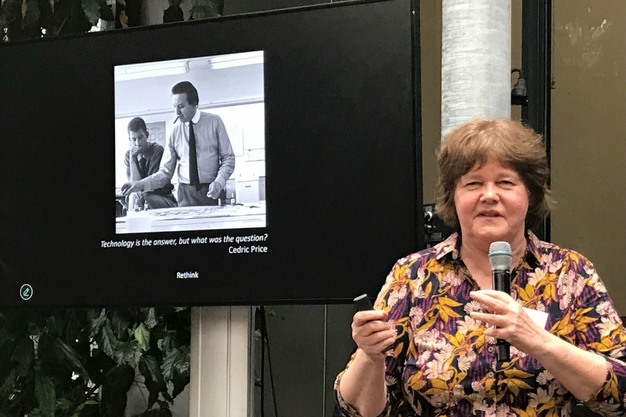
At the final event of the Hungry EcoCities programme, keynote speaker and urbanist Carolyn Steel quoted the provocation from the architect Cedric Price: "Technology is the answer, but what was the question?"
It's a simple line. But it stops you in your tracks. Because in urban farming, and in food systems more broadly, industrial engineers have become very good at answering questions with impressive technology. But we are not always great at pausing to ask whether those were the right questions to begin with.
That question has been at the heart of InstaGreen's work throughout the Hungry EcoCities project. And as the project reached its close, they want to share what they've learned, from their collaborative designing and prototyping works in Barcelona, from the inspiring thinkers they've had the privilege to work with, and from the bigger story of food and cities that Carolyn Steel has spent her career illuminating.
What is Hungry EcoCities?
Hungry EcoCities is a European S+T+ARTS innovation programme exploring the intersection of science, technology, and art in the context of urban food systems. Funded by the EU's Horizon Europe programme, it brought together artists, researchers, farmers, and entrepreneurs to ask some fundamental questions about how cities grow and eat food, and how they might do this better.
InstaGreen participated as part of what became Re.Source Society, a project they developed in partnership with artist and sustainability designer Nicolas Rotta. Their shared mission: to explore whether the energy-hungry task of controlling indoor agricultural climates could be reimagined, using the intelligence of ancient cultures and nature rather than the brute force of industrial machinery.
The problem with controlled environments
Controlled environment agriculture (CEA), which includes indoor vertical farms, hydroponic systems, and growing spaces like InstaGreen's in Barcelona, holds enormous benefits. You can grow healthy, fresh, chemical-free food in the city, year-round, using a fraction of the water of conventional farming. That's the vision InstaGreen was built around since 2012.
But there's a catch. Keeping an indoor growing space at the right temperature and humidity requires energy. Fans, dehumidifiers, heaters, air conditioning, the infrastructure of a controlled climate adds up. And these energy costs aren't just an environmental concern; they're also a survival concern for farms.
So InstaGreen asked: is there a smarter way? Can we control indoor climates not by fighting the environment outside, but by working with it?
"Innovation isn't only about efficiency: it's about reimagining our relationship with natural resources," says the Re.Source Society project video, quoted by keynote speaker Carolyn Steel at the Hungry EcoCities final event.
Re.Source Society: Right-Tech, not High-Tech
To find answers, InstaGreen started not with technology but with nature. They studied the physical principles that govern indoor climates, heat, humidity, airflow, phase change, and gathered real-world data in their Barcelona farm. Then they looked to living systems for inspiration.
How does a cactus survive in dry heat? How is the climate inside a termite mound kept stable at all times. How do lungs exchange gases across a membrane? How does a nervous system know when to act and when to rest? From these questions emerged a family of passive and low-energy devices, each inspired by a biological analogy:
The Cooling Cactus — A 3D printed terracotta evaporative cooling unit that harnesses a similar principle used by our own skin to stay cool. Air and water flow through an internal tube system; moist exhaust is expelled, lowering the temperature inside. Thanks to a glazing on the outside of the terracotta cactus, only the temperature of the air outside the cactus is lowered, without raising humidity: Low-tech, effective, and beautiful.
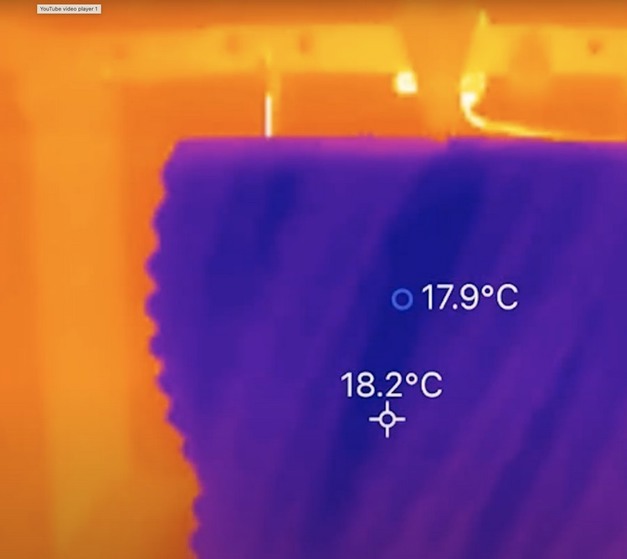 © InstaGreenThe Cooling Cactus
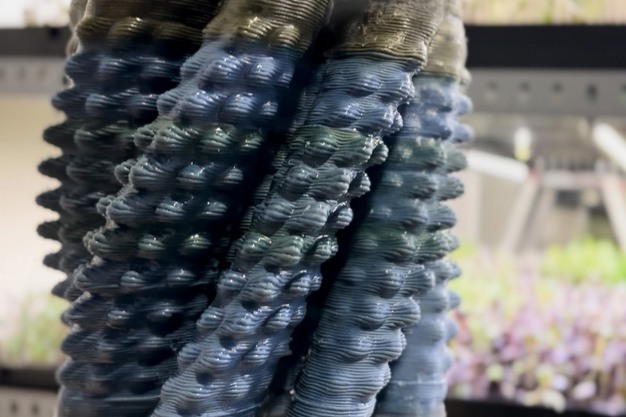 © InstaGreenA closeup of the Cooling Cactus
The Living Lung — A textile membrane allows water vapour to diffuse from humid indoor air into drier outdoor airflow, just as the lining of a lung moves gases across a boundary. Thanks to the protective fabric membrane, the temperature of the air circulating is not influenced much. With only fans operating the Living Lung, it requires little energy to lower the humidity.
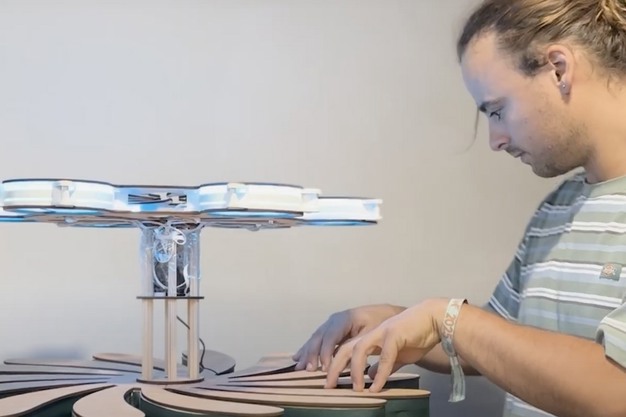 © InstaGreenThe Living Lung
 © InstaGreenA closeup of the Living Lung
The Basic Brain — A network of sensors that monitors indoor and outdoor conditions and activates each device only when it will make a real difference. Like a nervous system, it adds intelligence, not complexity, to the whole.
Digital twin simulations using Grasshopper and HTML modelling tools allow the system to be adapted to different farms, climates, seasons and building configurations.
InstaGreen calls this approach Right-Tech: using not the most advanced technology, but the most appropriate one. Low enough to be affordable and maintainable. Intelligent enough to actually work. And designed in harmony with nature's own strategies.
The final event: when food meets philosophy
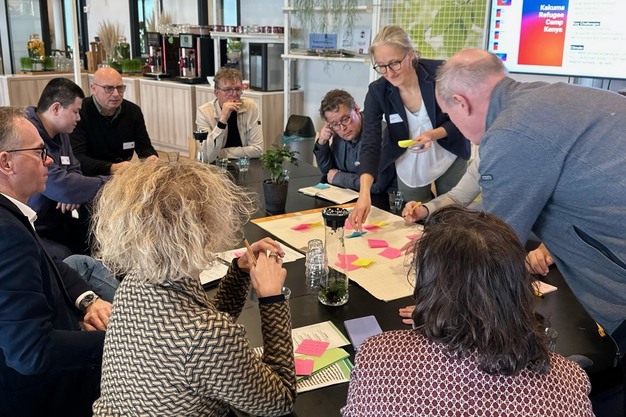
The Hungry EcoCities programme closed with a final gathering that brought together its participating teams, partners, invitees from the industry and speakers to share findings and reflect on the journey. InstaGreen ran a workshop on Low-Tech solutions, sharing their prototypes, their data, and the philosophy behind the Right-Tech approach.
The keynote was delivered by Carolyn Steel, one of the most important thinkers writing about food systems today. Author of Hungry City: How Food Shapes Our Lives and Sitopia: How Food Can Save the World, Carolyn has spent decades making the case that food is the most powerful lens we have for understanding, and redesigning, how we live together.
Her keynote wove together the big questions the programme had been addressing: what does it mean to feed a city sustainably? What is the role of technology in that mission? And how do we avoid building clever systems that answer the wrong questions?
 © InstaGreen
Carolyn Steel: feeding cities, reimagining food
For those unfamiliar with Carolyn's work, a brief introduction is worth it here.
In Hungry City (2008), she traces the entire journey of food through a modern city, from land and sea, through ships, roads, markets, supermarkets, kitchens, tables, and waste dumps, revealing just how profoundly the need to eat shapes the built environment. Cities, she argues, have always been defined by their relationship to food. We've simply stopped noticing.
In Sitopia (2020), she takes that analysis further. The word "sitopia", from the Greek sitos (food) and topos (place), describes a world shaped by food. Carolyn argues that food is the most powerful medium we have for thinking about everything that matters: our bodies, our homes, our societies, our relationship with nature, and our future on this planet.
Her central insight is both simple and radical: if we put food at the centre of our decisions, in urban planning, in architecture, in economics, in politics, we could find our way to cities that are not only sustainable but genuinely places to live a good life.
For InstaGreen, this resonates deeply. They started growing microgreens in Barcelona because they want food to be sustainable, local, fresh, and alive. They want farms to be part of the city again, not hidden somewhere outside it. They want growers, restaurants, and communities to be connected in a loop that made sense, both ecologically and humanly.
Carolyn Steel's work gives that instinct a wider frame. Urban farming isn't just a solution for sustainable and healthy food. It's part of a fundamental rethinking of how cities work, who they work for, and what we owe to the land that feeds us.
 © InstaGreen
What to take forward
The Hungry EcoCities project has come to an end. But the questions it raised aren't.
For InstaGreen, the Re.Source Society project reinforced something they've always believed: that the best solutions are usually the ones that work with natural processes, not against them. Their farm has always run on low-tech principles, "smart" watering trays (no sensors needed), gravity, capillarity, highly respecting natural resources. Not because they couldn't use higher technology, but because they didn't need it.
The Cooling Cactus and the Living Lung extend that philosophy into climate control. They're prototypes, not products, not yet. The principles they embody are real and tested, and InstaGreen plans to continue to develop and test them. They believe passive and low-energy climate solutions will matter enormously as urban farming scales, whether in Barcelona, Kenya, or the Swiss Alps.
They also take forward their appreciation for the power of asking the right questions. Cedric Price's provocation "Technology is the answer, but what was the question?" still rings true. When we reach for technology first, we risk building solutions to problems we've never properly defined. When we start with the problem, with the citizens to feed, the farm, the plant, the city, the climate, the right solutions often turn out to be simpler and more beautiful than we expected.
A thank you — and an invitation
InstaGreen is grateful to the Hungry EcoCities and S+T+ARTS programme, to the EU Horizon Europe funding that made it all possible, to Nicolas Rotta for his creativity and collaboration, to In4Art, EatThis and CRA for their support, and to Carolyn Steel for putting her work in such inspiring context.
If you'd like to learn more about the Re.Source Society project, their devices, their data, and their design process, you can read the full technical blog here: EU Innovation project: Feeding the cities of the future.
And if the bigger question, how to build a small, local, sustainable microgreen farm business, is something you've been sitting with, they'd love to talk. That's what they do, every day, in the city of Barcelona.
For more information:
InstaGreen SL
[email protected]
www.instagreen.eu